




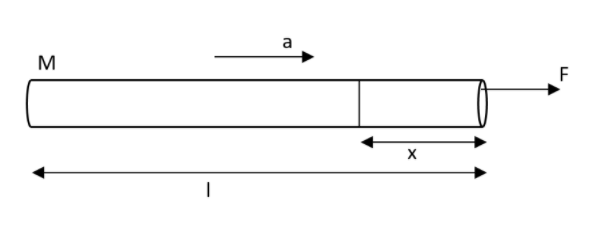
A uniform rope of length \[L\] is pulled by a fixed force \[F\] as represented in the figure. What will be the tension in the rope at distance \[x\] from the end where the force is applied?
Answer
 Verified
576.9k+ views
Hint: First of all find the acceleration of the rope. The acceleration can be found by taking the ratio of the force to the mass of the body. Then find the mass per unit length of the rope. For this part the tension can be found by taking the product of the mass of the body and the acceleration of the body. Substitute the values in it. This will help you in answering this question.
Complete step by step answer:
The acceleration can be found by taking the ratio of the force to the mass of the body. That is we can write that,
\[a=\dfrac{F}{M}\]
The mass per unit length can be shown as,
\[\lambda =\dfrac{M}{l}\]
Therefore the mass of the part of length \[\left( l-x \right)\] can be found by the equation,
\[m=\lambda \left( l-x \right)\]
Where the mass per unit length can be substituted as,
\[m=\dfrac{M}{l}\left( l-x \right)\]
For this part the tension can be found by taking the product of the mass of the body and the acceleration of the body. That is we can write that,
\[T=ma\]
Substituting the values in it will give,
\[T=ma=\dfrac{M}{l}\left( l-x \right)\dfrac{F}{M}\]
Simplifying this equation will give,
\[T=\dfrac{F}{l}\left( l-x \right)\]
Therefore the tension in the rope at distance \[x\] from the end where the force is applied has been found. Therefore the answer has been obtained.
Note:
Tension is basically the force itself. It can be explained as the pulling force which has been axially transmitted using the ways of a cable, a string, chain, or similar one-dimensional continuous object or a rope. The unit of tension is the same as that of force itself.
Complete step by step answer:
The acceleration can be found by taking the ratio of the force to the mass of the body. That is we can write that,
\[a=\dfrac{F}{M}\]
The mass per unit length can be shown as,
\[\lambda =\dfrac{M}{l}\]
Therefore the mass of the part of length \[\left( l-x \right)\] can be found by the equation,
\[m=\lambda \left( l-x \right)\]
Where the mass per unit length can be substituted as,
\[m=\dfrac{M}{l}\left( l-x \right)\]
For this part the tension can be found by taking the product of the mass of the body and the acceleration of the body. That is we can write that,
\[T=ma\]
Substituting the values in it will give,
\[T=ma=\dfrac{M}{l}\left( l-x \right)\dfrac{F}{M}\]
Simplifying this equation will give,
\[T=\dfrac{F}{l}\left( l-x \right)\]
Therefore the tension in the rope at distance \[x\] from the end where the force is applied has been found. Therefore the answer has been obtained.
Note:
Tension is basically the force itself. It can be explained as the pulling force which has been axially transmitted using the ways of a cable, a string, chain, or similar one-dimensional continuous object or a rope. The unit of tension is the same as that of force itself.
Recently Updated Pages
Master Class 11 Computer Science: Engaging Questions & Answers for Success

Master Class 11 Business Studies: Engaging Questions & Answers for Success
Master Class 11 Economics: Engaging Questions & Answers for Success
Master Class 11 English: Engaging Questions & Answers for Success
Master Class 11 Maths: Engaging Questions & Answers for Success
Master Class 11 Biology: Engaging Questions & Answers for Success
Trending doubts
One Metric ton is equal to kg A 10000 B 1000 C 100 class 11 physics CBSE
There are 720 permutations of the digits 1 2 3 4 5 class 11 maths CBSE
Discuss the various forms of bacteria class 11 biology CBSE
Draw a diagram of a plant cell and label at least eight class 11 biology CBSE
State the laws of reflection of light
Explain zero factorial class 11 maths CBSE