




A uniform rod of length $l$ is released from rest such that it rotates about a smooth pivot. Find the angular speed of the rod when it becomes vertical.
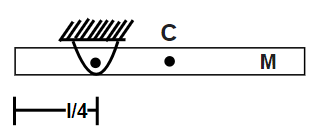
Answer
 Verified
625.5k+ views
Hint: So in this question, we have to find the angular speed and for this question as from the question statement we can say that the potential energy will get converted into kinetic energy. Then by using the center of mass theorem and solving the equation we will get to the answer.
Formula used:
The moment of inertia of a rod about its endpoint is given by
$ \Rightarrow I = \dfrac{1}{3}M{l^2}$
Here, $m$ will be the mass of the rod and $l$ will be the length of the rod.
Complete step by step answer
Since the uniform rod of length $l$ is released from rest and it gets rotated about a smooth pivot. So for this, the figure will look like
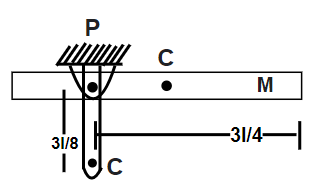
Mass We can see that mass per unit length is $m/l$ .
Therefore, the mass of length $l/4$ will be equal to
$ \Rightarrow \dfrac{l}{4} \times \dfrac{m}{l}$
And on solving it we will get the mass as $\dfrac{m}{4}$ .
Similarly, the mass of length $3l/4$ will be equal to
$ \Rightarrow \dfrac{{3l}}{4} \times \dfrac{m}{l}$
And on solving it we will get the mass as $\dfrac{{3m}}{4}$ .
We also know the moment of inertia of a rod about its endpoint is given by
$ \Rightarrow I = \dfrac{1}{3}M{l^2}$
Therefore, the moment of inertia of $\dfrac{l}{4}$ part will be equal to
$ \Rightarrow {I_1} = \dfrac{1}{3}\left( {\dfrac{M}{4}} \right){\left( {\dfrac{l}{4}} \right)^2}$
And on solving the above equation, we will get the equation as
$ \Rightarrow {I_1} = \dfrac{{M{l^2}}}{{192}}$
Similarly, the moment of inertia of $\dfrac{{3l}}{4}$ part will be equal to
$ \Rightarrow {I_2} = \dfrac{1}{3}\left( {\dfrac{{3M}}{4}} \right){\left( {\dfrac{{3l}}{4}} \right)^2}$
And on solving the above equation, we will get the equation as
$ \Rightarrow {I_2} = \dfrac{{9M{l^2}}}{{64}}$
Since from the hint we know that the potential energy will get converted into the kinetic energy, so mathematically it can be written as
$ \Rightarrow P.E = K.E$
Now by using the formula of these two and substituting the values, we will get the equation as
$ \Rightarrow - \left( {\dfrac{M}{4}} \right)g\left( {\dfrac{l}{8}} \right) + \left( {\dfrac{{3M}}{4}} \right)g\left( {\dfrac{{3l}}{8}} \right) = \dfrac{1}{2}{I_1}{\omega ^2} + \dfrac{1}{2}{I_2}{\omega ^2} $
Now on solving the braces, we will get
$ \Rightarrow - \dfrac{{mgl}}{{32}} + \dfrac{{9mgl}}{{32}} = \left[ {\left[ {\dfrac{1}{2}\left( {\dfrac{{M{l^2}}}{{192}}} \right) + \dfrac{1}{2}\left( {\dfrac{{9M{l^2}}}{{64}}} \right)} \right]} \right]{\omega ^2} $
On solving further the above equation will become,
$ \Rightarrow \dfrac{{8mgl}}{{32}} = \left[ {\left( {\dfrac{{M{l^2}}}{{192}}} \right) + \left( {\dfrac{{9M{l^2}}}{{64}}} \right)} \right]\dfrac{{{\omega ^2}}}{2} $
On taking the LCM of it and solving it, we get
$ \Rightarrow \dfrac{{8mgl}}{{32}} = \left[ {\dfrac{{m{l^2} + 27m{l^2}}}{{192}}} \right]\dfrac{{{\omega ^2}}}{2} $
Solving the above equation again, we get
$ \Rightarrow \dfrac{{8mgl}}{{32}} = \left[ {\dfrac{{28m{l^2}}}{{192}}} \right]\dfrac{{{\omega ^2}}}{2} $
And by doing the cross multiplication and solving it we get
$ \Rightarrow \omega = \sqrt {\dfrac{{24g}}{{7l}}} $
Therefore, the angular speed of the rod when it becomes vertical $\sqrt {\dfrac{{24g}}{{7l}}} $.
Note:
The center of mass greatly simplifies the problem and helps us analyze its rotational motion, linear motion, skidding, spinning, oscillation, periodic motion, and most other motions quite easily. So that’s why we used the center of mass.
Formula used:
The moment of inertia of a rod about its endpoint is given by
$ \Rightarrow I = \dfrac{1}{3}M{l^2}$
Here, $m$ will be the mass of the rod and $l$ will be the length of the rod.
Complete step by step answer
Since the uniform rod of length $l$ is released from rest and it gets rotated about a smooth pivot. So for this, the figure will look like
Mass We can see that mass per unit length is $m/l$ .
Therefore, the mass of length $l/4$ will be equal to
$ \Rightarrow \dfrac{l}{4} \times \dfrac{m}{l}$
And on solving it we will get the mass as $\dfrac{m}{4}$ .
Similarly, the mass of length $3l/4$ will be equal to
$ \Rightarrow \dfrac{{3l}}{4} \times \dfrac{m}{l}$
And on solving it we will get the mass as $\dfrac{{3m}}{4}$ .
We also know the moment of inertia of a rod about its endpoint is given by
$ \Rightarrow I = \dfrac{1}{3}M{l^2}$
Therefore, the moment of inertia of $\dfrac{l}{4}$ part will be equal to
$ \Rightarrow {I_1} = \dfrac{1}{3}\left( {\dfrac{M}{4}} \right){\left( {\dfrac{l}{4}} \right)^2}$
And on solving the above equation, we will get the equation as
$ \Rightarrow {I_1} = \dfrac{{M{l^2}}}{{192}}$
Similarly, the moment of inertia of $\dfrac{{3l}}{4}$ part will be equal to
$ \Rightarrow {I_2} = \dfrac{1}{3}\left( {\dfrac{{3M}}{4}} \right){\left( {\dfrac{{3l}}{4}} \right)^2}$
And on solving the above equation, we will get the equation as
$ \Rightarrow {I_2} = \dfrac{{9M{l^2}}}{{64}}$
Since from the hint we know that the potential energy will get converted into the kinetic energy, so mathematically it can be written as
$ \Rightarrow P.E = K.E$
Now by using the formula of these two and substituting the values, we will get the equation as
$ \Rightarrow - \left( {\dfrac{M}{4}} \right)g\left( {\dfrac{l}{8}} \right) + \left( {\dfrac{{3M}}{4}} \right)g\left( {\dfrac{{3l}}{8}} \right) = \dfrac{1}{2}{I_1}{\omega ^2} + \dfrac{1}{2}{I_2}{\omega ^2} $
Now on solving the braces, we will get
$ \Rightarrow - \dfrac{{mgl}}{{32}} + \dfrac{{9mgl}}{{32}} = \left[ {\left[ {\dfrac{1}{2}\left( {\dfrac{{M{l^2}}}{{192}}} \right) + \dfrac{1}{2}\left( {\dfrac{{9M{l^2}}}{{64}}} \right)} \right]} \right]{\omega ^2} $
On solving further the above equation will become,
$ \Rightarrow \dfrac{{8mgl}}{{32}} = \left[ {\left( {\dfrac{{M{l^2}}}{{192}}} \right) + \left( {\dfrac{{9M{l^2}}}{{64}}} \right)} \right]\dfrac{{{\omega ^2}}}{2} $
On taking the LCM of it and solving it, we get
$ \Rightarrow \dfrac{{8mgl}}{{32}} = \left[ {\dfrac{{m{l^2} + 27m{l^2}}}{{192}}} \right]\dfrac{{{\omega ^2}}}{2} $
Solving the above equation again, we get
$ \Rightarrow \dfrac{{8mgl}}{{32}} = \left[ {\dfrac{{28m{l^2}}}{{192}}} \right]\dfrac{{{\omega ^2}}}{2} $
And by doing the cross multiplication and solving it we get
$ \Rightarrow \omega = \sqrt {\dfrac{{24g}}{{7l}}} $
Therefore, the angular speed of the rod when it becomes vertical $\sqrt {\dfrac{{24g}}{{7l}}} $.
Note:
The center of mass greatly simplifies the problem and helps us analyze its rotational motion, linear motion, skidding, spinning, oscillation, periodic motion, and most other motions quite easily. So that’s why we used the center of mass.
Recently Updated Pages
If x a + bt + ct2 where x is in meters and t is in class 11 physics CBSE

A car covers the first half distance between two places class 11 physics CBSE
The resultant of two vectors overrightarrow P and overrightarrow class 11 physics CBSE
Find the value of cos 135 class 11 maths CBSE
A mass M is held in place by an applied force F and class 11 physics CBSE
A solution of glucose in water is labelled as 10 dfracwv class 11 chemistry CBSE
Trending doubts
One Metric ton is equal to kg A 10000 B 1000 C 100 class 11 physics CBSE
Find the value of the expression given below sin 30circ class 11 maths CBSE
Draw a diagram of nephron and explain its structur class 11 biology CBSE
10 examples of friction in our daily life
Proton was discovered by A Thomson B Rutherford C Chadwick class 11 chemistry CBSE
Bond order ofO2 O2+ O2 and O22 is in order A O2 langle class 11 chemistry CBSE