




A uniform rod AB of mass m and length 2a is falling freely without rotation under gravity with AB horizontal. Suddenly the end A is fixed when the speed of the rod is v. The angular speed with which the rod begins to rotate is
$
A.\dfrac{v}{{2a}} \\
B.\dfrac{{4v}}{{3a}} \\
C.\dfrac{v}{{3a}} \\
D.\dfrac{{3v}}{{4a}} \\
$
Answer
 Verified
597k+ views
Hint: The question is taken from the system of particles and rotational motion and the concept of dynamics of rotational motion about the fixed axis should be known. The question is solved by conservation of angular momentum principle. This states that initial angular momentum is equal to final angular momentum.
Complete step by step answer:
Considering a rod in this question it is given that the uniform rod AB which has a mass ‘m’ and length is ‘2a’, falls under the influence of gravity.

When it reached the speed ‘V’, it suddenly stopped at point ‘A’.
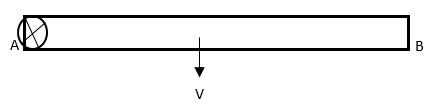
The rod rotates with ‘W’. We have to find the angular velocity.
Since, there is no torque about A (because it is punched), the angular momentum is conserved.
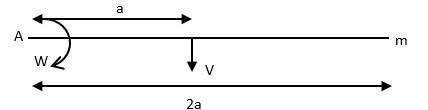
$\overrightarrow {{L_f}} = \left( {\dfrac{{m{L^2}}}{3}} \right)W $ (final angular momentum)
\[
\overrightarrow {{L_i}} = (mv)r \\
= (mv)\dfrac{L}{2} \\
\overrightarrow {{L_f}} = \overrightarrow {{L_i}} \\
\Rightarrow \left( {\dfrac{{m{L^2}}}{3}} \right)W = \dfrac{{mvL}}{2} \\
\Rightarrow W = \dfrac{3}{2}\dfrac{V}{L} \\
\]( By conservation of angular momentum)
Since,
$
L = 2a \\
\Rightarrow W = \dfrac{{3V}}{{2 \times 2a}} \\
\boxed{W = \dfrac{{3v}}{{4a}}} \\
$
So, the correct answer is “Option D”.
Note:
The angular momentum is conserved about the point ‘A’, hence initial angular momentum becomes equal to final angular momentum. Also remember that the concept of angular momentum is used in rotational motion. The concept of linear momentum as used in linear motion.
Complete step by step answer:
Considering a rod in this question it is given that the uniform rod AB which has a mass ‘m’ and length is ‘2a’, falls under the influence of gravity.
When it reached the speed ‘V’, it suddenly stopped at point ‘A’.
The rod rotates with ‘W’. We have to find the angular velocity.
Since, there is no torque about A (because it is punched), the angular momentum is conserved.
$\overrightarrow {{L_f}} = \left( {\dfrac{{m{L^2}}}{3}} \right)W $ (final angular momentum)
\[
\overrightarrow {{L_i}} = (mv)r \\
= (mv)\dfrac{L}{2} \\
\overrightarrow {{L_f}} = \overrightarrow {{L_i}} \\
\Rightarrow \left( {\dfrac{{m{L^2}}}{3}} \right)W = \dfrac{{mvL}}{2} \\
\Rightarrow W = \dfrac{3}{2}\dfrac{V}{L} \\
\]( By conservation of angular momentum)
Since,
$
L = 2a \\
\Rightarrow W = \dfrac{{3V}}{{2 \times 2a}} \\
\boxed{W = \dfrac{{3v}}{{4a}}} \\
$
So, the correct answer is “Option D”.
Note:
The angular momentum is conserved about the point ‘A’, hence initial angular momentum becomes equal to final angular momentum. Also remember that the concept of angular momentum is used in rotational motion. The concept of linear momentum as used in linear motion.
Recently Updated Pages
Master Class 11 Social Science: Engaging Questions & Answers for Success

Master Class 11 Physics: Engaging Questions & Answers for Success
Master Class 11 Maths: Engaging Questions & Answers for Success
Master Class 11 Economics: Engaging Questions & Answers for Success
Master Class 11 Computer Science: Engaging Questions & Answers for Success
Master Class 11 Chemistry: Engaging Questions & Answers for Success
Trending doubts
One Metric ton is equal to kg A 10000 B 1000 C 100 class 11 physics CBSE
There are 720 permutations of the digits 1 2 3 4 5 class 11 maths CBSE
1 Quintal is equal to a 110 kg b 10 kg c 100kg d 1000 class 11 physics CBSE
State and prove Bernoullis theorem class 11 physics CBSE
Difference Between Prokaryotic Cells and Eukaryotic Cells
Which among the following are examples of coming together class 11 social science CBSE