




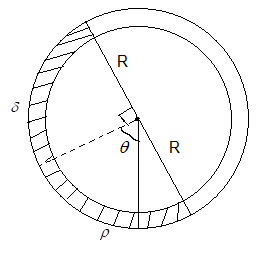
A uniform long tube is bent into a circle of radius R and it lies in a vertical plane. Two liquids of same volume but densities $\rho $ and $\delta $ fill half the tube. The angle $\theta $ is
$\text{A}\text{. }{{\tan }^{-1}}\left( \dfrac{\rho -\delta }{\rho +\delta } \right)$
$\text{B}\text{. }{{\tan }^{-1}}\left( \dfrac{\rho }{\delta } \right)$
$\text{C}\text{. }{{\tan }^{-1}}\left( \dfrac{\delta }{\rho } \right)$
$\text{D}\text{. }{{\tan }^{-1}}\left( \dfrac{\rho +\delta }{\rho -\delta } \right)$
Answer
 Verified
673.5k+ views
Hint: Pressure only depends on the vertical height and not the horizontal distance. Pressure at every point at a given horizontal axis is the same. If we jump from an axis to an axis that at a distance of h below then the pressure increases by $\rho gh$.
Complete step by step answer:
To solve this the given question we have to do certain things.
Suppose a cylindrical container is filled with a liquid of density $\rho $. Then the pressure at a point inside the liquid that is at depth of h from the surface (in contact with air outside) of the liquid is given as $P=\rho gh$, where P is the pressure at that given point and g is acceleration due to gravity.
Pressure only depends on the vertical height and not the horizontal distance. Pressure at every point at a given horizontal axis is the same. This means that if we take two points A and such that both the points pass through the same horizontal axis, then the pressure is the same as both the points. Not only just two points, the pressure is the same at all the points on this axis.
In addition, the pressure inside a liquid does not depend on the shape of the container.
If we jump from an axis to an axis that at a distance of h below then the pressure increases by $\rho gh$.
With this information we will be able to solve the given problem.
Redraw the given figure and label it as given below.
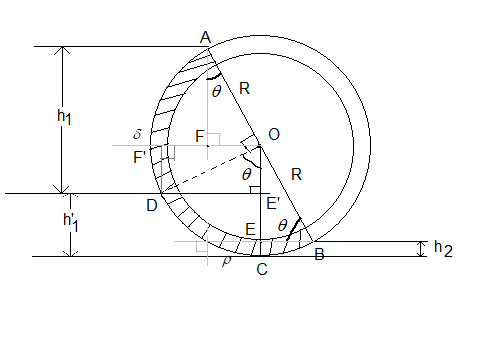
We will find the pressure at point C.
We can find the pressure at point C in two ways. One is by coming from point A and other is by coming from point B.
Consider the pressure at points A and B equal to zero.
From point B, the pressure at C is:
${{P}_{c}}=\rho g{{h}_{2}}$ ……………(i).
From point A, the pressure at D will be,
${{P}_{D}}=\delta g{{h}_{1}}$
From point D the pressure at C is:
${{P}_{c}}={{P}_{D}}+\rho gh{{'}_{1}}=\delta g{{h}_{1}}+\rho gh{{'}_{1}}$ ……………(ii).
If we use trigonometry ratios, we get that
$OE=R\sin \theta $ .
OC=R.
Therefore, ${{h}_{2}}=OC-OE=R-R\sin \theta $.
Substitute the value of ${{h}_{2}}$ in equation (i).
$\Rightarrow {{P}_{c}}=\rho g(R-R\sin \theta )$. …….(1).
We also get that,
$AF=R\sin \theta $
$F'D=R\cos \theta $
Therefore, ${{h}_{1}}=AF+F'D=R\cos \theta +R\sin \theta $.
And,
$OE'=R\cos \theta $
$OC=R$
$\Rightarrow E'C=OC-OE'=R-R\cos \theta $
$h{{'}_{1}}=E'C=R-R\cos \theta $.
Substitute the value of ${{h}_{1}}$and $h{{'}_{1}}$ in equation (ii).
${{P}_{c}}=\delta g\left( R\cos \theta +R\sin \theta \right)+\rho g\left( R-R\cos \theta \right)$. ………..(2).
Equate equations (1) and (2).
Therefore, $\rho g(R-R\sin \theta )=\delta g\left( R\cos \theta +R\sin \theta \right)+\rho g\left( R-R\cos \theta \right)$
$\Rightarrow \rho R-\rho R\sin \theta =\delta R\cos \theta +\delta R\sin \theta +\rho R-\rho R\cos \theta $
$\Rightarrow \delta R\sin \theta +\rho R\sin \theta =\rho R\cos \theta -\delta R\cos \theta \rho R\cos \theta $
$\Rightarrow (\delta +\rho )\sin \theta =(\rho -\delta )\cos \theta $
$\Rightarrow \dfrac{\sin \theta }{\cos \theta }=\dfrac{(\rho -\delta )}{(\rho +\delta )}$
$\Rightarrow \tan \theta =\dfrac{(\rho -\delta )}{(\rho +\delta )}$
Hence, the correct option is A.
Note: In the question, it is not mentioned that the two liquids are immiscible. It is to be noted that the two given liquids must be immiscible. Otherwise, the liquids will mix with each other.
Complete step by step answer:
To solve this the given question we have to do certain things.
Suppose a cylindrical container is filled with a liquid of density $\rho $. Then the pressure at a point inside the liquid that is at depth of h from the surface (in contact with air outside) of the liquid is given as $P=\rho gh$, where P is the pressure at that given point and g is acceleration due to gravity.
Pressure only depends on the vertical height and not the horizontal distance. Pressure at every point at a given horizontal axis is the same. This means that if we take two points A and such that both the points pass through the same horizontal axis, then the pressure is the same as both the points. Not only just two points, the pressure is the same at all the points on this axis.
In addition, the pressure inside a liquid does not depend on the shape of the container.
If we jump from an axis to an axis that at a distance of h below then the pressure increases by $\rho gh$.
With this information we will be able to solve the given problem.
Redraw the given figure and label it as given below.
We will find the pressure at point C.
We can find the pressure at point C in two ways. One is by coming from point A and other is by coming from point B.
Consider the pressure at points A and B equal to zero.
From point B, the pressure at C is:
${{P}_{c}}=\rho g{{h}_{2}}$ ……………(i).
From point A, the pressure at D will be,
${{P}_{D}}=\delta g{{h}_{1}}$
From point D the pressure at C is:
${{P}_{c}}={{P}_{D}}+\rho gh{{'}_{1}}=\delta g{{h}_{1}}+\rho gh{{'}_{1}}$ ……………(ii).
If we use trigonometry ratios, we get that
$OE=R\sin \theta $ .
OC=R.
Therefore, ${{h}_{2}}=OC-OE=R-R\sin \theta $.
Substitute the value of ${{h}_{2}}$ in equation (i).
$\Rightarrow {{P}_{c}}=\rho g(R-R\sin \theta )$. …….(1).
We also get that,
$AF=R\sin \theta $
$F'D=R\cos \theta $
Therefore, ${{h}_{1}}=AF+F'D=R\cos \theta +R\sin \theta $.
And,
$OE'=R\cos \theta $
$OC=R$
$\Rightarrow E'C=OC-OE'=R-R\cos \theta $
$h{{'}_{1}}=E'C=R-R\cos \theta $.
Substitute the value of ${{h}_{1}}$and $h{{'}_{1}}$ in equation (ii).
${{P}_{c}}=\delta g\left( R\cos \theta +R\sin \theta \right)+\rho g\left( R-R\cos \theta \right)$. ………..(2).
Equate equations (1) and (2).
Therefore, $\rho g(R-R\sin \theta )=\delta g\left( R\cos \theta +R\sin \theta \right)+\rho g\left( R-R\cos \theta \right)$
$\Rightarrow \rho R-\rho R\sin \theta =\delta R\cos \theta +\delta R\sin \theta +\rho R-\rho R\cos \theta $
$\Rightarrow \delta R\sin \theta +\rho R\sin \theta =\rho R\cos \theta -\delta R\cos \theta \rho R\cos \theta $
$\Rightarrow (\delta +\rho )\sin \theta =(\rho -\delta )\cos \theta $
$\Rightarrow \dfrac{\sin \theta }{\cos \theta }=\dfrac{(\rho -\delta )}{(\rho +\delta )}$
$\Rightarrow \tan \theta =\dfrac{(\rho -\delta )}{(\rho +\delta )}$
Hence, the correct option is A.
Note: In the question, it is not mentioned that the two liquids are immiscible. It is to be noted that the two given liquids must be immiscible. Otherwise, the liquids will mix with each other.
Recently Updated Pages
Which will be the least stable resonating structure class 11 chemistry CBSE

How many 5 digit telephone numbers can be construc-class-11-maths-CBSE
How do you find the angle of the resultant vector class 11 physics CBSE
Draw labelled diagram of the following i Gram seed class 11 biology CBSE
1 Quintal is equal to a 110 kg b 10 kg c 100kg d 1000 class 11 physics CBSE
What is the need and importance of classification class 11 biology CBSE
Trending doubts
Find the value of the expression given below sin 30circ class 11 maths CBSE
One Metric ton is equal to kg A 10000 B 1000 C 100 class 11 physics CBSE
10 examples of friction in our daily life
Draw a diagram of a plant cell and label at least eight class 11 biology CBSE
Difference between physical and chemical change class 11 chemistry CBSE
Proton was discovered by A Thomson B Rutherford C Chadwick class 11 chemistry CBSE