




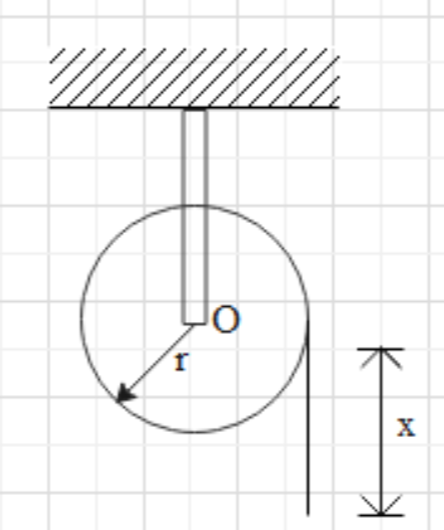
A uniform cylinder of radius r and mass m can rotate freely about a fixed horizontal axis. A thin cord of length l and mass \[{{m}_{0}}\]is wound on the cylinder in the single layer. Find the angular acceleration of the cylinder as a function of the length of x of the hanging part of the cord. The wound part of the cord is supposed to have a center of gravity on the cylinder axis as shown in figure
Answer
 Verified
585.6k+ views
Hint: We have to find the acceleration of the cylinder in terms of the length of the cord which is unwounded by the cylinder and hanging from it. Now the cylinder can rotate so it can have torque. The torque can be given as the rate of change of angular momentum. By using the formula of torque we can find the relation between the length of the hanging part of the cord and the angular acceleration.
Formula used:
\[\begin{align}
& \tau =\dfrac{dL}{dt} \\
& L=I\omega \\
\end{align}\]
Complete step-by-step solution:
The torque is a force that is experienced by an object due to its circular motion along with its axis. As the cylinder can rotate freely it can have torque and so the hanging part will also have torque which can be given as
\[\tau =\dfrac{{{m}_{0}}gxr}{l}\text{ }...................\text{(i)}\]
Where \[{{m}_{0}}\] is the mass of the thin cord of length l wounded on the cylinder of radius r and x is the hanging part. And the hanging part will experience the downward pull of the gravity hence acceleration due to gravity is considered. The rotating of the hanging part will be along the axis of the cylinder.
Now torque is also given as the rate of change of angular momentum
\[\tau =\dfrac{dL}{dt}\]
And angular momentum is given as the product of the moment of inertia and angular velocity.
\[L=I\omega \]
Here the total angular momentum will be given as the sum of the angular momentum of the cylinder and the angular momentum of the thin cord wounded and hanging from the cylinder.
The moment of inertia of the cylinder is given as \[\dfrac{1}{2}m{{r}^{2}}\], where m is the mass of the cylinder and r is the radius of it. Moment of inertia of wounded thin cord is given as \[\dfrac{{{m}_{0}}}{l}(l-x){{r}^{2}}\]. And the moment of inertia of the hanging part is given as \[\dfrac{{{m}_{0}}}{l}x{{r}^{2}}\]. The angular velocity of the cord (wounded and hanging) will be given by the angular velocity of the cylinder.
Hence, total angular momentum will be given as
\[\begin{align}
& L=\dfrac{1}{2}m{{r}^{2}}\omega +\dfrac{{{m}_{0}}}{l}(l-x){{r}^{2}}\omega +\dfrac{{{m}_{0}}}{l}x{{r}^{2}}\omega \\
& \Rightarrow L=\left( \dfrac{1}{2}m{{r}^{2}}+{{m}_{0}}{{r}^{2}}-\dfrac{{{m}_{0}}}{l}x{{r}^{2}}+\dfrac{{{m}_{0}}}{l}x{{r}^{2}} \right)\omega \\
& \Rightarrow L=\left( \dfrac{1}{2}m{{r}^{2}}+{{m}_{0}}{{r}^{2}} \right)\omega \\
\end{align}\]
Differentiating it with respect to time t we get
\[\dfrac{dL}{dt}=\left( \dfrac{1}{2}m{{r}^{2}}+{{m}_{0}}{{r}^{2}} \right)\dfrac{d\omega }{dt}\]
As mass and radius are constant and rate of change of angular velocity with respect to time is angular acceleration α and rate of change of angular momentum with respect to time is torque, hence above equation becomes
\[\tau =\left( \dfrac{1}{2}m{{r}^{2}}+{{m}_{0}}{{r}^{2}} \right)\alpha \]
Substituting value of torque from equation (i), we get
\[\begin{align}
& \Rightarrow \dfrac{{{m}_{0}}gxr}{l}=\left( \dfrac{1}{2}m{{r}^{2}}+{{m}_{0}}{{r}^{2}} \right)\alpha \\
& \Rightarrow \alpha =\dfrac{2{{m}_{0}}gxr}{\left( m{{r}^{2}}+2{{m}_{0}}{{r}^{2}} \right)l} \\
& \Rightarrow \alpha =\dfrac{2{{m}_{0}}gxr}{\left( m+2{{m}_{0}} \right){{r}^{2}}l} \\
& \Rightarrow \alpha =\dfrac{2{{m}_{0}}gx}{\left( m+2{{m}_{0}} \right)rl} \\
\end{align}\]
Hence we derived an equation of angular acceleration in terms of x.
Note: The angular velocity of the thin cord will be the same as the cylinder as the cord is wounded on it and the hanging cord is the part of the thin cord wounded on the cylinder. Also, note the moment of inertia of the cord has the term of r which is the radius of the cylinder as it was given in the question to assume that the cord has the center of gravity of the cylinder.
Formula used:
\[\begin{align}
& \tau =\dfrac{dL}{dt} \\
& L=I\omega \\
\end{align}\]
Complete step-by-step solution:
The torque is a force that is experienced by an object due to its circular motion along with its axis. As the cylinder can rotate freely it can have torque and so the hanging part will also have torque which can be given as
\[\tau =\dfrac{{{m}_{0}}gxr}{l}\text{ }...................\text{(i)}\]
Where \[{{m}_{0}}\] is the mass of the thin cord of length l wounded on the cylinder of radius r and x is the hanging part. And the hanging part will experience the downward pull of the gravity hence acceleration due to gravity is considered. The rotating of the hanging part will be along the axis of the cylinder.
Now torque is also given as the rate of change of angular momentum
\[\tau =\dfrac{dL}{dt}\]
And angular momentum is given as the product of the moment of inertia and angular velocity.
\[L=I\omega \]
Here the total angular momentum will be given as the sum of the angular momentum of the cylinder and the angular momentum of the thin cord wounded and hanging from the cylinder.
The moment of inertia of the cylinder is given as \[\dfrac{1}{2}m{{r}^{2}}\], where m is the mass of the cylinder and r is the radius of it. Moment of inertia of wounded thin cord is given as \[\dfrac{{{m}_{0}}}{l}(l-x){{r}^{2}}\]. And the moment of inertia of the hanging part is given as \[\dfrac{{{m}_{0}}}{l}x{{r}^{2}}\]. The angular velocity of the cord (wounded and hanging) will be given by the angular velocity of the cylinder.
Hence, total angular momentum will be given as
\[\begin{align}
& L=\dfrac{1}{2}m{{r}^{2}}\omega +\dfrac{{{m}_{0}}}{l}(l-x){{r}^{2}}\omega +\dfrac{{{m}_{0}}}{l}x{{r}^{2}}\omega \\
& \Rightarrow L=\left( \dfrac{1}{2}m{{r}^{2}}+{{m}_{0}}{{r}^{2}}-\dfrac{{{m}_{0}}}{l}x{{r}^{2}}+\dfrac{{{m}_{0}}}{l}x{{r}^{2}} \right)\omega \\
& \Rightarrow L=\left( \dfrac{1}{2}m{{r}^{2}}+{{m}_{0}}{{r}^{2}} \right)\omega \\
\end{align}\]
Differentiating it with respect to time t we get
\[\dfrac{dL}{dt}=\left( \dfrac{1}{2}m{{r}^{2}}+{{m}_{0}}{{r}^{2}} \right)\dfrac{d\omega }{dt}\]
As mass and radius are constant and rate of change of angular velocity with respect to time is angular acceleration α and rate of change of angular momentum with respect to time is torque, hence above equation becomes
\[\tau =\left( \dfrac{1}{2}m{{r}^{2}}+{{m}_{0}}{{r}^{2}} \right)\alpha \]
Substituting value of torque from equation (i), we get
\[\begin{align}
& \Rightarrow \dfrac{{{m}_{0}}gxr}{l}=\left( \dfrac{1}{2}m{{r}^{2}}+{{m}_{0}}{{r}^{2}} \right)\alpha \\
& \Rightarrow \alpha =\dfrac{2{{m}_{0}}gxr}{\left( m{{r}^{2}}+2{{m}_{0}}{{r}^{2}} \right)l} \\
& \Rightarrow \alpha =\dfrac{2{{m}_{0}}gxr}{\left( m+2{{m}_{0}} \right){{r}^{2}}l} \\
& \Rightarrow \alpha =\dfrac{2{{m}_{0}}gx}{\left( m+2{{m}_{0}} \right)rl} \\
\end{align}\]
Hence we derived an equation of angular acceleration in terms of x.
Note: The angular velocity of the thin cord will be the same as the cylinder as the cord is wounded on it and the hanging cord is the part of the thin cord wounded on the cylinder. Also, note the moment of inertia of the cord has the term of r which is the radius of the cylinder as it was given in the question to assume that the cord has the center of gravity of the cylinder.
Recently Updated Pages
Master Class 11 Computer Science: Engaging Questions & Answers for Success

Master Class 11 Business Studies: Engaging Questions & Answers for Success
Master Class 11 Economics: Engaging Questions & Answers for Success
Master Class 11 English: Engaging Questions & Answers for Success
Master Class 11 Maths: Engaging Questions & Answers for Success
Master Class 11 Biology: Engaging Questions & Answers for Success
Trending doubts
One Metric ton is equal to kg A 10000 B 1000 C 100 class 11 physics CBSE
There are 720 permutations of the digits 1 2 3 4 5 class 11 maths CBSE
Discuss the various forms of bacteria class 11 biology CBSE
Draw a diagram of a plant cell and label at least eight class 11 biology CBSE
State the laws of reflection of light
Explain zero factorial class 11 maths CBSE