




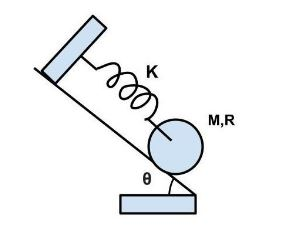
A uniform cylinder of mass M and radius \[R\] is released from rest on a rough inclined surface of inclination \[\theta \] with the horizontal as shown in figure. As the cylinder rolls down the inclined surface, the maximum elongation in the spring of stiffness \[k\] is ?
A. $\dfrac{3}{4}\dfrac{{Mg\sin \theta }}{k}$
B. $\dfrac{{2Mg\sin \theta }}{k}$
C. $\dfrac{{Mg\sin \theta }}{k}$
D. None of these
Answer
 Verified
510.3k+ views
Hint: In order to answer the given question to know the maximum elongation in the spring of stiffness, we will use the concept of Conservation of energy, which states that Conservation of energy is a physical principle that states that the energy in a closed system remains constant.
Complete step by step answer:
Since the cylinder's stated motion, there is no energy loss owing to friction. Hence, based on the notion of energy conservation,
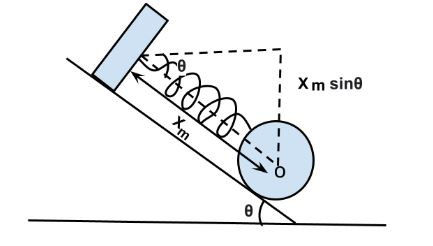
Maximum spring potential energy=maximum gravitational potential energy decrease
\[ \dfrac{1}{2}kx_m^2 = Mgh = Mg({x_m}sin\theta )\]
\[\therefore {x_m} = \dfrac{{2Mgsin\theta }}{k}\]
Therefore, the maximum elongation in the spring of stiffness \[k\] is \[\dfrac{{2Mgsin\theta }}{k}\].
So, the correct option is B.
Additional Information: The position of the object has no effect on a conservative force. If a force is conservative, it's possible to assign a numerical number to its potential at any time. When an object moves from one location to another, the force changes the potential energy of the object in a way that is independent of the path taken. Gravity and spring forces are examples of conservative forces.
Note: Non-conservative forces, like conservative forces, transfer energy from the moving item, but they do not transfer this energy back to the system's potential energy to retrieve it during reverse motion. Rather, they transfer energy from the system in an energy form that the force cannot employ to send it back to the moving object. Friction is an example of an anti-conservative force.
Complete step by step answer:
Since the cylinder's stated motion, there is no energy loss owing to friction. Hence, based on the notion of energy conservation,
Maximum spring potential energy=maximum gravitational potential energy decrease
\[ \dfrac{1}{2}kx_m^2 = Mgh = Mg({x_m}sin\theta )\]
\[\therefore {x_m} = \dfrac{{2Mgsin\theta }}{k}\]
Therefore, the maximum elongation in the spring of stiffness \[k\] is \[\dfrac{{2Mgsin\theta }}{k}\].
So, the correct option is B.
Additional Information: The position of the object has no effect on a conservative force. If a force is conservative, it's possible to assign a numerical number to its potential at any time. When an object moves from one location to another, the force changes the potential energy of the object in a way that is independent of the path taken. Gravity and spring forces are examples of conservative forces.
Note: Non-conservative forces, like conservative forces, transfer energy from the moving item, but they do not transfer this energy back to the system's potential energy to retrieve it during reverse motion. Rather, they transfer energy from the system in an energy form that the force cannot employ to send it back to the moving object. Friction is an example of an anti-conservative force.
Recently Updated Pages
Three beakers labelled as A B and C each containing 25 mL of water were taken A small amount of NaOH anhydrous CuSO4 and NaCl were added to the beakers A B and C respectively It was observed that there was an increase in the temperature of the solutions contained in beakers A and B whereas in case of beaker C the temperature of the solution falls Which one of the following statements isarecorrect i In beakers A and B exothermic process has occurred ii In beakers A and B endothermic process has occurred iii In beaker C exothermic process has occurred iv In beaker C endothermic process has occurred

Master Class 11 Social Science: Engaging Questions & Answers for Success
Master Class 11 Physics: Engaging Questions & Answers for Success
Master Class 11 Maths: Engaging Questions & Answers for Success
Master Class 11 Economics: Engaging Questions & Answers for Success
Master Class 11 Computer Science: Engaging Questions & Answers for Success
Three beakers labelled as A B and C each containing 25 mL of water were taken A small amount of NaOH anhydrous CuSO4 and NaCl were added to the beakers A B and C respectively It was observed that there was an increase in the temperature of the solutions contained in beakers A and B whereas in case of beaker C the temperature of the solution falls Which one of the following statements isarecorrect i In beakers A and B exothermic process has occurred ii In beakers A and B endothermic process has occurred iii In beaker C exothermic process has occurred iv In beaker C endothermic process has occurred
Master Class 11 Social Science: Engaging Questions & Answers for Success
Master Class 11 Physics: Engaging Questions & Answers for Success
Trending doubts
One Metric ton is equal to kg A 10000 B 1000 C 100 class 11 physics CBSE
There are 720 permutations of the digits 1 2 3 4 5 class 11 maths CBSE
State and prove Bernoullis theorem class 11 physics CBSE
Draw a diagram of a plant cell and label at least eight class 11 biology CBSE
Difference Between Prokaryotic Cells and Eukaryotic Cells
Discuss the various forms of bacteria class 11 biology CBSE