




A uniform circular disc of radius $R$, lying on a frictionless horizontal plane is rotating with an angular velocity ‘$\omega $’ about its own axis. Another identical circular disc is gently placed on the top of the first disc coaxially. The loss in rotational kinetic energy due to friction between the two discs, as they acquire angular velocity is:
($I$ is Moment of Inertia of the disc)
A. $\dfrac{1}{8}I{\omega ^2}$
B. $\dfrac{1}{4}I{\omega ^2}$
C. $\dfrac{1}{2}I{\omega ^2}$
D. $I{\omega ^2}$
Answer
 Verified
563.7k+ views
Hint:The rotational kinetic energy, in simple terms would be the kinetic energy caused by an object's rotation and is a constituent part of its overall kinetic energy. The concept of moment of inertia is related to the kinetic energy and it is a scalar measure that represents how complicated it is to modify an object's rotational velocity across any axis of rotation.
Complete step by step answer:
Initially let us note down the given conditions:
A circular disc having constant radius $ = R$.
This disc has an angular velocity given as $ = \omega $.
Then when another similar disc is placed on top of the given disc they would experience a friction while rotating hence our task is to calculate the loss of kinetic energy due to this friction;
Kinetic energy loss $ = ?$
A diagram illustrating the given conditions has been constructed below:
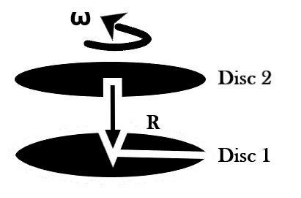
Now what we need to understand is that the answer for the loss of kinetic energy should be expressed in terms of the moment of inertia. Rotational inertia is also regarded as the 'moment of inertia.' We know that there is no external force applied in order to cause a rotation to the given bodies (since the surface has no friction), this implies zero torque. This in turn means that there is a conservation of angular momentum that takes place.
Angular momentum for any system is the product of the inertia of rotation and the body’s angular velocity. If the moment of inertia of original disc is $I$ and combined disc is $2I$, angular velocity of the original disc is $\omega $ and angular velocity of the combined disc is $\omega '$, then their angular momentum can be written as follows due to conservation:
$ \Rightarrow I\omega = 2I\omega '$
$ \Rightarrow \omega ' = \dfrac{\omega }{2}$
Now the loss of kinetic energy is the difference between kinetic energies produced by the original disc and combined system of discs. Note that kinetic energy of rotation in general can only be expressed with the help of the body's angular velocity and the 'moment of inertia.'
Kinetic energy of original disc $ = \dfrac{1}{2}I{\omega ^2}$
Kinetic energy of combined discs $ = \dfrac{1}{2}(2I){(\omega ')^2} = \dfrac{1}{2}(2I){(\dfrac{\omega }{2})^2}$
If loss of kinetic energy is denoted by $\Delta KE$;
$ \Rightarrow \Delta KE = \dfrac{1}{2}I{\omega ^2} - \dfrac{1}{2}(2I){\left( {\dfrac{\omega }{2}} \right)^2}$
Simplifying we get:
$ \therefore \Delta KE = \dfrac{1}{4}I{\omega ^2}$
The loss of kinetic energy is calculated to be $\dfrac{1}{4}I{\omega ^2}$.
Hence, the correct answer is option B.
Note:Remember that rotational motion will sometimes have an increase in speed or decrease in speed or sometimes reverses directions, so angular velocity is not always a constant quantity. Since the angular velocity varies in certain situations, angular acceleration happens. The higher the angular acceleration, it means that the change was quicker. The rate of change of angular velocity is defined as angular acceleration.
Complete step by step answer:
Initially let us note down the given conditions:
A circular disc having constant radius $ = R$.
This disc has an angular velocity given as $ = \omega $.
Then when another similar disc is placed on top of the given disc they would experience a friction while rotating hence our task is to calculate the loss of kinetic energy due to this friction;
Kinetic energy loss $ = ?$
A diagram illustrating the given conditions has been constructed below:
Now what we need to understand is that the answer for the loss of kinetic energy should be expressed in terms of the moment of inertia. Rotational inertia is also regarded as the 'moment of inertia.' We know that there is no external force applied in order to cause a rotation to the given bodies (since the surface has no friction), this implies zero torque. This in turn means that there is a conservation of angular momentum that takes place.
Angular momentum for any system is the product of the inertia of rotation and the body’s angular velocity. If the moment of inertia of original disc is $I$ and combined disc is $2I$, angular velocity of the original disc is $\omega $ and angular velocity of the combined disc is $\omega '$, then their angular momentum can be written as follows due to conservation:
$ \Rightarrow I\omega = 2I\omega '$
$ \Rightarrow \omega ' = \dfrac{\omega }{2}$
Now the loss of kinetic energy is the difference between kinetic energies produced by the original disc and combined system of discs. Note that kinetic energy of rotation in general can only be expressed with the help of the body's angular velocity and the 'moment of inertia.'
Kinetic energy of original disc $ = \dfrac{1}{2}I{\omega ^2}$
Kinetic energy of combined discs $ = \dfrac{1}{2}(2I){(\omega ')^2} = \dfrac{1}{2}(2I){(\dfrac{\omega }{2})^2}$
If loss of kinetic energy is denoted by $\Delta KE$;
$ \Rightarrow \Delta KE = \dfrac{1}{2}I{\omega ^2} - \dfrac{1}{2}(2I){\left( {\dfrac{\omega }{2}} \right)^2}$
Simplifying we get:
$ \therefore \Delta KE = \dfrac{1}{4}I{\omega ^2}$
The loss of kinetic energy is calculated to be $\dfrac{1}{4}I{\omega ^2}$.
Hence, the correct answer is option B.
Note:Remember that rotational motion will sometimes have an increase in speed or decrease in speed or sometimes reverses directions, so angular velocity is not always a constant quantity. Since the angular velocity varies in certain situations, angular acceleration happens. The higher the angular acceleration, it means that the change was quicker. The rate of change of angular velocity is defined as angular acceleration.
Recently Updated Pages
Master Class 11 English: Engaging Questions & Answers for Success

Master Class 11 Social Science: Engaging Questions & Answers for Success
Master Class 11 Maths: Engaging Questions & Answers for Success
Master Class 11 Biology: Engaging Questions & Answers for Success
Master Class 11 Physics: Engaging Questions & Answers for Success
Master Class 11 Chemistry: Engaging Questions & Answers for Success
Trending doubts
One Metric ton is equal to kg A 10000 B 1000 C 100 class 11 physics CBSE
What is cell theory Who formulated it class 11 biology CBSE
Phyllotaxy is the arrangement of ALeaflets BLeaves class 11 biology CBSE
Difference Between Prokaryotic Cells and Eukaryotic Cells
The symbiotic association of fungi and algae is called class 11 biology CBSE
Cell theory was formulated by A Schleiden and Schwann class 11 biology CBSE