




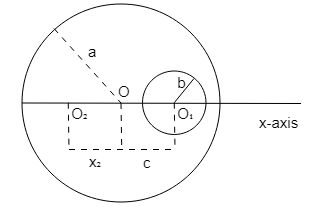
A uniform circular disc of radius \[a\] is taken. A circular portion of radius $b$ has been removed from it as shown in the figure. If the centre of hole is at a distance $c$ from the centre of the disc, the distance ${x_2}$ of the centre of mass of the remaining part from the initial centre of mass $O$ is given by :
$(A)\dfrac{{\pi {b^2}}}{{{a^2} - {c^2}}}$
$(B)\dfrac{{{b^2}c}}{{{a^2} - {b^2}}}$
$(C)\dfrac{{\pi {c^2}}}{{{a^2} - {b^2}}}$
$(D)\dfrac{{c{a^2}}}{{{c^2} - {b^2}}}$
Answer
 Verified
549.3k+ views
Hint: In order to solve this question, first we will directly apply the formula for the centre of mass. Then we will put the required values in the expression of the centre of mass. The point $O$ is the centre of the whole disk and is taken as the origin.
Complete step by step solution:
We know the expression for the centre of mass is given by the formula,
${x_{cm}} = \dfrac{{{A_1}{x_1} - {A_2}{x_2}}}{{{A_1} - {A_2}}}......(1)$
Where, ${A_1}$ is the area of the whole disc,
${A_2}$ is the area of the removed part of the disk,
${x_1}$ is the centre of mass of the whole disk,
${x_2}$ is the centre of mass of the removed part of the disk
Now, on putting the values of these quantities, we get,
${A_1} = \pi \times {a^2}$
${A_2} = \pi \times {b^2}$
${x_1} = 0$
${x_2} = c$
On putting the following values in equation (1), we get,
\[{x_{cm}} = \dfrac{{\pi {a^2} \times 0 - \pi {b^2} \times c}}{{\pi {a^2} - \pi {b^2}}}\]
\[{x_{cm}} = \dfrac{{ - \pi {b^2}c}}{{\pi ({a^2} - {b^2})}}\]
On cancelling the value of $\pi $ on both the sides, we get,
\[{x_{cm}} = \dfrac{{ - {b^2}c}}{{({a^2} - {b^2})}}\]
The negative sign in the above expression shows that the centre of mass is present on the left and side.
So, we can conclude that from the point $O$, the centre of mass is present in the left hand side at a distance of \[\dfrac{{{b^2}c}}{{({a^2} - {b^2})}}\].
So, the final answer is $(B)\dfrac{{{b^2}c}}{{{a^2} - {b^2}}}$.
Note:
It is important to note that the centre of mass can be negative as well as positive. If the centre of mass is negative, then it means that the centre of mass is present on the left hand side and if it is positive, then it means that it is present on the right hand side. Also, the centre of mass of a body can lie outside the body. For example, the centre of mass of any particular ring lies at its centre but the centre itself is not a part of the ring.
Complete step by step solution:
We know the expression for the centre of mass is given by the formula,
${x_{cm}} = \dfrac{{{A_1}{x_1} - {A_2}{x_2}}}{{{A_1} - {A_2}}}......(1)$
Where, ${A_1}$ is the area of the whole disc,
${A_2}$ is the area of the removed part of the disk,
${x_1}$ is the centre of mass of the whole disk,
${x_2}$ is the centre of mass of the removed part of the disk
Now, on putting the values of these quantities, we get,
${A_1} = \pi \times {a^2}$
${A_2} = \pi \times {b^2}$
${x_1} = 0$
${x_2} = c$
On putting the following values in equation (1), we get,
\[{x_{cm}} = \dfrac{{\pi {a^2} \times 0 - \pi {b^2} \times c}}{{\pi {a^2} - \pi {b^2}}}\]
\[{x_{cm}} = \dfrac{{ - \pi {b^2}c}}{{\pi ({a^2} - {b^2})}}\]
On cancelling the value of $\pi $ on both the sides, we get,
\[{x_{cm}} = \dfrac{{ - {b^2}c}}{{({a^2} - {b^2})}}\]
The negative sign in the above expression shows that the centre of mass is present on the left and side.
So, we can conclude that from the point $O$, the centre of mass is present in the left hand side at a distance of \[\dfrac{{{b^2}c}}{{({a^2} - {b^2})}}\].
So, the final answer is $(B)\dfrac{{{b^2}c}}{{{a^2} - {b^2}}}$.
Note:
It is important to note that the centre of mass can be negative as well as positive. If the centre of mass is negative, then it means that the centre of mass is present on the left hand side and if it is positive, then it means that it is present on the right hand side. Also, the centre of mass of a body can lie outside the body. For example, the centre of mass of any particular ring lies at its centre but the centre itself is not a part of the ring.
Recently Updated Pages
Master Class 11 Social Science: Engaging Questions & Answers for Success

Master Class 11 English: Engaging Questions & Answers for Success
Master Class 11 Accountancy: Engaging Questions & Answers for Success
Master Class 11 Physics: Engaging Questions & Answers for Success
Master Class 11 Computer Science: Engaging Questions & Answers for Success
Master Class 11 Business Studies: Engaging Questions & Answers for Success
Trending doubts
Find the value of the expression given below sin 30circ class 11 maths CBSE
One Metric ton is equal to kg A 10000 B 1000 C 100 class 11 physics CBSE
Draw a diagram of nephron and explain its structur class 11 biology CBSE
10 examples of friction in our daily life
Proton was discovered by A Thomson B Rutherford C Chadwick class 11 chemistry CBSE
The teeth used for biting and cutting food are called class 11 biology CBSE