




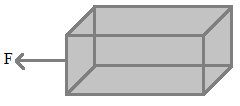
A uniform bar of square cross section is lying along a frictionless horizontal surface. A horizontal force is applied to pull it from one of its ends. Then,
A. The bar is under the same stress throughout its length
B. The bar is not under any stress because force has been applied only at one end
C. The bar simply moves without any stress in it
D. The stress developed reduces to zero at the end of the bar where no force is applied.
Answer
 Verified
576.3k+ views
Hint: We are given a uniform bar of square cross section which is lying on a frictionless horizontal surface. It is said that we apply a force to one of the ends to pull the bar. We are given four statements about the stress developed in the bar. So to find the correct answer we need to account for the stress in the bar due to the applied force.
Complete step by step answer:
In the question we are given a uniform bar of square cross section. It is said that the bar is lying on a frictionless horizontal surface and a horizontal force is applied on it.
We are given four statements about the stress developed in the bar.
We know that stress will only be produced in an object when we apply force to it from both ends.
Consider the figure given below,
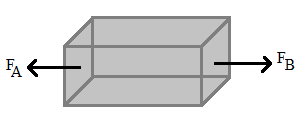
Here we are applying two forces at the two ends. In this case a stress will be developed in the bar and the bar will move under that stress.
But, since in this case force is applied only to one end, no stress is developed in the bar.
So, the correct answer is “Option B”.
Note:
When we apply a force to an object we know that the object will deform. To restore its original shape, size etc a force which is opposite to the deforming force known as the restoring force is developed in the object. This restoring force is equal to the magnitude of the applied deforming force and opposite in direction of the deforming force. The measure of this restoring force developed due to the deforming force per unit area is known as stress.
Complete step by step answer:
In the question we are given a uniform bar of square cross section. It is said that the bar is lying on a frictionless horizontal surface and a horizontal force is applied on it.
We are given four statements about the stress developed in the bar.
We know that stress will only be produced in an object when we apply force to it from both ends.
Consider the figure given below,
Here we are applying two forces at the two ends. In this case a stress will be developed in the bar and the bar will move under that stress.
But, since in this case force is applied only to one end, no stress is developed in the bar.
So, the correct answer is “Option B”.
Note:
When we apply a force to an object we know that the object will deform. To restore its original shape, size etc a force which is opposite to the deforming force known as the restoring force is developed in the object. This restoring force is equal to the magnitude of the applied deforming force and opposite in direction of the deforming force. The measure of this restoring force developed due to the deforming force per unit area is known as stress.
Recently Updated Pages
Master Class 11 Computer Science: Engaging Questions & Answers for Success

Master Class 11 Business Studies: Engaging Questions & Answers for Success
Master Class 11 Economics: Engaging Questions & Answers for Success
Master Class 11 English: Engaging Questions & Answers for Success
Master Class 11 Maths: Engaging Questions & Answers for Success
Master Class 11 Biology: Engaging Questions & Answers for Success
Trending doubts
One Metric ton is equal to kg A 10000 B 1000 C 100 class 11 physics CBSE
There are 720 permutations of the digits 1 2 3 4 5 class 11 maths CBSE
Discuss the various forms of bacteria class 11 biology CBSE
Draw a diagram of a plant cell and label at least eight class 11 biology CBSE
State the laws of reflection of light
Explain zero factorial class 11 maths CBSE