




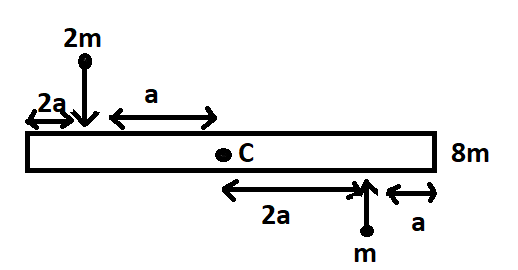
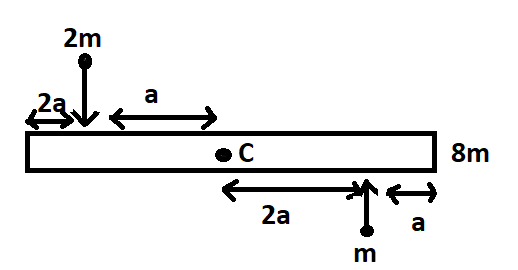
A uniform bar of length $6a$ and mass $8m$ lies on a smooth horizontal table. Two point masses $m$ and $2m$ moving in the same horizontal plane with speed $2v$ and $v$ respectively, strike the bar( as shown in figure) and stick to the bar after collision. C represents the centre of mass of the bar. Denoting angular velocity (about the centre of mass), total energy and velocity of centre of mass by $\omega, E$ and ${{\text{v}}_{c}}$ respectively, then after collision we have
$\begin{align}
& \text{A}\text{. }{{\text{v}}_{c}}=0 \\
& \text{B}\text{. }\omega =\dfrac{3\text{v}}{5a} \\
& \text{C}\text{. }\omega =\dfrac{\text{v}}{5a} \\
& \text{D}\text{. }E=\dfrac{3m{{\text{v}}^{2}}}{5} \\
\end{align}$
Answer
 Verified
647.7k+ views
- Hint: We will have to calculate each physical quantity to find the correct answer for the given question. The two masses stick to the bar and hence there is no external force or torque on the bar and the conservation laws can be used.
Complete step-by-step solution -
We are given a uniform bar of length $6a$ and mass $8m$ which lies on a smooth horizontal table as shown in the figure. There are two masses $m$ and $2m$ striking the bar with velocities of $2v$ and $v$ respectively as shown in the figure.
Firstly, the body is experiencing no external force so
${{F}_{ext}}=0$
Therefore using law of conservation of linear momentum we can write the equation:
$({{m}_{1}}+{{m}_{2}}+{{m}_{3}})V={{m}_{1}}{{v}_{1}}+{{m}_{2}}{{v}_{2}}+{{m}_{3}}{{v}_{3}}$
$(2m+m+8m){{v}_{c}}=-2mv+m\times 2v+0$
$11m{{v}_{c}}=0$
${{v}_{c}}=0$
Therefore, there is no translatory motion as velocity of centre of mass of the bar is zero
Now since the external torque on the system is also zero i.e.
${{\tau }_{ext}}=0$
Angular momentum of the system is also conserved. Thus, we will apply the law of conservation of angular momentum on the system
$({{I}_{1}}+{{I}_{2}}+{{I}_{3}})\omega ={{m}_{1}}{{v}_{1}}{{r}_{1}}+{{m}_{2}}{{v}_{2}}{{r}_{2}}$
Here, we must use the formula of moment of inertia of a bar when the axis of rotation is perpendicular to bar and through its centre i.e,
$I\omega =\dfrac{M{{l}^{2}}}{12}$
$\begin{align}
& \left\{ 2m{{a}^{2}}+m{{(2a)}^{2}}+\dfrac{8m\times {{(6a)}^{2}}}{12} \right\}\omega =2mva+m(2v)(2a) \\
& \Rightarrow \left( \dfrac{72m{{a}^{2}}+288m{{a}^{2}}}{12} \right)\omega =6mva \\
& \Rightarrow \dfrac{360m{{a}^{2}}}{12}\omega =6mva \\
\end{align}$
$30m\omega {{a}^{2}}=6mva$
Cancelling the like terms, we get
$\Rightarrow \omega =\dfrac{v}{5a}$
This is the rotational velocity of the system.
Now,
$\text{Total energy=Rotational energy+Translational energy}$
(There is no translatory motion since ${{v}_{c}}=0$ )
$\text{E=}\dfrac{1}{2}I{{\omega }^{2}}$
$\text{E=}\dfrac{1}{2}(30m{{a}^{2}}){{\left( \dfrac{v}{5a} \right)}^{2}}$
$\text{E=}\dfrac{3}{5}m{{v}^{2}}$
The correct answers are A. ${{v}_{c}}=0$, C. $\omega =\dfrac{v}{5a}$, D. $E=\dfrac{3m{{v}^{2}}}{5}$
Note: Students must note that the centre of mass is nothing but a point where the whole mass of the body is concentrated. Also, certain formulas for moment of inertia for a rod, disc, cylinder, sphere should be memorised by the students to use directly in the numerical problems. The various formulas are given as
\[\begin{align}
& {{I}_{rod}}=\dfrac{1}{12}M{{r}^{2}} \\
& {{I}_{disc}}=\dfrac{1}{2}M{{r}^{2}} \\
& {{I}_{cylinder}}=\dfrac{1}{2}M{{r}^{2}} \\
\end{align}\]
Complete step-by-step solution -
We are given a uniform bar of length $6a$ and mass $8m$ which lies on a smooth horizontal table as shown in the figure. There are two masses $m$ and $2m$ striking the bar with velocities of $2v$ and $v$ respectively as shown in the figure.
Firstly, the body is experiencing no external force so
${{F}_{ext}}=0$
Therefore using law of conservation of linear momentum we can write the equation:
$({{m}_{1}}+{{m}_{2}}+{{m}_{3}})V={{m}_{1}}{{v}_{1}}+{{m}_{2}}{{v}_{2}}+{{m}_{3}}{{v}_{3}}$
$(2m+m+8m){{v}_{c}}=-2mv+m\times 2v+0$
$11m{{v}_{c}}=0$
${{v}_{c}}=0$
Therefore, there is no translatory motion as velocity of centre of mass of the bar is zero
Now since the external torque on the system is also zero i.e.
${{\tau }_{ext}}=0$
Angular momentum of the system is also conserved. Thus, we will apply the law of conservation of angular momentum on the system
$({{I}_{1}}+{{I}_{2}}+{{I}_{3}})\omega ={{m}_{1}}{{v}_{1}}{{r}_{1}}+{{m}_{2}}{{v}_{2}}{{r}_{2}}$
Here, we must use the formula of moment of inertia of a bar when the axis of rotation is perpendicular to bar and through its centre i.e,
$I\omega =\dfrac{M{{l}^{2}}}{12}$
$\begin{align}
& \left\{ 2m{{a}^{2}}+m{{(2a)}^{2}}+\dfrac{8m\times {{(6a)}^{2}}}{12} \right\}\omega =2mva+m(2v)(2a) \\
& \Rightarrow \left( \dfrac{72m{{a}^{2}}+288m{{a}^{2}}}{12} \right)\omega =6mva \\
& \Rightarrow \dfrac{360m{{a}^{2}}}{12}\omega =6mva \\
\end{align}$
$30m\omega {{a}^{2}}=6mva$
Cancelling the like terms, we get
$\Rightarrow \omega =\dfrac{v}{5a}$
This is the rotational velocity of the system.
Now,
$\text{Total energy=Rotational energy+Translational energy}$
(There is no translatory motion since ${{v}_{c}}=0$ )
$\text{E=}\dfrac{1}{2}I{{\omega }^{2}}$
$\text{E=}\dfrac{1}{2}(30m{{a}^{2}}){{\left( \dfrac{v}{5a} \right)}^{2}}$
$\text{E=}\dfrac{3}{5}m{{v}^{2}}$
The correct answers are A. ${{v}_{c}}=0$, C. $\omega =\dfrac{v}{5a}$, D. $E=\dfrac{3m{{v}^{2}}}{5}$
Note: Students must note that the centre of mass is nothing but a point where the whole mass of the body is concentrated. Also, certain formulas for moment of inertia for a rod, disc, cylinder, sphere should be memorised by the students to use directly in the numerical problems. The various formulas are given as
\[\begin{align}
& {{I}_{rod}}=\dfrac{1}{12}M{{r}^{2}} \\
& {{I}_{disc}}=\dfrac{1}{2}M{{r}^{2}} \\
& {{I}_{cylinder}}=\dfrac{1}{2}M{{r}^{2}} \\
\end{align}\]
Recently Updated Pages
Basicity of sulphurous acid and sulphuric acid are

Master Class 11 English: Engaging Questions & Answers for Success
Master Class 11 Physics: Engaging Questions & Answers for Success
Master Class 11 Computer Science: Engaging Questions & Answers for Success
Master Class 11 Chemistry: Engaging Questions & Answers for Success
Master Class 11 Social Science: Engaging Questions & Answers for Success
Trending doubts
Draw a diagram of a plant cell and label at least eight class 11 biology CBSE
Proton was discovered by A Thomson B Rutherford C Chadwick class 11 chemistry CBSE
What is the purity of pure gold in carat class 11 chemistry CBSE
Can anyone list 10 advantages and disadvantages of friction
Lysosomes are known as suicidal bags of cell why class 11 biology CBSE
Derive the equation of motion by the calculus method class 11 physics CBSE