




A turn of radius $20m$ is banked for the vehicles going at a speed of $36km/h$. If the coefficient of static friction between the road and the tyre is $0.4$, what are the possible speeds of a vehicle so that it neither slips down nor skids up?
A) $14.7km/h$ and $54km/h$
B) $14.2km/h$ and $50km/h$
C) $11.7km/h$ and $44km/h$
D) $17.7km/h$ and $34km/h$
Answer
 Verified
615.3k+ views
Hint:In this question we want to find the range of speed of vehicle so that it neither slip down nor skids up
We take two possible conditions when a vehicle moving its maximum speed means if it increases its speed now it will skid up. In this condition we mark all forces and balance them and same thing we will do for minimum speed friction gives required centripetal force for turn
Complete step by step answer:
In the question it is given radius of turn $r = 20m$ and banked with angle $\theta $ for speed $v = 36km/h = \dfrac{{36 \times 5}}{{18}} = 10m/\sec $
And coefficient of friction $\mu = 0.4$
From here we can find the value of $\tan \theta $
We know $\tan \theta = \dfrac{{{v^2}}}{{rg}}$
$ \Rightarrow \tan \theta = \dfrac{{{{10}^2}}}{{20 \times 10}} = \dfrac{1}{2}$ .............. (1)
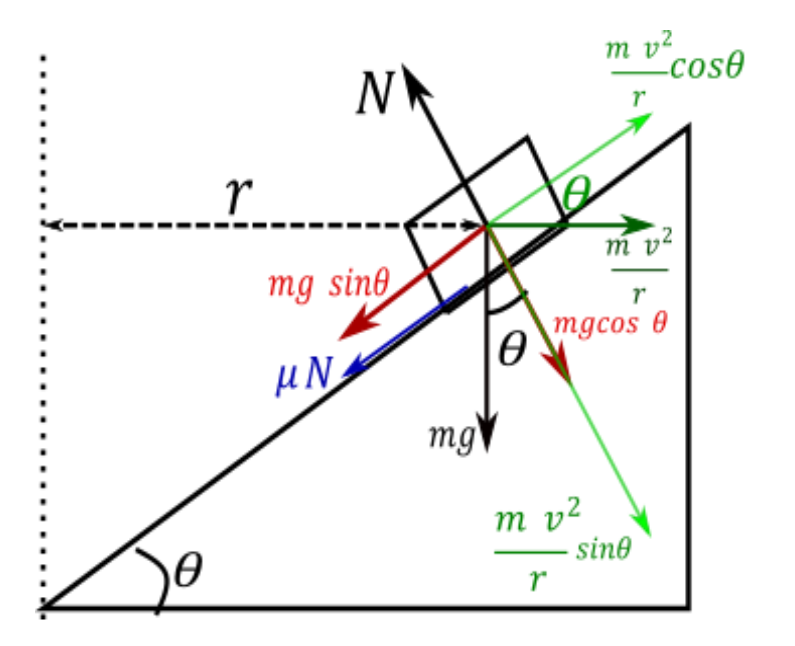
We assume two conditions one when a vehicle moves with maximum speed in this condition the vehicle may skid up if speed will increase.
In this situation friction between road and tyre is opposite to skidding direction as shown in figure
We mark all forces on vehicle as shown in figure and dividing them in their component
From figure clearly see that if vehicle is in equilibrium so the force acting on vehicle are equal along the road and perpendicular to the road
Force along the road
$ \Rightarrow mg\sin \theta + \mu N = \dfrac{{m{v^2}}}{r}\cos \theta $
Rearranging this equation
$ \Rightarrow \mu N = \dfrac{{m{v^2}}}{r}\cos \theta - mg\sin \theta $ ............ (2)
Now take forces perpendicular to road
$ \Rightarrow N = mg\cos \theta + \dfrac{{m{v^2}}}{r}\sin \theta $ ............... (3)
Divide (2) by (3)
$ \Rightarrow \mu = \dfrac{{\dfrac{{m{v^2}}}{r}\cos \theta - mg\sin \theta }}{{mg\cos \theta + \dfrac{{m{v^2}}}{r}\sin \theta }}$
Solving this equation we get
$ \Rightarrow \mu = \dfrac{{{v^2}\cos \theta - r\sin \theta }}{{rg\cos \theta + {v^2}\sin \theta }}$
Right hand side divided by $\cos \theta $
$ \Rightarrow \mu \left( {rg + {v^2}\tan \theta } \right) = {v^2} - rg\tan \theta $
Solving this we can find value of $v$ maximum velocity of vehicle where it will not skid
$ \Rightarrow v = \sqrt {\dfrac{{rg\tan \theta + \mu rg}}{{1 - \mu \tan \theta }}} $
Put the given values in this equation
$ \Rightarrow v = \sqrt {\dfrac{{20 \times 10 \times \dfrac{1}{2} + 0.4 \times 20 \times 10}}{{1 - 0.4 \times \dfrac{1}{2}}}} $
$ \Rightarrow v = \sqrt {225} $
$v = 15m/\sec $
Convert into $km/h$
Maximum speed $v = 54km/h$
Now we take the minimum speed case in this case friction applied in upward direction along the road as shown in figure.
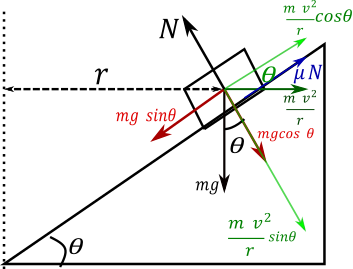
Equate Forces along road
$ \Rightarrow \mu N + \dfrac{{m{v^2}}}{r}\cos \theta = mg\sin \theta $
$ \Rightarrow \mu N = mg\sin \theta - \dfrac{{m{v^2}}}{r}\cos \theta $ .................. (4)
Forces perpendicular to road
$ \Rightarrow N = mg\cos \theta + \dfrac{{m{v^2}}}{r}\sin \theta $ ............... (5)
Divide (4) by (5)
$ \Rightarrow \mu = \dfrac{{mg\sin \theta - \dfrac{{m{v^2}}}{r}\cos \theta }}{{mg\cos \theta + \dfrac{{m{v^2}}}{r}\sin \theta }}$
Solving this we get
$ \Rightarrow \mu = \dfrac{{rg\sin \theta - {v^2}\cos \theta }}{{rg\cos \theta + {v^2}\sin \theta }}$
Divide right hand side by $\cos \theta $
$ \Rightarrow \mu = \dfrac{{rg\tan \theta - {v^2}}}{{rg + {v^2}\tan \theta }}$
Further solving it we get
$ \Rightarrow v = \sqrt {\dfrac{{rg\tan \theta - \mu rg}}{{\mu \tan \theta + 1}}} $
Putting given values in above equation
$ \Rightarrow v = \sqrt {\dfrac{{20 \times 10 \times \dfrac{1}{2} - 0.4 \times 20 \times 10}}{{0.4 \times \dfrac{1}{2} + 1}}} $
By solving this
$ \Rightarrow v = \sqrt {16.66} $
Minimum speed
$\therefore v = 4.08m/\sec $
Convert into $km/h$
$v = 4.08 \times \dfrac{{18}}{5} = 14.68km/h$
Hence the minimum speed is $14.7km/h$
Hence in this question option A is correct
Note:We get the range of speed of vehicle is $14.7km/h$ to $54km/h$ its means that if vehicle moves with slower speed then $14.7km/h$ than it will slip down because friction in upward direction can not provide sufficient centripetal force to take turn
And if a vehicle moving with higher speed then $54km/h$ then the friction force can not provide centripetal force to hold the vehicle so it will skid up.
We take two possible conditions when a vehicle moving its maximum speed means if it increases its speed now it will skid up. In this condition we mark all forces and balance them and same thing we will do for minimum speed friction gives required centripetal force for turn
Complete step by step answer:
In the question it is given radius of turn $r = 20m$ and banked with angle $\theta $ for speed $v = 36km/h = \dfrac{{36 \times 5}}{{18}} = 10m/\sec $
And coefficient of friction $\mu = 0.4$
From here we can find the value of $\tan \theta $
We know $\tan \theta = \dfrac{{{v^2}}}{{rg}}$
$ \Rightarrow \tan \theta = \dfrac{{{{10}^2}}}{{20 \times 10}} = \dfrac{1}{2}$ .............. (1)
We assume two conditions one when a vehicle moves with maximum speed in this condition the vehicle may skid up if speed will increase.
In this situation friction between road and tyre is opposite to skidding direction as shown in figure
We mark all forces on vehicle as shown in figure and dividing them in their component
From figure clearly see that if vehicle is in equilibrium so the force acting on vehicle are equal along the road and perpendicular to the road
Force along the road
$ \Rightarrow mg\sin \theta + \mu N = \dfrac{{m{v^2}}}{r}\cos \theta $
Rearranging this equation
$ \Rightarrow \mu N = \dfrac{{m{v^2}}}{r}\cos \theta - mg\sin \theta $ ............ (2)
Now take forces perpendicular to road
$ \Rightarrow N = mg\cos \theta + \dfrac{{m{v^2}}}{r}\sin \theta $ ............... (3)
Divide (2) by (3)
$ \Rightarrow \mu = \dfrac{{\dfrac{{m{v^2}}}{r}\cos \theta - mg\sin \theta }}{{mg\cos \theta + \dfrac{{m{v^2}}}{r}\sin \theta }}$
Solving this equation we get
$ \Rightarrow \mu = \dfrac{{{v^2}\cos \theta - r\sin \theta }}{{rg\cos \theta + {v^2}\sin \theta }}$
Right hand side divided by $\cos \theta $
$ \Rightarrow \mu \left( {rg + {v^2}\tan \theta } \right) = {v^2} - rg\tan \theta $
Solving this we can find value of $v$ maximum velocity of vehicle where it will not skid
$ \Rightarrow v = \sqrt {\dfrac{{rg\tan \theta + \mu rg}}{{1 - \mu \tan \theta }}} $
Put the given values in this equation
$ \Rightarrow v = \sqrt {\dfrac{{20 \times 10 \times \dfrac{1}{2} + 0.4 \times 20 \times 10}}{{1 - 0.4 \times \dfrac{1}{2}}}} $
$ \Rightarrow v = \sqrt {225} $
$v = 15m/\sec $
Convert into $km/h$
Maximum speed $v = 54km/h$
Now we take the minimum speed case in this case friction applied in upward direction along the road as shown in figure.
Equate Forces along road
$ \Rightarrow \mu N + \dfrac{{m{v^2}}}{r}\cos \theta = mg\sin \theta $
$ \Rightarrow \mu N = mg\sin \theta - \dfrac{{m{v^2}}}{r}\cos \theta $ .................. (4)
Forces perpendicular to road
$ \Rightarrow N = mg\cos \theta + \dfrac{{m{v^2}}}{r}\sin \theta $ ............... (5)
Divide (4) by (5)
$ \Rightarrow \mu = \dfrac{{mg\sin \theta - \dfrac{{m{v^2}}}{r}\cos \theta }}{{mg\cos \theta + \dfrac{{m{v^2}}}{r}\sin \theta }}$
Solving this we get
$ \Rightarrow \mu = \dfrac{{rg\sin \theta - {v^2}\cos \theta }}{{rg\cos \theta + {v^2}\sin \theta }}$
Divide right hand side by $\cos \theta $
$ \Rightarrow \mu = \dfrac{{rg\tan \theta - {v^2}}}{{rg + {v^2}\tan \theta }}$
Further solving it we get
$ \Rightarrow v = \sqrt {\dfrac{{rg\tan \theta - \mu rg}}{{\mu \tan \theta + 1}}} $
Putting given values in above equation
$ \Rightarrow v = \sqrt {\dfrac{{20 \times 10 \times \dfrac{1}{2} - 0.4 \times 20 \times 10}}{{0.4 \times \dfrac{1}{2} + 1}}} $
By solving this
$ \Rightarrow v = \sqrt {16.66} $
Minimum speed
$\therefore v = 4.08m/\sec $
Convert into $km/h$
$v = 4.08 \times \dfrac{{18}}{5} = 14.68km/h$
Hence the minimum speed is $14.7km/h$
Hence in this question option A is correct
Note:We get the range of speed of vehicle is $14.7km/h$ to $54km/h$ its means that if vehicle moves with slower speed then $14.7km/h$ than it will slip down because friction in upward direction can not provide sufficient centripetal force to take turn
And if a vehicle moving with higher speed then $54km/h$ then the friction force can not provide centripetal force to hold the vehicle so it will skid up.
Recently Updated Pages
Master Class 11 English: Engaging Questions & Answers for Success

Master Class 11 Social Science: Engaging Questions & Answers for Success
Master Class 11 Maths: Engaging Questions & Answers for Success
Master Class 11 Chemistry: Engaging Questions & Answers for Success
Master Class 11 Biology: Engaging Questions & Answers for Success
Master Class 11 Physics: Engaging Questions & Answers for Success
Trending doubts
One Metric ton is equal to kg A 10000 B 1000 C 100 class 11 physics CBSE
Difference Between Prokaryotic Cells and Eukaryotic Cells
Find the value of the expression given below sin 30circ class 11 maths CBSE
1 ton equals to A 100 kg B 1000 kg C 10 kg D 10000 class 11 physics CBSE
Two of the body parts which do not appear in MRI are class 11 biology CBSE
Draw a diagram of nephron and explain its structur class 11 biology CBSE