




A tunnel is made across the earth passing through its centre. A ball is dropped from a height h in the tunnel. The motion will be periodic with time period:
A) $2\pi \sqrt {\dfrac{R}{g}} + \sqrt {\dfrac{{2h}}{g}} $
B) $2\pi \sqrt {\dfrac{R}{g}} + 4\sqrt {\dfrac{h}{g}} $
C) $2\pi \sqrt {\dfrac{R}{g}} + 4\sqrt {\dfrac{{2h}}{g}} $
D) $2\pi \sqrt {\dfrac{R}{g}} + \sqrt {\dfrac{h}{g}} $
Answer
 Verified
585k+ views
Hint:In order to solve this question a student must always keep in mind that whatever may be the position of an object is, the force as well as the acceleration due to gravity will always be having a direction always towards the centre of the earth. Using this concept we can derive the time period for the ball in the given problem.
Complete step by step answer:
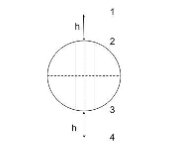
The ball is dropped from a point 1 at a height h above the surface. Thus during the entire motion, let the time taken by the ball to move move from 1 to 2 be t1, from 2 to 3 and 3 to 2 be t2, from 3 to 4 be t3
, from 4 to 3 be t4, and from 2 to 1 be t5
Let T be the time period of the complete motion.
Hence, for the motion from 1 to 2, we can write
$h = 0 + \dfrac{1}{2}gt_1^2$ $ \to {t_1} = \sqrt {\dfrac{{2h}}{g}} $
Similarly, we can write,
${t_3} = {t_4} = {t_5} = {t_1} = \sqrt {\dfrac{{2h}}{g}} $
The time period for executing the simple harmonic motion inside the tunnel is given by
$t = 2\pi \sqrt {\dfrac{R}{g}} $
Hence, the time period inside the tunnel i.e from 2 t 3 and 3 to 2 can be written as,
${t_2} = 2\pi \sqrt {\dfrac{R}{g}} $
Now, the total periodic time (T) is given by
$T = {t_1} + {t_2} + {t_3} + {t_4} + {t_5}$
Therefore,
$T = 2\pi \sqrt {\dfrac{R}{g}} + 4\sqrt {\dfrac{{2h}}{g}} $
Hence, option C is the correct choice.
Note:The main concept behind the derivation is that the acceleration due to gravity changes as the position of a body with respect to the centre of the earth changes. It is advisable to go through all such derivations for solving such problems.
Complete step by step answer:
The ball is dropped from a point 1 at a height h above the surface. Thus during the entire motion, let the time taken by the ball to move move from 1 to 2 be t1, from 2 to 3 and 3 to 2 be t2, from 3 to 4 be t3
, from 4 to 3 be t4, and from 2 to 1 be t5
Let T be the time period of the complete motion.
Hence, for the motion from 1 to 2, we can write
$h = 0 + \dfrac{1}{2}gt_1^2$ $ \to {t_1} = \sqrt {\dfrac{{2h}}{g}} $
Similarly, we can write,
${t_3} = {t_4} = {t_5} = {t_1} = \sqrt {\dfrac{{2h}}{g}} $
The time period for executing the simple harmonic motion inside the tunnel is given by
$t = 2\pi \sqrt {\dfrac{R}{g}} $
Hence, the time period inside the tunnel i.e from 2 t 3 and 3 to 2 can be written as,
${t_2} = 2\pi \sqrt {\dfrac{R}{g}} $
Now, the total periodic time (T) is given by
$T = {t_1} + {t_2} + {t_3} + {t_4} + {t_5}$
Therefore,
$T = 2\pi \sqrt {\dfrac{R}{g}} + 4\sqrt {\dfrac{{2h}}{g}} $
Hence, option C is the correct choice.
Note:The main concept behind the derivation is that the acceleration due to gravity changes as the position of a body with respect to the centre of the earth changes. It is advisable to go through all such derivations for solving such problems.
Recently Updated Pages
Master Class 11 Social Science: Engaging Questions & Answers for Success

Master Class 11 Physics: Engaging Questions & Answers for Success
Master Class 11 Maths: Engaging Questions & Answers for Success
Master Class 11 Economics: Engaging Questions & Answers for Success
Master Class 11 Computer Science: Engaging Questions & Answers for Success
Master Class 11 Chemistry: Engaging Questions & Answers for Success
Trending doubts
One Metric ton is equal to kg A 10000 B 1000 C 100 class 11 physics CBSE
There are 720 permutations of the digits 1 2 3 4 5 class 11 maths CBSE
1 Quintal is equal to a 110 kg b 10 kg c 100kg d 1000 class 11 physics CBSE
State and prove Bernoullis theorem class 11 physics CBSE
Difference Between Prokaryotic Cells and Eukaryotic Cells
Discuss the various forms of bacteria class 11 biology CBSE