




A tubular snout with terminal mouth occurs in
(a)Solea
(b)Hippocampus
(c)Echeneis
(d)Anguilla
Answer
 Verified
603.9k+ views
Hint: It belongs to the class of the bony fishes. Their body is found to be compressed bilaterally without any scales on the body but consists of dermal rings that divide into rings and parallel lines that are large and tough.
Complete answer:
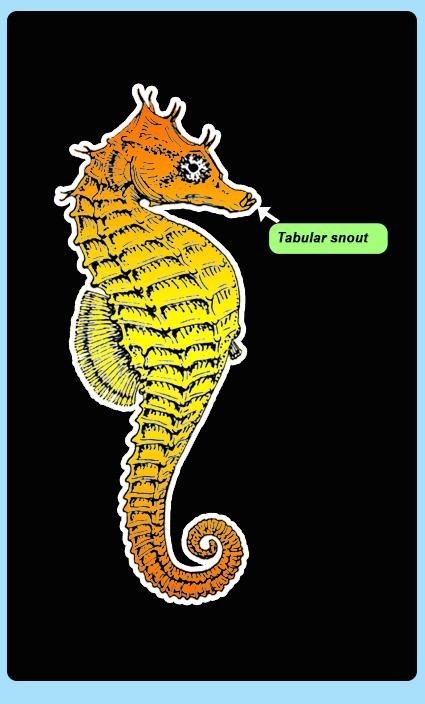
-A tubular snout is a kind of structure as an extended or elongated head with a mouth at its end. As in Hippocampus.
The eyes are also useful for spotting food as they move independently of one another, covering a broader visual field. Their menu mostly consists of plankton, small crustaceans, and anything small enough to fit through its snout and be swallowed whole.
-Hippocampus will remain motionless until a small animal passes within them such as a shrimp. Within a second, the seahorse will flick its head and suck its prey out of the water column through its long tubular snout. The hippocampus has no teeth or stomach, therefore prey that is caught is swallowed whole and passes rapidly through the digestive system.
Additional Information:
-The hippocampus plays a major role in spatial memory, navigation, and in some animals, episodic memory.
-Solea is one of the varieties of a flatfish found in temperate and tropical seas. They are flattened and are less elongated in body structure and are commercially valuable as they are consumed as food.
-Echeneis is a genus of suckerfish, present in brackish areas and around coral reefs. They have been used for fishing.
-Anguilla is a freshwater eel that has a snake-like body. They are cultured in marine and brackish water called Valliculture.
So, the correct answer is,” Hippocampus”.
Note: -Ancient Greek poets described Hippocampus as “a half-horse,half-fish mythical god”.
-Their biogeographic regions are - Indian ocean and the pacific ocean.
-Their aquatic biomes are reefs and coastal
-Until today, seahorse fossils found in Rimini, Italy are dated to 3,000,000 years ago.
Complete answer:
-A tubular snout is a kind of structure as an extended or elongated head with a mouth at its end. As in Hippocampus.
The eyes are also useful for spotting food as they move independently of one another, covering a broader visual field. Their menu mostly consists of plankton, small crustaceans, and anything small enough to fit through its snout and be swallowed whole.
-Hippocampus will remain motionless until a small animal passes within them such as a shrimp. Within a second, the seahorse will flick its head and suck its prey out of the water column through its long tubular snout. The hippocampus has no teeth or stomach, therefore prey that is caught is swallowed whole and passes rapidly through the digestive system.
Additional Information:
-The hippocampus plays a major role in spatial memory, navigation, and in some animals, episodic memory.
-Solea is one of the varieties of a flatfish found in temperate and tropical seas. They are flattened and are less elongated in body structure and are commercially valuable as they are consumed as food.
-Echeneis is a genus of suckerfish, present in brackish areas and around coral reefs. They have been used for fishing.
-Anguilla is a freshwater eel that has a snake-like body. They are cultured in marine and brackish water called Valliculture.
So, the correct answer is,” Hippocampus”.
Note: -Ancient Greek poets described Hippocampus as “a half-horse,half-fish mythical god”.
-Their biogeographic regions are - Indian ocean and the pacific ocean.
-Their aquatic biomes are reefs and coastal
-Until today, seahorse fossils found in Rimini, Italy are dated to 3,000,000 years ago.
Recently Updated Pages
Master Class 11 Social Science: Engaging Questions & Answers for Success

Master Class 11 English: Engaging Questions & Answers for Success
Master Class 11 Maths: Engaging Questions & Answers for Success
Master Class 11 Chemistry: Engaging Questions & Answers for Success
Master Class 11 Biology: Engaging Questions & Answers for Success
Master Class 11 Physics: Engaging Questions & Answers for Success
Trending doubts
Differentiate between an exothermic and an endothermic class 11 chemistry CBSE
One Metric ton is equal to kg A 10000 B 1000 C 100 class 11 physics CBSE
Difference Between Prokaryotic Cells and Eukaryotic Cells
There are 720 permutations of the digits 1 2 3 4 5 class 11 maths CBSE
Two of the body parts which do not appear in MRI are class 11 biology CBSE
Which gas is abundant in air class 11 chemistry CBSE