




A tube of a certain diameter and of length l is open at both the ends. The radius of tube is 2 cm, the end correction is
A. 1.2 cm
B. 0.6 cm
C. 2.4 cm
D. 4.8 cm
Answer
 Verified
614.4k+ views
Hint: End correction is a short distance which is added to the actual length of the resonance tube or a pipe to calculate the resonance frequency of it with precision. It depends mainly on the radius of the tube. Calculate the end correction using the below formula.
Formula Used: End correction of a tube with both the ends open is $2 \times 0.6 \times r$, where r is the radius of the tube.
Complete step by step answer:We are given to find the end correction of a double open ended tube with radius 2 cm.
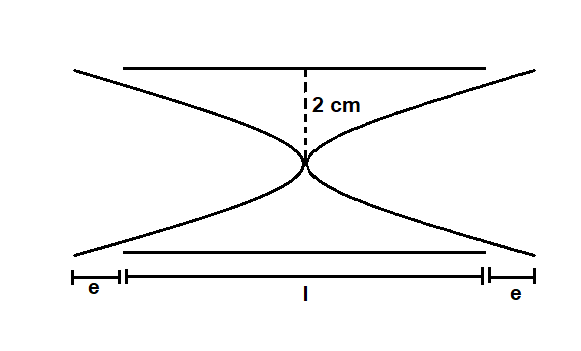
In a pipe which is open at both the ends, when air is blown into it through one end, a wave travels through it to the next end from where it is reflected.
End correction of a tube which is open at both the ends can be calculated by $0.6 \times d$, where d is the diameter of the tube, which can also be written as $0.6 \times 2 \times r$ as diameter is twice the radius.
Here the radius is 2 cm.
$e = 0.6 \times 2 \times 2 = 2.4cm$
This means a distance of 2.4 cm must be added to the length of tube to calculate the resonant frequency precisely.
Hence, the correct option is Option C.
Note:End correction is 0.3 times the diameter of a pipe or a tube for each end. When it is open at both the ends, then end correction must be added on both sides else only one side. Resonant frequency is different from natural frequency. Resonant frequency is for forced vibrations whereas natural frequency is for unforced vibrations which occur naturally. When a force is applied to the body in natural frequency, then it goes into resonance.
Formula Used: End correction of a tube with both the ends open is $2 \times 0.6 \times r$, where r is the radius of the tube.
Complete step by step answer:We are given to find the end correction of a double open ended tube with radius 2 cm.
In a pipe which is open at both the ends, when air is blown into it through one end, a wave travels through it to the next end from where it is reflected.
End correction of a tube which is open at both the ends can be calculated by $0.6 \times d$, where d is the diameter of the tube, which can also be written as $0.6 \times 2 \times r$ as diameter is twice the radius.
Here the radius is 2 cm.
$e = 0.6 \times 2 \times 2 = 2.4cm$
This means a distance of 2.4 cm must be added to the length of tube to calculate the resonant frequency precisely.
Hence, the correct option is Option C.
Note:End correction is 0.3 times the diameter of a pipe or a tube for each end. When it is open at both the ends, then end correction must be added on both sides else only one side. Resonant frequency is different from natural frequency. Resonant frequency is for forced vibrations whereas natural frequency is for unforced vibrations which occur naturally. When a force is applied to the body in natural frequency, then it goes into resonance.
Recently Updated Pages
Master Class 11 English: Engaging Questions & Answers for Success

Master Class 11 Social Science: Engaging Questions & Answers for Success
Master Class 11 Maths: Engaging Questions & Answers for Success
Master Class 11 Biology: Engaging Questions & Answers for Success
Master Class 11 Physics: Engaging Questions & Answers for Success
Master Class 11 Chemistry: Engaging Questions & Answers for Success
Trending doubts
One Metric ton is equal to kg A 10000 B 1000 C 100 class 11 physics CBSE
Difference Between Prokaryotic Cells and Eukaryotic Cells
Find the value of the expression given below sin 30circ class 11 maths CBSE
1 ton equals to A 100 kg B 1000 kg C 10 kg D 10000 class 11 physics CBSE
Two of the body parts which do not appear in MRI are class 11 biology CBSE
What are hard magnetic materials class 11 physics CBSE