




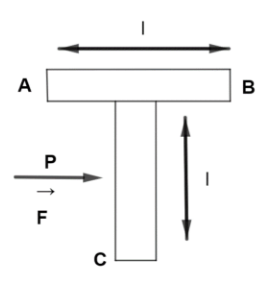
A T-shaped object with dimensions shown in the figure is lying on a smooth floor. A force F is applied at the point P parallel to AB, such that the object has only the translational motion without rotation. Find the location of P with respect to C.
Answer
 Verified
525k+ views
Hint: The T-shaped object with dimensions shown in the figure is lying on a smooth floor. A force F is applied at the point P parallel to AB, such that the object has only the translational motion without rotation. To find the location of P with respect to C.
Complete step by step answer:
To have the required motion, the force F has to be applied at the center of mass. The point P must be the center of mass of the T-shaped object since the force F does not produce any rotational motion of the object. The horizontal part of the T-shaped object has length L. If the mass of the horizontal portion is ‘m’, the mass of the vertical portion of the T- shaped object is 2m since its length is 2L.
Therefore, the T-shaped object reduces to two-point masses m and 2m at distances 2L and L respectively from the point C. The distance ‘r’ of the center of mass of the system from the point C is given by
$r = \dfrac{{{m_1}{r_1} + {m_2}{r_2}}}{{{m_1} + {m_2}}}$
Substituting the given values,
$ \Rightarrow r = \dfrac{{m \times 2L + 2m \times L}}{{m + 2m}}$
$ \therefore r = \dfrac{{4L}}{3}$
Therefore, $\dfrac{{4L}}{3}$ is the location of the p with respect to C.
Additional information: When a stationary body is subjected to external forces and if the body remains in the state of rest under the action of forces, it is said to be in equilibrium.According to the principle of equilibrium, a body is said to be in equilibrium if the algebraic sum of all forces acting on the body is zero, and also if the algebraic sum of moments of forces about any fixed point is zero.
A body is said to be in equilibrium if there is no translation and no rotation of the body under the application of external forces. Sometimes the resultant of the force system is not equal to zero. That means the body is not in equilibrium. The force which is required to keep the body in equilibrium, is known as equilibrant.
Note: Students should note that point P must be the center of mass of the T-shaped object since the force F does not produce any rotational motion of the object. Should know the concept of equilibrium of forces to solve this problem and the formulas used in the equilibrium of forces.
Complete step by step answer:
To have the required motion, the force F has to be applied at the center of mass. The point P must be the center of mass of the T-shaped object since the force F does not produce any rotational motion of the object. The horizontal part of the T-shaped object has length L. If the mass of the horizontal portion is ‘m’, the mass of the vertical portion of the T- shaped object is 2m since its length is 2L.
Therefore, the T-shaped object reduces to two-point masses m and 2m at distances 2L and L respectively from the point C. The distance ‘r’ of the center of mass of the system from the point C is given by
$r = \dfrac{{{m_1}{r_1} + {m_2}{r_2}}}{{{m_1} + {m_2}}}$
Substituting the given values,
$ \Rightarrow r = \dfrac{{m \times 2L + 2m \times L}}{{m + 2m}}$
$ \therefore r = \dfrac{{4L}}{3}$
Therefore, $\dfrac{{4L}}{3}$ is the location of the p with respect to C.
Additional information: When a stationary body is subjected to external forces and if the body remains in the state of rest under the action of forces, it is said to be in equilibrium.According to the principle of equilibrium, a body is said to be in equilibrium if the algebraic sum of all forces acting on the body is zero, and also if the algebraic sum of moments of forces about any fixed point is zero.
A body is said to be in equilibrium if there is no translation and no rotation of the body under the application of external forces. Sometimes the resultant of the force system is not equal to zero. That means the body is not in equilibrium. The force which is required to keep the body in equilibrium, is known as equilibrant.
Note: Students should note that point P must be the center of mass of the T-shaped object since the force F does not produce any rotational motion of the object. Should know the concept of equilibrium of forces to solve this problem and the formulas used in the equilibrium of forces.
Recently Updated Pages
Master Class 11 Economics: Engaging Questions & Answers for Success

Master Class 11 English: Engaging Questions & Answers for Success
Master Class 11 Maths: Engaging Questions & Answers for Success
Class 11 Question and Answer - Your Ultimate Solutions Guide
Master Class 11 Social Science: Engaging Questions & Answers for Success
Master Class 11 Business Studies: Engaging Questions & Answers for Success
Trending doubts
One Metric ton is equal to kg A 10000 B 1000 C 100 class 11 physics CBSE
There are 720 permutations of the digits 1 2 3 4 5 class 11 maths CBSE
Differentiate between an exothermic and an endothermic class 11 chemistry CBSE
In what year Guru Nanak Dev ji was born A15 April 1469 class 11 social science CBSE
Difference Between Prokaryotic Cells and Eukaryotic Cells
State and prove Bernoullis theorem class 11 physics CBSE