




A triangle has three vertices A (2,1,6), B (4,7,9), and C (8,5,-6). Determine the area of the triangle. Prove that the triangle is a right angle triangle?
Answer
 Verified
522k+ views
Hint: In a 3d space area of triangles or parallelograms can be found by using the cross product of any two adjacent sides. If two vectors are perpendicular they don’t have any kind of projection on each other so their dot product comes to be zero.
Complete step-by-step answer:
Area triangle in a 3d space can be calculated by taking the half of the magnitude of the cross product of any two sides. And to check whether the triangle is a right-angle triangle or not we need to take the dot product of sides, if any one of the dot products becomes zero then those sides are at right angles to each other and the triangle is a right-angle triangle.
So, here we have a triangle with coordinates as A (2,1,6), B (4,7,9), and C (8,5,-6).
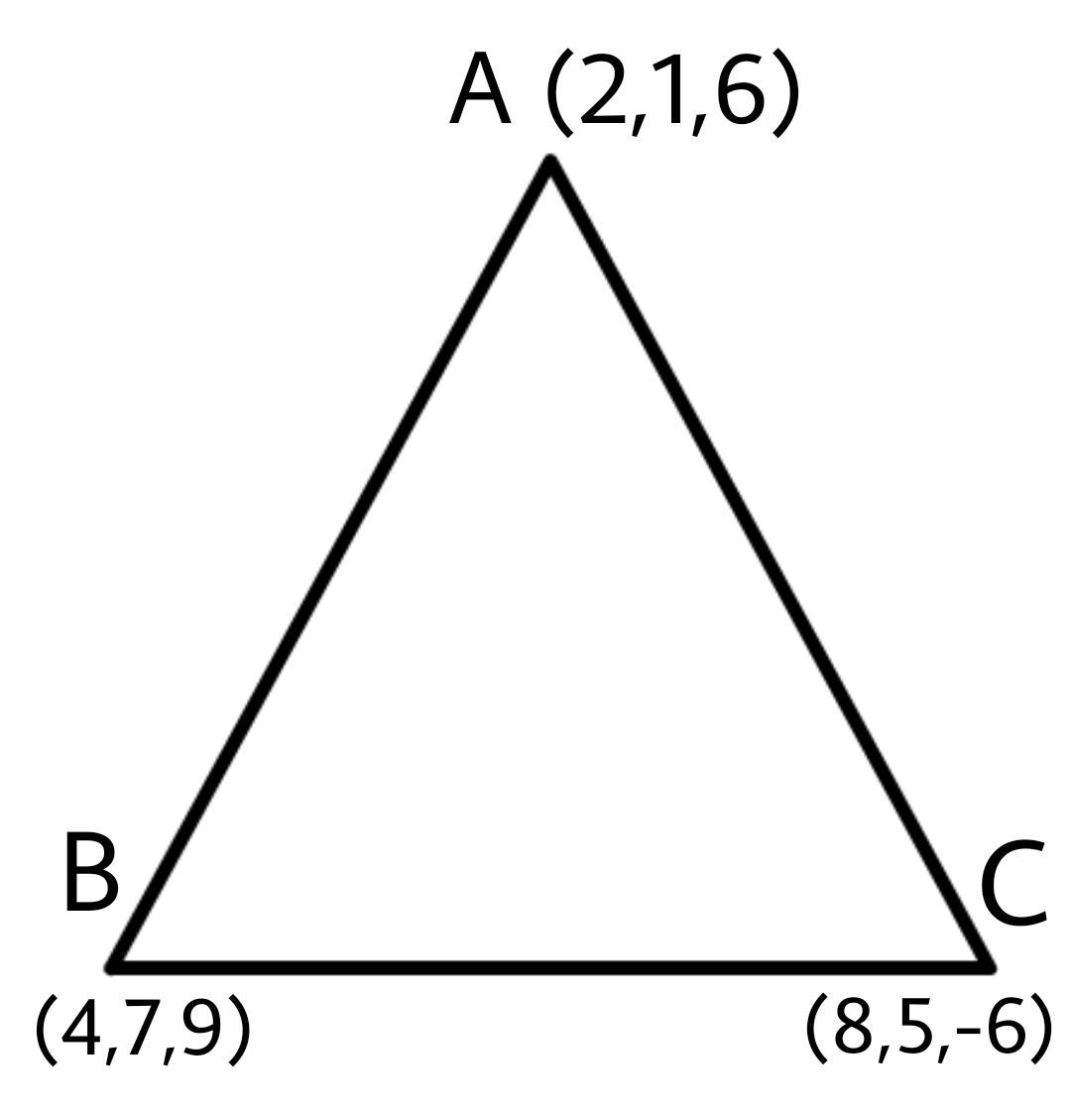
Let’s find the sides this is done by subtracting the coordinates:
For $\overrightarrow {AB} $ we will subtract the coordinates of A from the coordinates of B.
$\overrightarrow {AB} = \left( {4 - 2} \right)\widehat i + \left( {7 - 1} \right)\widehat j + \left( {9 - 6} \right)\widehat k$
$\overrightarrow {AB} = 2\widehat i + 6\widehat j + 3\widehat k$
For $\overrightarrow {BC} $ we will subtract the coordinates of B from the coordinates of C.
$\overrightarrow {BC} = \left( {8 - 4} \right)\widehat i + \left( {5 - 7} \right)\widehat j + \left( { - 6 - 9} \right)\widehat k$
\[\overrightarrow {BC} = 4\widehat i - 2\widehat j - 15\widehat k\]
For $\overrightarrow {AC} $ we will subtract the coordinates of A from the coordinates of C.
$\overrightarrow {AC} = \left( {8 - 2} \right)\widehat i + \left( {5 - 1} \right)\widehat j + \left( { - 6 - 6} \right)\widehat k$
\[\overrightarrow {AC} = 6\widehat i + 4\widehat j - 12\widehat k\]
Finding the area:
For area we will take the cross product of any two sides, let’s take $\overrightarrow {AB} $ and $\overrightarrow {AC} $
\[\overrightarrow {AB} \times \overrightarrow {AC} = \left( {\begin{array}{*{20}{c}}
{\widehat i}&{\widehat j}&{\widehat k} \\
2&6&3 \\
6&4&{ - 12}
\end{array}} \right)\]
\[\overrightarrow {AB} \times \overrightarrow {AC} = \widehat i\left( {6 \times \left( { - 12} \right) - 3 \times 4} \right) - \widehat j\left( {2 \times \left( { - 12} \right) - 3 \times 6} \right) + \widehat k\left( {2 \times 4 - 6 \times 6} \right)\]
\[\overrightarrow {AB} \times \overrightarrow {AC} = \widehat i\left( { - 72 - 12} \right) - \widehat j\left( { - 24 - 18} \right) + \widehat k\left( {8 - 36} \right)\]
\[\overrightarrow {AB} \times \overrightarrow {AC} = - 84\widehat i + 42\widehat j - 28\widehat k\]
Now let’s find the magnitude of \[\overrightarrow {AB} \times \overrightarrow {AC} \]:
$\left| {\overrightarrow {AB} \times \overrightarrow {AC} } \right| = \sqrt {{{\left( { - 84} \right)}^2} + {{\left( {42} \right)}^2} + {{\left( { - 28} \right)}^2}} $
$\left| {\overrightarrow {AB} \times \overrightarrow {AC} } \right| = \sqrt {7056 + 1764 + 784} $
$\left| {\overrightarrow {AB} \times \overrightarrow {AC} } \right| = \sqrt {9604} $
$\left| {\overrightarrow {AB} \times \overrightarrow {AC} } \right| = 98$
So the area is the half of the magnitude of the cross product of any two sides, that is half of $\left| {\overrightarrow {AB} \times \overrightarrow {AC} } \right|$
Area $ = \frac{1}{2}\left| {\overrightarrow {AB} \times \overrightarrow {AC} } \right|$
Area $ = \frac{1}{2} \times 98 = 49$
So the area of the triangle is 49 ${\left( {unit} \right)^2}$
Now let’s check whether the triangle is a right angle triangle or not by taking dot products of two sides. If the dot product comes to be zero, then the sides are perpendicular to each other
$\overrightarrow {AB} .\overrightarrow {BC} = \left( {2 \times 4} \right)\widehat i.\widehat i + \left( {6 \times \left( { - 2} \right)} \right)\widehat j.\widehat j + \left( {3 \times \left( { - 15} \right)} \right)\widehat k.\widehat k$
$\overrightarrow {AB} .\overrightarrow {BC} = 8 - 12 - 45$
$\overrightarrow {AB} .\overrightarrow {BC} = - 49 \ne 0$
$\overrightarrow {AB} .\overrightarrow {AC} = \left( {2 \times 6} \right)\widehat i.\widehat i + \left( {6 \times 4} \right)\widehat j.\widehat j + \left( {3 \times \left( { - 12} \right)} \right)\widehat k.\widehat k$
$\overrightarrow {AB} .\overrightarrow {AC} = 12 - 24 + 36$
$\overrightarrow {AB} .\overrightarrow {AC} = 0$
Now $\overrightarrow {AB} .\overrightarrow {AC} = 0$ so sides $\overrightarrow {AC} $and $\overrightarrow {AB} $ are perpendicular to each other thus the triangle is a right angle triangle.
So the area of the triangle ABC is 49 ${\left( {unit} \right)^2}$and the sides AC and AB are perpendicular to each other.
Note: When calculating the cross product of two vectors be very careful as the major error in that specific region only. Especially with the signs as we have to multiply with a negative sign for every alternate product.
Another method to determine whether the triangle is a right-angled triangle is by calculating the length of all sides and checking whether the three fit into a Pythagoras triplet or not.
Complete step-by-step answer:
Area triangle in a 3d space can be calculated by taking the half of the magnitude of the cross product of any two sides. And to check whether the triangle is a right-angle triangle or not we need to take the dot product of sides, if any one of the dot products becomes zero then those sides are at right angles to each other and the triangle is a right-angle triangle.
So, here we have a triangle with coordinates as A (2,1,6), B (4,7,9), and C (8,5,-6).
Let’s find the sides this is done by subtracting the coordinates:
For $\overrightarrow {AB} $ we will subtract the coordinates of A from the coordinates of B.
$\overrightarrow {AB} = \left( {4 - 2} \right)\widehat i + \left( {7 - 1} \right)\widehat j + \left( {9 - 6} \right)\widehat k$
$\overrightarrow {AB} = 2\widehat i + 6\widehat j + 3\widehat k$
For $\overrightarrow {BC} $ we will subtract the coordinates of B from the coordinates of C.
$\overrightarrow {BC} = \left( {8 - 4} \right)\widehat i + \left( {5 - 7} \right)\widehat j + \left( { - 6 - 9} \right)\widehat k$
\[\overrightarrow {BC} = 4\widehat i - 2\widehat j - 15\widehat k\]
For $\overrightarrow {AC} $ we will subtract the coordinates of A from the coordinates of C.
$\overrightarrow {AC} = \left( {8 - 2} \right)\widehat i + \left( {5 - 1} \right)\widehat j + \left( { - 6 - 6} \right)\widehat k$
\[\overrightarrow {AC} = 6\widehat i + 4\widehat j - 12\widehat k\]
Finding the area:
For area we will take the cross product of any two sides, let’s take $\overrightarrow {AB} $ and $\overrightarrow {AC} $
\[\overrightarrow {AB} \times \overrightarrow {AC} = \left( {\begin{array}{*{20}{c}}
{\widehat i}&{\widehat j}&{\widehat k} \\
2&6&3 \\
6&4&{ - 12}
\end{array}} \right)\]
\[\overrightarrow {AB} \times \overrightarrow {AC} = \widehat i\left( {6 \times \left( { - 12} \right) - 3 \times 4} \right) - \widehat j\left( {2 \times \left( { - 12} \right) - 3 \times 6} \right) + \widehat k\left( {2 \times 4 - 6 \times 6} \right)\]
\[\overrightarrow {AB} \times \overrightarrow {AC} = \widehat i\left( { - 72 - 12} \right) - \widehat j\left( { - 24 - 18} \right) + \widehat k\left( {8 - 36} \right)\]
\[\overrightarrow {AB} \times \overrightarrow {AC} = - 84\widehat i + 42\widehat j - 28\widehat k\]
Now let’s find the magnitude of \[\overrightarrow {AB} \times \overrightarrow {AC} \]:
$\left| {\overrightarrow {AB} \times \overrightarrow {AC} } \right| = \sqrt {{{\left( { - 84} \right)}^2} + {{\left( {42} \right)}^2} + {{\left( { - 28} \right)}^2}} $
$\left| {\overrightarrow {AB} \times \overrightarrow {AC} } \right| = \sqrt {7056 + 1764 + 784} $
$\left| {\overrightarrow {AB} \times \overrightarrow {AC} } \right| = \sqrt {9604} $
$\left| {\overrightarrow {AB} \times \overrightarrow {AC} } \right| = 98$
So the area is the half of the magnitude of the cross product of any two sides, that is half of $\left| {\overrightarrow {AB} \times \overrightarrow {AC} } \right|$
Area $ = \frac{1}{2}\left| {\overrightarrow {AB} \times \overrightarrow {AC} } \right|$
Area $ = \frac{1}{2} \times 98 = 49$
So the area of the triangle is 49 ${\left( {unit} \right)^2}$
Now let’s check whether the triangle is a right angle triangle or not by taking dot products of two sides. If the dot product comes to be zero, then the sides are perpendicular to each other
$\overrightarrow {AB} .\overrightarrow {BC} = \left( {2 \times 4} \right)\widehat i.\widehat i + \left( {6 \times \left( { - 2} \right)} \right)\widehat j.\widehat j + \left( {3 \times \left( { - 15} \right)} \right)\widehat k.\widehat k$
$\overrightarrow {AB} .\overrightarrow {BC} = 8 - 12 - 45$
$\overrightarrow {AB} .\overrightarrow {BC} = - 49 \ne 0$
$\overrightarrow {AB} .\overrightarrow {AC} = \left( {2 \times 6} \right)\widehat i.\widehat i + \left( {6 \times 4} \right)\widehat j.\widehat j + \left( {3 \times \left( { - 12} \right)} \right)\widehat k.\widehat k$
$\overrightarrow {AB} .\overrightarrow {AC} = 12 - 24 + 36$
$\overrightarrow {AB} .\overrightarrow {AC} = 0$
Now $\overrightarrow {AB} .\overrightarrow {AC} = 0$ so sides $\overrightarrow {AC} $and $\overrightarrow {AB} $ are perpendicular to each other thus the triangle is a right angle triangle.
So the area of the triangle ABC is 49 ${\left( {unit} \right)^2}$and the sides AC and AB are perpendicular to each other.
Note: When calculating the cross product of two vectors be very careful as the major error in that specific region only. Especially with the signs as we have to multiply with a negative sign for every alternate product.
Another method to determine whether the triangle is a right-angled triangle is by calculating the length of all sides and checking whether the three fit into a Pythagoras triplet or not.
Recently Updated Pages
Master Class 12 Business Studies: Engaging Questions & Answers for Success

Master Class 12 Chemistry: Engaging Questions & Answers for Success
Master Class 12 Biology: Engaging Questions & Answers for Success
Class 12 Question and Answer - Your Ultimate Solutions Guide
Master Class 11 English: Engaging Questions & Answers for Success
Master Class 11 Social Science: Engaging Questions & Answers for Success
Trending doubts
Which are the Top 10 Largest Countries of the World?
Draw a labelled sketch of the human eye class 12 physics CBSE
Differentiate between homogeneous and heterogeneous class 12 chemistry CBSE
Differentiate between Pyramid of energy and pyramid class 12 biology CBSE
Why is the cell called the structural and functional class 12 biology CBSE
Draw the diagram of the pyramid of energy Explain In class 12 biology CBSE