



A triangle has sides $A,B$ and $C$. Sides $A$ and $B$ are of lengths $5$ and $3$, respectively, and the angle between $A$ and $B$ is$\dfrac{\pi }{8}$ . What is the length of side $C$?
Answer
 Verified
487.2k+ views
Hint: First we have to identify what we are given in the question and hence identify what to do. SO, in the question, we are given the length of two sides of the triangle and the angle between them. We are required to find the third side. So, we will use the cosine rule to find the third side, which is the side opposite to the given angle. So, the cosine rule gives the formulas, ${c^2} = {a^2} + {b^2} - 2ab\cos C$, where $a, b$ and $c$ are the sides of the triangle and $C$ is the angle opposite to side $c$.
Complete step by step answer:
Given, the length of sides $A$ and $B$ of the triangle are $5$ and $3$. The angle between $A$ and $B$ is$\dfrac{\pi }{8}$.
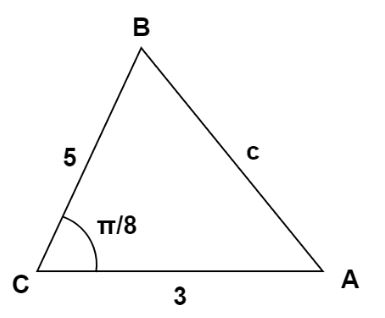
Let us name the angle as $\theta $. Now, we are to find the length of side $C$. Now, by using the cosine rule, we get,
${C^2} = {A^2} + {B^2} - 2AB\cos \theta $.......[$\theta $ is the angle opposite to side $C$]
Now, substituting the given values, we get,
$ \Rightarrow {C^2} = {\left( 5 \right)^2} + {\left( 3 \right)^2} - 2.\left( 5 \right).\left( 3 \right)\cos \dfrac{\pi }{8}$
$ \Rightarrow {C^2} = 25 + 9 - 30.\cos \dfrac{\pi }{8}$
We know, $\cos \theta = \dfrac{1}{2}\sqrt {1 + \cos 2\theta } $
So, using this formula, we get,
$ \Rightarrow {C^2} = 25 + 9 - 30.\dfrac{1}{2}\sqrt {1 + \cos \left( {2.\dfrac{\pi }{8}} \right)} $
$ \Rightarrow {C^2} = 34 - 15\sqrt {1 + \cos \left( {\dfrac{\pi }{4}} \right)} $
We know, $\cos \dfrac{\pi }{4} = \dfrac{1}{{\sqrt 2 }}$, so we get,
$ \Rightarrow {C^2} = 34 - 15\sqrt {1 + \dfrac{1}{{\sqrt 2 }}} $
$ \Rightarrow {C^2} = 34 - 15\sqrt {1 + 0.707} $
$ \Rightarrow {C^2} = 34 - 15\sqrt {1.707} $
$ \Rightarrow {C^2} = 34 - 15\left( {1.306} \right)$
Now, further simplifying, we get,
$ \Rightarrow {C^2} = 34 - 19.59$
$ \Rightarrow {C^2} = 14.41$
Now, taking square root on both sides, we get,
$ \therefore C = 3.796$
Therefore, the length of the third side $C$ is $3.796$.
Note: he cosine rule in case of triangles, there’s also the sine rule that gives the formula $\dfrac{{\sin A}}{a} = \dfrac{{\sin B}}{b} = \dfrac{{\sin C}}{c}$. It is more useful if two sides and corresponding angles are known or to be found. Cosine rule also helps us to relate the sides of sides with the angles as \[\cos A = {b^2} + {c^2} - {a^2} + 2bc\cos A\].
Complete step by step answer:
Given, the length of sides $A$ and $B$ of the triangle are $5$ and $3$. The angle between $A$ and $B$ is$\dfrac{\pi }{8}$.
Let us name the angle as $\theta $. Now, we are to find the length of side $C$. Now, by using the cosine rule, we get,
${C^2} = {A^2} + {B^2} - 2AB\cos \theta $.......[$\theta $ is the angle opposite to side $C$]
Now, substituting the given values, we get,
$ \Rightarrow {C^2} = {\left( 5 \right)^2} + {\left( 3 \right)^2} - 2.\left( 5 \right).\left( 3 \right)\cos \dfrac{\pi }{8}$
$ \Rightarrow {C^2} = 25 + 9 - 30.\cos \dfrac{\pi }{8}$
We know, $\cos \theta = \dfrac{1}{2}\sqrt {1 + \cos 2\theta } $
So, using this formula, we get,
$ \Rightarrow {C^2} = 25 + 9 - 30.\dfrac{1}{2}\sqrt {1 + \cos \left( {2.\dfrac{\pi }{8}} \right)} $
$ \Rightarrow {C^2} = 34 - 15\sqrt {1 + \cos \left( {\dfrac{\pi }{4}} \right)} $
We know, $\cos \dfrac{\pi }{4} = \dfrac{1}{{\sqrt 2 }}$, so we get,
$ \Rightarrow {C^2} = 34 - 15\sqrt {1 + \dfrac{1}{{\sqrt 2 }}} $
$ \Rightarrow {C^2} = 34 - 15\sqrt {1 + 0.707} $
$ \Rightarrow {C^2} = 34 - 15\sqrt {1.707} $
$ \Rightarrow {C^2} = 34 - 15\left( {1.306} \right)$
Now, further simplifying, we get,
$ \Rightarrow {C^2} = 34 - 19.59$
$ \Rightarrow {C^2} = 14.41$
Now, taking square root on both sides, we get,
$ \therefore C = 3.796$
Therefore, the length of the third side $C$ is $3.796$.
Note: he cosine rule in case of triangles, there’s also the sine rule that gives the formula $\dfrac{{\sin A}}{a} = \dfrac{{\sin B}}{b} = \dfrac{{\sin C}}{c}$. It is more useful if two sides and corresponding angles are known or to be found. Cosine rule also helps us to relate the sides of sides with the angles as \[\cos A = {b^2} + {c^2} - {a^2} + 2bc\cos A\].

Recently Updated Pages
Master Class 8 Social Science: Engaging Questions & Answers for Success

Master Class 8 English: Engaging Questions & Answers for Success
Class 8 Question and Answer - Your Ultimate Solutions Guide
Master Class 8 Maths: Engaging Questions & Answers for Success
Master Class 8 Science: Engaging Questions & Answers for Success
Master Class 7 English: Engaging Questions & Answers for Success
Trending doubts
Difference Between Plant Cell and Animal Cell
Fill the blanks with the suitable prepositions 1 The class 9 english CBSE
Who is eligible for RTE class 9 social science CBSE
Which places in India experience sunrise first and class 9 social science CBSE
What is pollution? How many types of pollution? Define it
Name 10 Living and Non living things class 9 biology CBSE