




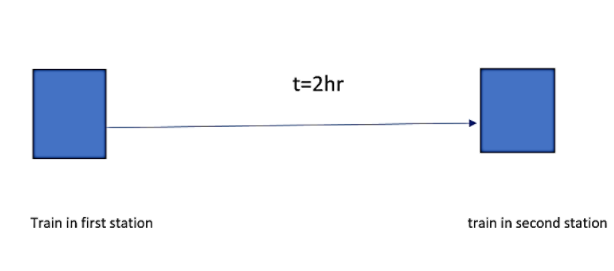
A train is moving from one station to another in two hours’ time, its speed during the motion. The maximum acceleration during the journey. Also calculate distance covered during the time interval from $0.75hr$ to $1.00hr$.
Answer
 Verified
590.7k+ views
Hint: In physics, acceleration is given as the rate of change of the velocity of an object with respect to the time. Acceleration is a vector quantity. The orientation of acceleration of an object is given by the orientation of the net force acting on that object.
Complete step by step answer:
First of all let us discuss the acceleration of an object in mechanics. The acceleration of a body is given as its variation in velocity over an increment of time. This can mean a variation in the speed of an object or its direction. Average acceleration is defined as the change of velocity happening over a period of time. Constant acceleration or the uniform acceleration is described when the velocity varies the same amount in every equal time period.
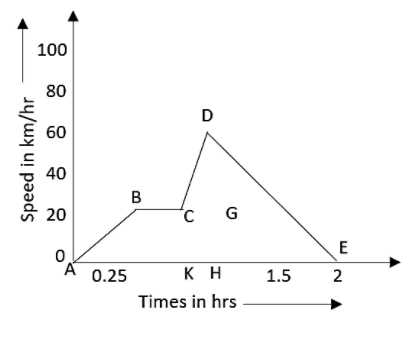
Here since acceleration is the rate of change of speed, it is expressed as the slope of the velocity time curve. Here the slope is largest in between $0.75hr$ and $1.00hr$ when we look into the graph.
Therefore the change in velocity is given as
$s=ut+\dfrac{1}{2}a{{t}^{2}}$ $=60-20km{{h}^{-1}}$
The acceleration in the interval $0.75hr$ to $1.00hr$ will be, change in velocity divided by change in time. That is,
$\begin{align}
& =\left( \dfrac{\left( 60-20 \right)km{{h}^{-1}}}{\left( 1-0.75 \right)h} \right)km{{h}^{-2}} \\
& =160km{{h}^{-1}} \\
\end{align}$
Now let us find out the distance travelled,
Newton’s equation will give,
$s=ut+\dfrac{1}{2}a{{t}^{2}}$
Substituting the terms given in the question,
$\begin{align}
& 20\times \dfrac{1}{4}+\dfrac{1}{2}\times 160\times {{\left( \dfrac{1}{4} \right)}^{2}} \\
& =10km \\
\end{align}$
Hence the problem is solved.
Note:
There's no limit for acceleration since acceleration is dependable on the magnitude of the force resulting in the acceleration and the magnitude of the mass being accelerated. Newton's Second Law of Motion states that acceleration occurs when a force acts on a mass or an object. Riding your bicycle is a perfect example of this law of motion at work.
Complete step by step answer:
First of all let us discuss the acceleration of an object in mechanics. The acceleration of a body is given as its variation in velocity over an increment of time. This can mean a variation in the speed of an object or its direction. Average acceleration is defined as the change of velocity happening over a period of time. Constant acceleration or the uniform acceleration is described when the velocity varies the same amount in every equal time period.
Here since acceleration is the rate of change of speed, it is expressed as the slope of the velocity time curve. Here the slope is largest in between $0.75hr$ and $1.00hr$ when we look into the graph.
Therefore the change in velocity is given as
$s=ut+\dfrac{1}{2}a{{t}^{2}}$ $=60-20km{{h}^{-1}}$
The acceleration in the interval $0.75hr$ to $1.00hr$ will be, change in velocity divided by change in time. That is,
$\begin{align}
& =\left( \dfrac{\left( 60-20 \right)km{{h}^{-1}}}{\left( 1-0.75 \right)h} \right)km{{h}^{-2}} \\
& =160km{{h}^{-1}} \\
\end{align}$
Now let us find out the distance travelled,
Newton’s equation will give,
$s=ut+\dfrac{1}{2}a{{t}^{2}}$
Substituting the terms given in the question,
$\begin{align}
& 20\times \dfrac{1}{4}+\dfrac{1}{2}\times 160\times {{\left( \dfrac{1}{4} \right)}^{2}} \\
& =10km \\
\end{align}$
Hence the problem is solved.
Note:
There's no limit for acceleration since acceleration is dependable on the magnitude of the force resulting in the acceleration and the magnitude of the mass being accelerated. Newton's Second Law of Motion states that acceleration occurs when a force acts on a mass or an object. Riding your bicycle is a perfect example of this law of motion at work.
Recently Updated Pages
Master Class 11 Social Science: Engaging Questions & Answers for Success

Master Class 11 Physics: Engaging Questions & Answers for Success
Master Class 11 Maths: Engaging Questions & Answers for Success
Master Class 11 Economics: Engaging Questions & Answers for Success
Master Class 11 Computer Science: Engaging Questions & Answers for Success
Master Class 11 Chemistry: Engaging Questions & Answers for Success
Trending doubts
There are 720 permutations of the digits 1 2 3 4 5 class 11 maths CBSE
1 Quintal is equal to a 110 kg b 10 kg c 100kg d 1000 class 11 physics CBSE
Which among the following are examples of coming together class 11 social science CBSE
Discuss the various forms of bacteria class 11 biology CBSE
What organs are located on the left side of your body class 11 biology CBSE
Draw a labelled diagram showing structure of LS of class 11 biology CBSE