




A train has to negotiate a curve of radius $400\,m$. By how much should the outer rail be raised with respect to the inner rail for a speed of $48\,kmph$. The distance between the rails is $1\,m$
A. $12\,m$
B. $12\,cm$
C. $4.5\,cm$
D. $4.5\,m$
Answer
 Verified
513.3k+ views
Hint:This question utilizes the concept of banking of roads. Here, the railway tracks are banked to prevent slipping of the train from its tracks. We can use the formula of banking of roads here with a few modifications and find out the answer.
Formulae used:
$\tan \theta = \dfrac{{{v^2}}}{{rg}}$
where $\theta $ is the angle of inclination, $r$ is the radius of the curve to be negotiated, $g$ is the acceleration due to gravity and $v$ is the velocity of the car/train.
$\tan \theta = \dfrac{h}{b}$
where $h$ is the height of the right angled triangle and $b$ is the base
Useful conversions:
$1\,kmph = \dfrac{5}{{18}}\,m{s^{ - 1}}$
Complete step by step answer:
According to the given question
Radius of the curve $r = 400\,m$
Velocity of the train $v = 48\,kmph$
Converting to SI unit, we have,
$v = 48 \times \dfrac{5}{{18}}\,m{s^{ - 1}} \\
\Rightarrow v= \dfrac{{40}}{3}\,m{s^{ - 1}}$
Acceleration due to gravity $g = 9.8\,m{s^{ - 1}}$
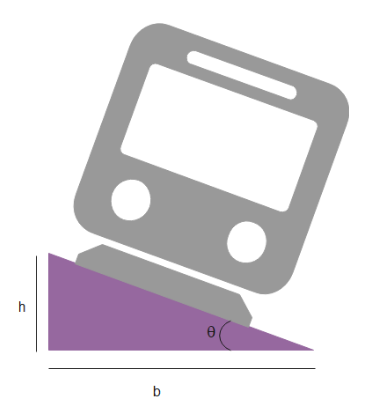
Applying $\tan \theta = \dfrac{h}{b}$ here, where $h$ is the elevation of the outer rail from the inner one and the distance between two rails is given as $b = 1m$
We have
$\tan \theta = \dfrac{h}{1}$ ----(i)
Also we know
$\tan \theta = \dfrac{{{v^2}}}{{rg}}$ -----(ii)
Merging eq (i) and (ii) , we have
$\Rightarrow \dfrac{{{v^2}}}{{rg}} = \dfrac{h}{{1m}} \\$
Substituting the respective values, we have
$ \Rightarrow \dfrac{{{{\left( {\dfrac{{40}}{3}m{s^{ - 1}}} \right)}^2}}}{{400m \times 9.8m{s^{ - 2}}}} = \dfrac{h}{{1m}}$
$\Rightarrow h = 0.0045m \\
\therefore h = 4.5\,cm $
Thus, the correct answer is option C.
Note:Normally, this track can take the above velocity with ease in this situation. But in real life scenarios, the velocity can be increased even more because friction comes into play. Also, tracks are made to withstand about $3$ to $4$ times more than the maximum velocity to prevent any accident.
Formulae used:
$\tan \theta = \dfrac{{{v^2}}}{{rg}}$
where $\theta $ is the angle of inclination, $r$ is the radius of the curve to be negotiated, $g$ is the acceleration due to gravity and $v$ is the velocity of the car/train.
$\tan \theta = \dfrac{h}{b}$
where $h$ is the height of the right angled triangle and $b$ is the base
Useful conversions:
$1\,kmph = \dfrac{5}{{18}}\,m{s^{ - 1}}$
Complete step by step answer:
According to the given question
Radius of the curve $r = 400\,m$
Velocity of the train $v = 48\,kmph$
Converting to SI unit, we have,
$v = 48 \times \dfrac{5}{{18}}\,m{s^{ - 1}} \\
\Rightarrow v= \dfrac{{40}}{3}\,m{s^{ - 1}}$
Acceleration due to gravity $g = 9.8\,m{s^{ - 1}}$
Applying $\tan \theta = \dfrac{h}{b}$ here, where $h$ is the elevation of the outer rail from the inner one and the distance between two rails is given as $b = 1m$
We have
$\tan \theta = \dfrac{h}{1}$ ----(i)
Also we know
$\tan \theta = \dfrac{{{v^2}}}{{rg}}$ -----(ii)
Merging eq (i) and (ii) , we have
$\Rightarrow \dfrac{{{v^2}}}{{rg}} = \dfrac{h}{{1m}} \\$
Substituting the respective values, we have
$ \Rightarrow \dfrac{{{{\left( {\dfrac{{40}}{3}m{s^{ - 1}}} \right)}^2}}}{{400m \times 9.8m{s^{ - 2}}}} = \dfrac{h}{{1m}}$
$\Rightarrow h = 0.0045m \\
\therefore h = 4.5\,cm $
Thus, the correct answer is option C.
Note:Normally, this track can take the above velocity with ease in this situation. But in real life scenarios, the velocity can be increased even more because friction comes into play. Also, tracks are made to withstand about $3$ to $4$ times more than the maximum velocity to prevent any accident.
Recently Updated Pages
Master Class 11 Social Science: Engaging Questions & Answers for Success

Master Class 11 Physics: Engaging Questions & Answers for Success
Master Class 11 Maths: Engaging Questions & Answers for Success
Master Class 11 Economics: Engaging Questions & Answers for Success
Master Class 11 Computer Science: Engaging Questions & Answers for Success
Master Class 11 Chemistry: Engaging Questions & Answers for Success
Trending doubts
One Metric ton is equal to kg A 10000 B 1000 C 100 class 11 physics CBSE
There are 720 permutations of the digits 1 2 3 4 5 class 11 maths CBSE
1 Quintal is equal to a 110 kg b 10 kg c 100kg d 1000 class 11 physics CBSE
State and prove Bernoullis theorem class 11 physics CBSE
Difference Between Prokaryotic Cells and Eukaryotic Cells
Which among the following are examples of coming together class 11 social science CBSE