




A toy is in the form of a cone of radius 3.5 cm mounted on a hemisphere of the same radius. The total height of the toy is 15.5 cm. Find the total surface area of the toy.
Answer
 Verified
584.7k+ views
Hint:
Find the curved surface area of the cone and the hemisphere respectively and then add them up to get the total surface area of the toy.
Curved surface area of the hemisphere\[ = 2\pi {r^2}\]
Curved surface area of the cone\[ = \pi rl\]
Complete step by step solution:
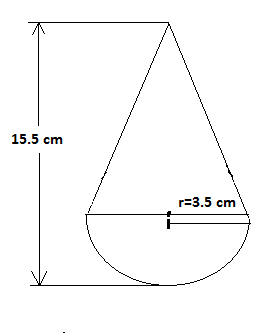
Given the toy is in the form of a cone mounted over a hemisphere as shown in the diagram below, hence to find the total surface area first find the curved surface area of the hemisphere and then the cone and then we will add them up
Curved surface area of the hemisphere:
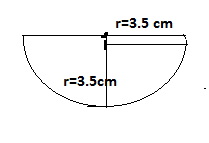
Given radius \[r = 3.5cm\]
Curved surface area of the hemisphere is given by the formula \[ = 2\pi {r^2} - - (i)\]
Hence by substituting the value of r in the formula, we get
\[
CS{A_1} = 2\pi {r^2} \\
= 2 \times \dfrac{{22}}{7} \times 3.5 \times 3.5 \\
= 22 \times 3.5 \\
= 77c{m^2} \\
\]
Curved surface area of the cone:
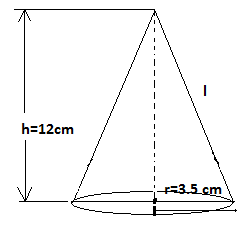
Curved surface area of the cone is given by the formula \[ = \pi rl - - (ii)\]
Where, the radius of the cone \[r = 3.5cm\]
Height of cone (h) = height of toy –Height of hemisphere\[ = 15.5 - 3.5 = 12cm\]
Now for slant height of the cone, by using Pythagoras theorem, we can write
\[{l^2} = {h^2} + {r^2} - - (iii)\]
Hence by substituting the value of height and radius, we get
\[
{l^2} = {h^2} + {r^2} \\
{l^2} = {\left( {12} \right)^2} + {\left( {3.5} \right)^2} \\
l = \sqrt {144 + 12.25} \\
l = \sqrt {156.25} \\
l = 12.5cm \\
\]
Hence the curved surface area of the cone will be
\[
CS{A_2} = \pi rl \\
= \dfrac{{22}}{7} \times 3.5 \times 12.5 \\
= 11 \times 12.5 \\
= 137.5c{m^2} \\
\]
Therefore the total surface area of the toy which is the sum of the curved surface area of a cone and the hemisphere will be
\[
TSA = CS{A_1} + CS{A_2} \\
= 77 + 137.5 \\
= 214.5c{m^2} \\
\]
Therefore the total surface area of the toy \[ = 214.5c{m^2}\]
Note:
Students should note that whenever they are given a composite figure to find their area, volume, surface area, they must separate that figure in regular geometrical shapes the find their area, surface area and then they must add them up.
Find the curved surface area of the cone and the hemisphere respectively and then add them up to get the total surface area of the toy.
Curved surface area of the hemisphere\[ = 2\pi {r^2}\]
Curved surface area of the cone\[ = \pi rl\]
Complete step by step solution:
Given the toy is in the form of a cone mounted over a hemisphere as shown in the diagram below, hence to find the total surface area first find the curved surface area of the hemisphere and then the cone and then we will add them up
Curved surface area of the hemisphere:
Given radius \[r = 3.5cm\]
Curved surface area of the hemisphere is given by the formula \[ = 2\pi {r^2} - - (i)\]
Hence by substituting the value of r in the formula, we get
\[
CS{A_1} = 2\pi {r^2} \\
= 2 \times \dfrac{{22}}{7} \times 3.5 \times 3.5 \\
= 22 \times 3.5 \\
= 77c{m^2} \\
\]
Curved surface area of the cone:
Curved surface area of the cone is given by the formula \[ = \pi rl - - (ii)\]
Where, the radius of the cone \[r = 3.5cm\]
Height of cone (h) = height of toy –Height of hemisphere\[ = 15.5 - 3.5 = 12cm\]
Now for slant height of the cone, by using Pythagoras theorem, we can write
\[{l^2} = {h^2} + {r^2} - - (iii)\]
Hence by substituting the value of height and radius, we get
\[
{l^2} = {h^2} + {r^2} \\
{l^2} = {\left( {12} \right)^2} + {\left( {3.5} \right)^2} \\
l = \sqrt {144 + 12.25} \\
l = \sqrt {156.25} \\
l = 12.5cm \\
\]
Hence the curved surface area of the cone will be
\[
CS{A_2} = \pi rl \\
= \dfrac{{22}}{7} \times 3.5 \times 12.5 \\
= 11 \times 12.5 \\
= 137.5c{m^2} \\
\]
Therefore the total surface area of the toy which is the sum of the curved surface area of a cone and the hemisphere will be
\[
TSA = CS{A_1} + CS{A_2} \\
= 77 + 137.5 \\
= 214.5c{m^2} \\
\]
Therefore the total surface area of the toy \[ = 214.5c{m^2}\]
Note:
Students should note that whenever they are given a composite figure to find their area, volume, surface area, they must separate that figure in regular geometrical shapes the find their area, surface area and then they must add them up.
Recently Updated Pages
Master Class 10 Computer Science: Engaging Questions & Answers for Success

Master Class 10 General Knowledge: Engaging Questions & Answers for Success
Master Class 10 English: Engaging Questions & Answers for Success
Master Class 10 Social Science: Engaging Questions & Answers for Success
Master Class 10 Maths: Engaging Questions & Answers for Success
Master Class 10 Science: Engaging Questions & Answers for Success
Trending doubts
What is the median of the first 10 natural numbers class 10 maths CBSE
Which women's tennis player has 24 Grand Slam singles titles?
Who is the Brand Ambassador of Incredible India?
Why is there a time difference of about 5 hours between class 10 social science CBSE
Write a letter to the principal requesting him to grant class 10 english CBSE
A moving boat is observed from the top of a 150 m high class 10 maths CBSE