




A tower \[{T_1}\] of height 60m is located exactly opposite to a tower \[{T_2}\]of height 80m on a straight road. From the top of \[{T_1}\] , if the angle of depression of the foot of \[{T_2}\] , is twice the angle of elevation of the top of \[{T_1}\], then the width ( in m ) of the road between the feet of the towers \[{T_1}\] and \[{T_2}\] is:
\[A.{\text{ }}10\sqrt 2 \]
\[B.{\text{ }}10\sqrt 3 \]
\[C.20\sqrt 3 \]
\[D.20\sqrt 2 \]
Answer
 Verified
657.3k+ views
Hint :- We had to assume the distance between the road from the feet of tower ( \[{T_1}\] ) and tower ( \[{T_2}\] ) and then by using the trigonometric formulas such as \[\tan \theta = \dfrac{{{\text{Height}}}}{{{\text{Base}}}}\] and \[\cot \theta = \dfrac{1}{{\tan \theta }} = \dfrac{{{\text{Base}}}}{{{\text{Height}}}}\]. Then after solving these equations we will get the distance of cars from the tower.
Complete step by step solution:
Let us assume that the distance between the road from the feet of tower( \[{T_1}\] ) and tower ( \[{T_2}\] ) is equal to x metres.
Now let us assume that the angle of elevation from top of \[{T_1}\] is \[\theta \].
So, according to the question , the angle of the depression of the foot of \[{T_2}\] must be \[2\theta \].
Now let us understand this all with the help of a diagram that is given below
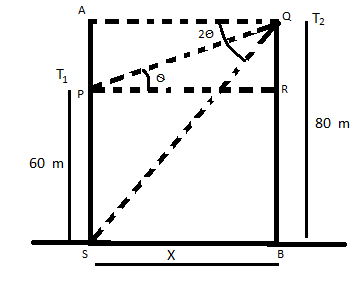
So, now according to the diagram we can say \[\angle QPR = \theta \]and \[\angle AQS = 2\theta \].
Now as we know that \[\tan \theta = \dfrac{{perpendicular}}{{base}}\].
So, applying \[\tan \theta \] in \[\Delta QPR\]
\[ \Rightarrow \tan \theta = \dfrac{{perpendicular}}{{base}} = \dfrac{{QR}}{{PR}}\]
And now QR = QB – RB and PR = SB so can say that QR = 80 – 60 = 20 and PR = x
\[ \Rightarrow \tan \theta = \dfrac{{20}}{x}\]
Now as we know that in \[\Delta AQS\],\[\theta \] becomes \[2\theta \] so now applying \[\tan 2\theta \] in \[\Delta AQS\]
\[ \Rightarrow \tan 2\theta = \dfrac{{AS}}{{AQ}}\] ( AS = QB and AQ = SB )
\[ \Rightarrow \tan 2\theta = \dfrac{{80}}{x}\]
Now the width of road between the feet of both towers must be equal and we know that \[\tan 2\theta = \dfrac{{2\tan \theta }}{{1 - {{\tan }^2}\theta }}\].
So, using the above identity to solve the question
\[\tan 2\theta = \dfrac{{2\tan \theta }}{{1 - {{\tan }^2}\theta }}\]
\[ \Rightarrow \dfrac{{80}}{x} = \dfrac{{2 \times \dfrac{{20}}{x}}}{{1 - {{\left( {\dfrac{{20}}{x}} \right)}^2}}}\] ( \[\tan 2\theta = \dfrac{{80}}{x}\] and \[\tan \theta = \dfrac{{20}}{x}\] )
Now taking L.C.M of denominator of R.H.S and solving it
\[ \Rightarrow \dfrac{{80}}{x} = \dfrac{{\dfrac{{40}}{x}}}{{\dfrac{{{x^2} - 400}}{{{x^2}}}}}\]
\[ \Rightarrow \dfrac{{80}}{x} = {\text{ }}\dfrac{{40}}{x}{\text{ }} \times {\text{ }}\dfrac{{{x^2}}}{{{x^2} - 400}}\]
Now taking \[\dfrac{{40}}{x}\] common from both L.H.S and R.H.S
\[ \Rightarrow 2 = {\text{ }}\dfrac{{{x^2}}}{{{x^2} - 400}}\]
On cross multiplying we will get
\[ \Rightarrow 2{x^2} - 800 = {x^2}\]
\[ \Rightarrow 2{x^2} - {x^2} = 800\]
\[ \Rightarrow {x^2} = 800{\text{, x}}\,{\text{ = }}\sqrt {800} = 20\sqrt 2 \]
So, the width of roads between the feets of towers is \[20\sqrt 2 \]m
Hence D is the correct option.
Note :- Whenever we come up with this type of problem then we should remember that there is one another way to solve it. i.e. apart from using the trigonometric formula of \[\tan \theta \] we can also use \[\cot \theta \]. And in that case according to the trigonometric formula the values became vice versa .
Complete step by step solution:
Let us assume that the distance between the road from the feet of tower( \[{T_1}\] ) and tower ( \[{T_2}\] ) is equal to x metres.
Now let us assume that the angle of elevation from top of \[{T_1}\] is \[\theta \].
So, according to the question , the angle of the depression of the foot of \[{T_2}\] must be \[2\theta \].
Now let us understand this all with the help of a diagram that is given below
So, now according to the diagram we can say \[\angle QPR = \theta \]and \[\angle AQS = 2\theta \].
Now as we know that \[\tan \theta = \dfrac{{perpendicular}}{{base}}\].
So, applying \[\tan \theta \] in \[\Delta QPR\]
\[ \Rightarrow \tan \theta = \dfrac{{perpendicular}}{{base}} = \dfrac{{QR}}{{PR}}\]
And now QR = QB – RB and PR = SB so can say that QR = 80 – 60 = 20 and PR = x
\[ \Rightarrow \tan \theta = \dfrac{{20}}{x}\]
Now as we know that in \[\Delta AQS\],\[\theta \] becomes \[2\theta \] so now applying \[\tan 2\theta \] in \[\Delta AQS\]
\[ \Rightarrow \tan 2\theta = \dfrac{{AS}}{{AQ}}\] ( AS = QB and AQ = SB )
\[ \Rightarrow \tan 2\theta = \dfrac{{80}}{x}\]
Now the width of road between the feet of both towers must be equal and we know that \[\tan 2\theta = \dfrac{{2\tan \theta }}{{1 - {{\tan }^2}\theta }}\].
So, using the above identity to solve the question
\[\tan 2\theta = \dfrac{{2\tan \theta }}{{1 - {{\tan }^2}\theta }}\]
\[ \Rightarrow \dfrac{{80}}{x} = \dfrac{{2 \times \dfrac{{20}}{x}}}{{1 - {{\left( {\dfrac{{20}}{x}} \right)}^2}}}\] ( \[\tan 2\theta = \dfrac{{80}}{x}\] and \[\tan \theta = \dfrac{{20}}{x}\] )
Now taking L.C.M of denominator of R.H.S and solving it
\[ \Rightarrow \dfrac{{80}}{x} = \dfrac{{\dfrac{{40}}{x}}}{{\dfrac{{{x^2} - 400}}{{{x^2}}}}}\]
\[ \Rightarrow \dfrac{{80}}{x} = {\text{ }}\dfrac{{40}}{x}{\text{ }} \times {\text{ }}\dfrac{{{x^2}}}{{{x^2} - 400}}\]
Now taking \[\dfrac{{40}}{x}\] common from both L.H.S and R.H.S
\[ \Rightarrow 2 = {\text{ }}\dfrac{{{x^2}}}{{{x^2} - 400}}\]
On cross multiplying we will get
\[ \Rightarrow 2{x^2} - 800 = {x^2}\]
\[ \Rightarrow 2{x^2} - {x^2} = 800\]
\[ \Rightarrow {x^2} = 800{\text{, x}}\,{\text{ = }}\sqrt {800} = 20\sqrt 2 \]
So, the width of roads between the feets of towers is \[20\sqrt 2 \]m
Hence D is the correct option.
Note :- Whenever we come up with this type of problem then we should remember that there is one another way to solve it. i.e. apart from using the trigonometric formula of \[\tan \theta \] we can also use \[\cot \theta \]. And in that case according to the trigonometric formula the values became vice versa .
Recently Updated Pages
Class 10 Question and Answer - Your Ultimate Solutions Guide

Master Class 10 Computer Science: Engaging Questions & Answers for Success
Master Class 10 General Knowledge: Engaging Questions & Answers for Success
Master Class 12 Economics: Engaging Questions & Answers for Success
Master Class 12 Social Science: Engaging Questions & Answers for Success
Master Class 12 English: Engaging Questions & Answers for Success
Trending doubts
Explain the Treaty of Vienna of 1815 class 10 social science CBSE
The slogan Jai Hind was given by A Lal Bahadur Shastri class 10 social science CBSE
10 examples of evaporation in daily life with explanations
What is the full form of POSCO class 10 social science CBSE
Identify the feminine form of noun nephew a shenephew class 10 english CBSE
CSIR full form?