




A tower subtends an angle of $30^o$ at a point on the same level at its foot. At a second point h metres above the first, the depression of the foot of the tower is $60^o$. The height of the tower is-
$
{\text{A}}.\;\dfrac{{\text{h}}}{2}{\text{m}} \\
{\text{B}}.\;\sqrt 3 {\text{h}}\;{\text{m}} \\
{\text{C}}.\;\dfrac{{\text{h}}}{3}\;{\text{m}} \\
{\text{D}}.\;\dfrac{{\text{h}}}{{\sqrt 3 }}\;{\text{m}} \\
$
Answer
 Verified
527.5k+ views
Hint: The angle of elevation is the angle above the eye level of the observer towards a given point. The angle of depression is the angle below the eye level of the observer towards a given point. The tangent function is the ratio of the opposite side and the adjacent side.
Complete step-by-step answer:
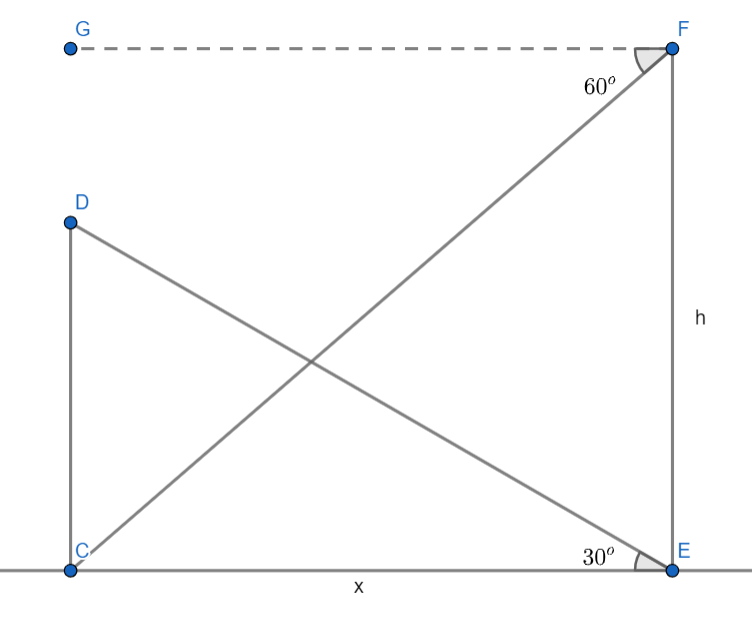
We have to find the height of the tower CD. Let E be the point on the ground where the tower subtends $30^o$, and F be the point at a height of h m above E. Let CE = x. We will apply trigonometric formulas in triangles DCE and FEC.
$
In\;\vartriangle DCE, \\
\tan {30^{\text{o}}} = \dfrac{{DC}}{{CE}} \\
\dfrac{1}{{\sqrt 3 }} = \dfrac{{DC}}{{\text{x}}} \\
DC = \dfrac{{\text{x}}}{{\sqrt 3 }} \\
$
$
\angle CFG\;and\angle FCE\;are\;alternate\;interior\;angles\;and\;are\;equal. \\
In\;\vartriangle FCE, \\
\tan {60^{\text{o}}} = \dfrac{{EF}}{{CE}} \\
\sqrt 3 = \dfrac{{\text{h}}}{{\text{x}}} \\
{\text{x}} = \dfrac{{\text{h}}}{{\sqrt 3 }} \\
$
Substituting this value of x in the other equation,
$
DC = \dfrac{{\text{h}}}{{\sqrt 3 \left( {\sqrt 3 } \right)}} \\
DC = \dfrac{{\text{h}}}{3} \\
$
Hence, the correct option is C.
Note: In such types of questions, it is important to read the language of the question carefully and draw the diagram step by step correctly. When the diagram is drawn, we just have to apply basic trigonometry to find the required answer.
Complete step-by-step answer:
We have to find the height of the tower CD. Let E be the point on the ground where the tower subtends $30^o$, and F be the point at a height of h m above E. Let CE = x. We will apply trigonometric formulas in triangles DCE and FEC.
$
In\;\vartriangle DCE, \\
\tan {30^{\text{o}}} = \dfrac{{DC}}{{CE}} \\
\dfrac{1}{{\sqrt 3 }} = \dfrac{{DC}}{{\text{x}}} \\
DC = \dfrac{{\text{x}}}{{\sqrt 3 }} \\
$
$
\angle CFG\;and\angle FCE\;are\;alternate\;interior\;angles\;and\;are\;equal. \\
In\;\vartriangle FCE, \\
\tan {60^{\text{o}}} = \dfrac{{EF}}{{CE}} \\
\sqrt 3 = \dfrac{{\text{h}}}{{\text{x}}} \\
{\text{x}} = \dfrac{{\text{h}}}{{\sqrt 3 }} \\
$
Substituting this value of x in the other equation,
$
DC = \dfrac{{\text{h}}}{{\sqrt 3 \left( {\sqrt 3 } \right)}} \\
DC = \dfrac{{\text{h}}}{3} \\
$
Hence, the correct option is C.
Note: In such types of questions, it is important to read the language of the question carefully and draw the diagram step by step correctly. When the diagram is drawn, we just have to apply basic trigonometry to find the required answer.
Recently Updated Pages
Master Class 10 Computer Science: Engaging Questions & Answers for Success

Master Class 10 General Knowledge: Engaging Questions & Answers for Success
Master Class 10 English: Engaging Questions & Answers for Success
Master Class 10 Social Science: Engaging Questions & Answers for Success
Master Class 10 Maths: Engaging Questions & Answers for Success
Master Class 10 Science: Engaging Questions & Answers for Success
Trending doubts
What is the median of the first 10 natural numbers class 10 maths CBSE
Which women's tennis player has 24 Grand Slam singles titles?
Who is the Brand Ambassador of Incredible India?
Why is there a time difference of about 5 hours between class 10 social science CBSE
Write a letter to the principal requesting him to grant class 10 english CBSE
A moving boat is observed from the top of a 150 m high class 10 maths CBSE