




What is a total reflecting prism? State three actions that it can produce. Draw a diagram to show one action of the total reflecting prism.
Answer
 Verified
590.1k+ views
Hint: A total reflecting prism is a right angled isosceles prism that has one angle equal to ${{90}^{0}}$ and other two angles equal to ${{45}^{0}}$. When light is incident normally on its faces, it suffers total internal reflection. It has many applications like it deviates light through ${{90}^{0}}$, erects an inverted image, etc.
Complete answer:
A total reflecting prism is a prism that reflects the light that falls normally on its faces, if angle of incidence is more than the critical angle (critical angle of glass is ${{42}^{0}}$), then total internal reflection takes place. It is a right angled isosceles prism that has one angle equal to ${{90}^{0}}$ and other two angles equal to ${{45}^{0}}$.
Three actions of total reflecting prism are,
1. It deviates light falling on any of its faces through ${{90}^{0}}$.
2. It deviates light falling on any of its faces through ${{180}^{0}}$.
3. It erects an image without any deviation.
The figure below shows one of the actions of the total reflecting prism, deviation of light through ${{180}^{0}}$.
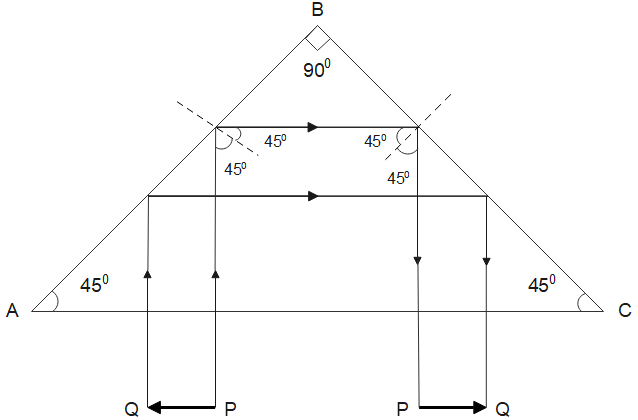
The light from point P is incident normally on face AC of the prism and then falls on face AB at an angle of incidence ${{45}^{0}}$ and suffers total internal reflection as it is greater than critical angle of glass, i.e. ${{45}^{0}}\rangle {{42}^{0}}$, then again falls on face BC and suffers total internal reflection and similarly light from point Q suffers two total internal reflection and thus light is deviated through ${{180}^{0}}$.
Note:
The condition necessary for total internal reflection is that the angle of incident should be more than the critical angle of prism and value of critical angle of glass is ${{42}^{0}}$ should be kept in mind to solve prism and its applications related questions.
Complete answer:
A total reflecting prism is a prism that reflects the light that falls normally on its faces, if angle of incidence is more than the critical angle (critical angle of glass is ${{42}^{0}}$), then total internal reflection takes place. It is a right angled isosceles prism that has one angle equal to ${{90}^{0}}$ and other two angles equal to ${{45}^{0}}$.
Three actions of total reflecting prism are,
1. It deviates light falling on any of its faces through ${{90}^{0}}$.
2. It deviates light falling on any of its faces through ${{180}^{0}}$.
3. It erects an image without any deviation.
The figure below shows one of the actions of the total reflecting prism, deviation of light through ${{180}^{0}}$.
The light from point P is incident normally on face AC of the prism and then falls on face AB at an angle of incidence ${{45}^{0}}$ and suffers total internal reflection as it is greater than critical angle of glass, i.e. ${{45}^{0}}\rangle {{42}^{0}}$, then again falls on face BC and suffers total internal reflection and similarly light from point Q suffers two total internal reflection and thus light is deviated through ${{180}^{0}}$.
Note:
The condition necessary for total internal reflection is that the angle of incident should be more than the critical angle of prism and value of critical angle of glass is ${{42}^{0}}$ should be kept in mind to solve prism and its applications related questions.
Recently Updated Pages
Master Class 12 Business Studies: Engaging Questions & Answers for Success

Master Class 12 Chemistry: Engaging Questions & Answers for Success
Master Class 12 Biology: Engaging Questions & Answers for Success
Class 12 Question and Answer - Your Ultimate Solutions Guide
Master Class 11 English: Engaging Questions & Answers for Success
Master Class 11 Social Science: Engaging Questions & Answers for Success
Trending doubts
Write any five applications of photoelectric cells class 12 physics CBSE
The electric field due to a uniformly charged nonconducting class 12 physics CBSE
The relation between halflife T and decay constant class 12 physics CBSE
Distinguish between the democratic government and nondemocratic class 12 social science CBSE
Drive an expression for the electric field due to an class 12 physics CBSE
What is the direction of electric fieldEat pointPin class 12 physics CBSE