




A torch bulb rated $4.5W$, $1.5V$is connected to a battery with internal resistance of $2.67\Omega $ as shown in the figure. Find the EMF of the cell needed to make the bulb glow at full intensity.
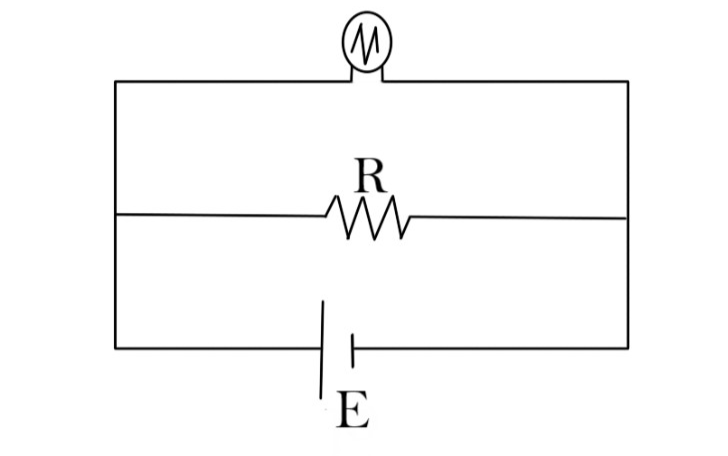
a. $4.5V$
b. $1.5V$
c. $2.67V$
d. $13.5V$
Answer
 Verified
649.8k+ views
Hint: We have to find the total current and total resistance in the circuit. with this much information we can use Ohm’s law to find the emf.
Complete step by step answer:
Power of the bulb is given by
$P = \dfrac{{{V^2}}}{R}$
Where,
$V = $voltage of the bulb
$R = $resistance of the bulb
By using the formula we get,
$4.5W = \dfrac{{{{\left( {1.5V} \right)}^2}}}{R}$
$R = 0.5\Omega $
Two of the resistance are in parallel
Net resistance
$\dfrac{1}{{{R_{eq}}}} = \dfrac{1}{{0.5}} + \dfrac{1}{1}$
${R_{eq}} = 0.34\Omega $
The internal resistance of the battery is connected in series to ${R_{eq}}$.
Total resistance of the circuit $
= 0.34\Omega + 2.67\Omega \\
\approx 3\Omega \\
$
We know that,
$
P = IV \\
I = \dfrac{P}{V} \\
I = \dfrac{{4.5}}{{1.5}} = 3A \\
$
Current is inversely proportional to resistance,
$I \propto \dfrac{1}{R}$
Let ${I_1}$ and ${I_2}$ be the current in $1\Omega $ resistance and bulb respectively.
So,
$\dfrac{{{I_1}}}{{{I_2}}} = \dfrac{{{R_2}}}{{{R_1}}}$
$\dfrac{{{I_1}}}{3} = \dfrac{1}{2}$
${I_1} = 1.5A$
Applying junction law at junction
Total current$ = {I_1} + {I_2}$
Total current$ = 3 + 1.5 = 4.5A$
Total resistance as calculated earlier$ = 3\Omega $
By using OHM’S LAW
$
E = IR \\
E = 4.5A \times 3\Omega \\
E = 13.5V \\
$
Therefore d) is the correct answer
Note: The voltage given in the question is the maximum voltage the bulb can bear. Therefore the resistance of the bulb is the maximum resistance it can offer in the circuit
Complete step by step answer:
Power of the bulb is given by
$P = \dfrac{{{V^2}}}{R}$
Where,
$V = $voltage of the bulb
$R = $resistance of the bulb
By using the formula we get,
$4.5W = \dfrac{{{{\left( {1.5V} \right)}^2}}}{R}$
$R = 0.5\Omega $
Two of the resistance are in parallel
Net resistance
$\dfrac{1}{{{R_{eq}}}} = \dfrac{1}{{0.5}} + \dfrac{1}{1}$
${R_{eq}} = 0.34\Omega $
The internal resistance of the battery is connected in series to ${R_{eq}}$.
Total resistance of the circuit $
= 0.34\Omega + 2.67\Omega \\
\approx 3\Omega \\
$
We know that,
$
P = IV \\
I = \dfrac{P}{V} \\
I = \dfrac{{4.5}}{{1.5}} = 3A \\
$
Current is inversely proportional to resistance,
$I \propto \dfrac{1}{R}$
Let ${I_1}$ and ${I_2}$ be the current in $1\Omega $ resistance and bulb respectively.
So,
$\dfrac{{{I_1}}}{{{I_2}}} = \dfrac{{{R_2}}}{{{R_1}}}$
$\dfrac{{{I_1}}}{3} = \dfrac{1}{2}$
${I_1} = 1.5A$
Applying junction law at junction
Total current$ = {I_1} + {I_2}$
Total current$ = 3 + 1.5 = 4.5A$
Total resistance as calculated earlier$ = 3\Omega $
By using OHM’S LAW
$
E = IR \\
E = 4.5A \times 3\Omega \\
E = 13.5V \\
$
Therefore d) is the correct answer
Note: The voltage given in the question is the maximum voltage the bulb can bear. Therefore the resistance of the bulb is the maximum resistance it can offer in the circuit
Recently Updated Pages
Basicity of sulphurous acid and sulphuric acid are

Master Class 12 Economics: Engaging Questions & Answers for Success
Master Class 12 Biology: Engaging Questions & Answers for Success
Master Class 11 English: Engaging Questions & Answers for Success
Master Class 11 Physics: Engaging Questions & Answers for Success
Master Class 11 Computer Science: Engaging Questions & Answers for Success
Trending doubts
Draw a labelled sketch of the human eye class 12 physics CBSE
The chemical formula of tear gas is A CO Cl 2 B C 10 class 12 chemistry CBSE
Draw ray diagrams each showing i myopic eye and ii class 12 physics CBSE
Which are the Top 10 Largest Countries of the World?
Differentiate between homogeneous and heterogeneous class 12 chemistry CBSE
Which is the correct genotypic ratio of mendel dihybrid class 12 biology CBSE