




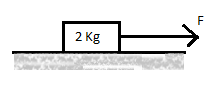
A time-varying horizontal force (in Newton) $F=8|sin (4πt) |$ is acting on a stationary block of mass 2 kg as shown. The friction coefficient between the block and ground is $μ=0.5$ and $g=10 \dfrac {m}{s^2}$. Then the resulting motion of the block will be:
(A) It will oscillate
(B) It remains stationary
(C) It moves towards left
(D) It moves towards the right
Answer
 Verified
608.4k+ views
Hint
The frictional force opposing the motion of the body i.e. the direction of frictional force is opposite to the direction of applied force. For the movement of the body applied force must be greater than the frictional force on the body.
Complete step by step answer
Given, the mass of a stationary block is ${\rm{m}} = 2{\rm{\;}}$kg.
The coefficient of friction between the block and ground is ${\rm{\mu }} = 0.5$.
The time-varying force acting on the stationary body is ${\rm{F}} = 8\left| {\sin \left( {4{\rm{\pi t}}} \right)} \right|$ N
And, the value of g is $10{\rm{\;m}}/{{\rm{s}}^2}$
We know that the maximum possible frictional force is given by,
${{\rm{F}}_{{\rm{frictional}}}} = {\rm{\mu mg}}$
$ = 0.5 \times 2 \times 10$
$ = 10{\rm{\;}}N$ … (1)
From the given equation of force,
${\rm{F}} = 8\left| {\sin \left( {4{\rm{\pi t}}} \right)} \right|$ Newton
The maximum applied force will be, ${{\rm{F}}_{{\rm{applied}}}} = 8$ N … (2)
From equation (1) and (2), we get
${{\rm{F}}_{{\rm{frictional}}}} > {{\rm{F}}_{{\rm{applied}}}}$
i.e. the maximum frictional force is greater than the force applied on the stationary body. Therefore, the body will remain stationary.
Therefore, (B) It remains stationary is the required solution.
Note
In order to find out that the stationary body will move or not, we must consider the maximum value of the applied force. If we have a static force then there is no need to calculate maximum value of force. We can directly compare the value with friction force.
The frictional force opposing the motion of the body i.e. the direction of frictional force is opposite to the direction of applied force. For the movement of the body applied force must be greater than the frictional force on the body.
Complete step by step answer
Given, the mass of a stationary block is ${\rm{m}} = 2{\rm{\;}}$kg.
The coefficient of friction between the block and ground is ${\rm{\mu }} = 0.5$.
The time-varying force acting on the stationary body is ${\rm{F}} = 8\left| {\sin \left( {4{\rm{\pi t}}} \right)} \right|$ N
And, the value of g is $10{\rm{\;m}}/{{\rm{s}}^2}$
We know that the maximum possible frictional force is given by,
${{\rm{F}}_{{\rm{frictional}}}} = {\rm{\mu mg}}$
$ = 0.5 \times 2 \times 10$
$ = 10{\rm{\;}}N$ … (1)
From the given equation of force,
${\rm{F}} = 8\left| {\sin \left( {4{\rm{\pi t}}} \right)} \right|$ Newton
The maximum applied force will be, ${{\rm{F}}_{{\rm{applied}}}} = 8$ N … (2)
From equation (1) and (2), we get
${{\rm{F}}_{{\rm{frictional}}}} > {{\rm{F}}_{{\rm{applied}}}}$
i.e. the maximum frictional force is greater than the force applied on the stationary body. Therefore, the body will remain stationary.
Therefore, (B) It remains stationary is the required solution.
Note
In order to find out that the stationary body will move or not, we must consider the maximum value of the applied force. If we have a static force then there is no need to calculate maximum value of force. We can directly compare the value with friction force.
Recently Updated Pages
Master Class 11 English: Engaging Questions & Answers for Success

Master Class 11 Social Science: Engaging Questions & Answers for Success
Master Class 11 Maths: Engaging Questions & Answers for Success
Master Class 11 Biology: Engaging Questions & Answers for Success
Master Class 11 Physics: Engaging Questions & Answers for Success
Master Class 11 Chemistry: Engaging Questions & Answers for Success
Trending doubts
One Metric ton is equal to kg A 10000 B 1000 C 100 class 11 physics CBSE
Difference Between Prokaryotic Cells and Eukaryotic Cells
Find the value of the expression given below sin 30circ class 11 maths CBSE
Difference between physical and chemical change class 11 chemistry CBSE
Two of the body parts which do not appear in MRI are class 11 biology CBSE
Draw a diagram of a plant cell and label at least eight class 11 biology CBSE