




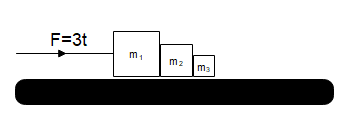
A time-dependent force $ F = 3t\,N $ acts on three blocks $ {m_1},{m_2} $ and $ {m_3} $ kept in contact on rough ground as shown. The coefficient of friction between blocks and ground is $ 0.4 $ . If $ {m_1},{m_2} $ and $ {m_3} $ are 3kg,2kg, and 1kg respectively, the time after which the blocks started to move is $ \left( {g = {\text{ }}10m{s^{ - 2}}} \right) $
A) 4 sec
B) 8 sec
C) $ 8/3 $ sec
D) $ 4/3 $ sec
Answer
 Verified
568.8k+ views
Hint : The blocks will start to move when the time-dependent force overcomes the static frictional drag force due to the combined frictional force of all three blocks. We will calculate the net frictional force due to three blocks and find the time for which the external force overcomes the frictional force.
Complete step by step answer
We’ve been given that three blocks $ {m_1},{m_2} $ and $ {m_3} $ kept in contact on rough ground as shown and that the coefficient of friction between blocks and ground is $ 0.4 $ .
The net static friction that will act on the three blocks will be the sum of the friction forces of all three blocks. We know that the friction force due to any block can be written as
$ F = \mu mg $
As the coefficient of friction between the blocks and the surface is $ 0.4 $ , the net friction force which is the sum of friction forces of all the three individual blocks can be written as:
$ F = 0.4(3)(10) + 0.4(2)(10) + 0.4(1)(10) $
$ \Rightarrow F = \,24\,N $
Now since the external time-dependent force changes as $ F = 3t\,N $ , we can equalize this force with the total friction force of the three boxes as this will be the time moment where the blocks will start moving. So,
$ 3t = 24 $
$ \Rightarrow t = 8\,s $ which corresponds to option (B).
Note
Here we have assumed that the blocks stay in contact all the time so that one single block cannot move on its own. While the external force will overcome the individual frictional forces before 8s, the blocks will only start to move when the net friction force will be overcome by the external force.
Complete step by step answer
We’ve been given that three blocks $ {m_1},{m_2} $ and $ {m_3} $ kept in contact on rough ground as shown and that the coefficient of friction between blocks and ground is $ 0.4 $ .
The net static friction that will act on the three blocks will be the sum of the friction forces of all three blocks. We know that the friction force due to any block can be written as
$ F = \mu mg $
As the coefficient of friction between the blocks and the surface is $ 0.4 $ , the net friction force which is the sum of friction forces of all the three individual blocks can be written as:
$ F = 0.4(3)(10) + 0.4(2)(10) + 0.4(1)(10) $
$ \Rightarrow F = \,24\,N $
Now since the external time-dependent force changes as $ F = 3t\,N $ , we can equalize this force with the total friction force of the three boxes as this will be the time moment where the blocks will start moving. So,
$ 3t = 24 $
$ \Rightarrow t = 8\,s $ which corresponds to option (B).
Note
Here we have assumed that the blocks stay in contact all the time so that one single block cannot move on its own. While the external force will overcome the individual frictional forces before 8s, the blocks will only start to move when the net friction force will be overcome by the external force.
Recently Updated Pages
Master Class 11 Computer Science: Engaging Questions & Answers for Success

Master Class 11 Business Studies: Engaging Questions & Answers for Success
Master Class 11 Economics: Engaging Questions & Answers for Success
Master Class 11 English: Engaging Questions & Answers for Success
Master Class 11 Maths: Engaging Questions & Answers for Success
Master Class 11 Biology: Engaging Questions & Answers for Success
Trending doubts
One Metric ton is equal to kg A 10000 B 1000 C 100 class 11 physics CBSE
There are 720 permutations of the digits 1 2 3 4 5 class 11 maths CBSE
Discuss the various forms of bacteria class 11 biology CBSE
Draw a diagram of a plant cell and label at least eight class 11 biology CBSE
State the laws of reflection of light
Explain zero factorial class 11 maths CBSE