



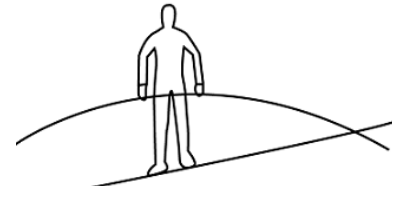
A tightrope walker in a circus holds a long flexible pole to help stay balanced on the rope. Holding the pole horizontally and perpendicular to the rope helps the performer
(A) By lowering the overall centre-of-gravity
(B) By increasing the rotational inertia
(C) In the ability to adjust the centre-of-gravity to be over the rope.
(D) In achieving the centre of gravity to be under the rope.
Answer
 Verified
606.9k+ views
Hint : In order to solve this question, we are going to first see the phenomenon of the balancing of the person over the rope and the alignment of the pole in the hands of the ropewalker. After that the correct options out of the four options given in the question are chosen.
Complete Step By Step Answer:
In order to balance himself on the rope, the ropewalker needs to align the centre of mass and the centre of gravity should locate in a line over the support point i.e. the rope.. Hence, if the pole is held horizontally and perpendicular to the rope, this helps the performer to make balance by increasing the rotational inertia and the ability to adjust the center – of –gravity to be over the rope.
Thus, holding the pole horizontally and perpendicular to the rope helps the performer by increasing the rotational inertia and in the ability to adjust the centre-of-gravity to be over the rope.
Hence, options (B) and (C) are the correct answer.
Note :
The smaller moment of inertia means that there is a less resistant force of rotation. In order to achieve the rotational equilibrium, some rapid corrections have to be made. However, the moment of inertia can be increased by stretching the hands outside standing on the rope to make the balance.
Complete Step By Step Answer:
In order to balance himself on the rope, the ropewalker needs to align the centre of mass and the centre of gravity should locate in a line over the support point i.e. the rope.. Hence, if the pole is held horizontally and perpendicular to the rope, this helps the performer to make balance by increasing the rotational inertia and the ability to adjust the center – of –gravity to be over the rope.
Thus, holding the pole horizontally and perpendicular to the rope helps the performer by increasing the rotational inertia and in the ability to adjust the centre-of-gravity to be over the rope.
Hence, options (B) and (C) are the correct answer.
Note :
The smaller moment of inertia means that there is a less resistant force of rotation. In order to achieve the rotational equilibrium, some rapid corrections have to be made. However, the moment of inertia can be increased by stretching the hands outside standing on the rope to make the balance.
Recently Updated Pages
If x a + bt + ct2 where x is in meters and t is in class 11 physics CBSE

A car covers the first half distance between two places class 11 physics CBSE
The resultant of two vectors overrightarrow P and overrightarrow class 11 physics CBSE
Find the value of cos 135 class 11 maths CBSE
A mass M is held in place by an applied force F and class 11 physics CBSE
A solution of glucose in water is labelled as 10 dfracwv class 11 chemistry CBSE
Trending doubts
One Metric ton is equal to kg A 10000 B 1000 C 100 class 11 physics CBSE
Find the value of the expression given below sin 30circ class 11 maths CBSE
What do you mean by retardation What is its SI uni class 11 physics CBSE
Draw a diagram of nephron and explain its structur class 11 biology CBSE
10 examples of friction in our daily life
Difference between physical and chemical change class 11 chemistry CBSE