




A thin wire of resistance 4 ohm is bent to form a circle. The resistance across any diameter is:
A.4 ohm
B.2 ohm
C.1 ohm
D.8 ohm
Answer
 Verified
561.9k+ views
Hint: Here, we calculate the electric resistance with the expression of the parallel circuit.
$\dfrac{1}{R} = \dfrac{1}{{{R_1}}} + \dfrac{1}{{{R_2}}}$
Complete answer:
According to the question
A thin wire having an electric resistance of 4 ohm is bent and formed a circle. So, the length of the wire converts to the circumference.
So, here’s the diagram
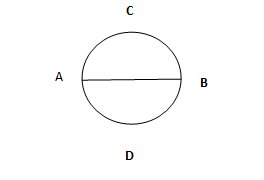
Here the ACB and ACD are having equal electric resistance, here’s the diameter is AB and we have to calculate the resistance across the diameter:
Resistance is equal to 4 ohm.
So, the ACB and ACD have a resistance of 2 ohm and 2 ohm each.
It is parallel connection,
So, we use this expression
$\dfrac{1}{R} = \dfrac{1}{{{R_1}}} + \dfrac{1}{{{R_2}}}$
Here, $R_1$ is equal to 2 ohm
And $R_2$ is equal to 2ohm
R is the resistance across diameter.
$\dfrac{1}{R} = \dfrac{1}{2} + \dfrac{1}{2}$
$\Rightarrow \dfrac{1}{R} = 1$
$\Rightarrow R = 1\Omega$
Here, the resistance across diameter is 1 ohm
So, the option (C) is correct.
Note:
The electric resistance depends on this factor:
The temperature of the conductor,
The cross sectional area of the conductor, as well as the thickness,
The length of the conductor,
The nature of the material of the conductor,
The electric resistance increases with the increasing of the length of the wire and the thickness of the wire decreases.
We can reduce the resistance of the wire in many different ways. We can use thicker wire because of their thickness. There is an increase of the cross sectional area, we can lower the temperature of the material or we can change the material.
A good wire has a resistance of less than 10 ohm and the isolated conductor offers a resistance of 1 mega ohm or more.
$\dfrac{1}{R} = \dfrac{1}{{{R_1}}} + \dfrac{1}{{{R_2}}}$
Complete answer:
According to the question
A thin wire having an electric resistance of 4 ohm is bent and formed a circle. So, the length of the wire converts to the circumference.
So, here’s the diagram
Here the ACB and ACD are having equal electric resistance, here’s the diameter is AB and we have to calculate the resistance across the diameter:
Resistance is equal to 4 ohm.
So, the ACB and ACD have a resistance of 2 ohm and 2 ohm each.
It is parallel connection,
So, we use this expression
$\dfrac{1}{R} = \dfrac{1}{{{R_1}}} + \dfrac{1}{{{R_2}}}$
Here, $R_1$ is equal to 2 ohm
And $R_2$ is equal to 2ohm
R is the resistance across diameter.
$\dfrac{1}{R} = \dfrac{1}{2} + \dfrac{1}{2}$
$\Rightarrow \dfrac{1}{R} = 1$
$\Rightarrow R = 1\Omega$
Here, the resistance across diameter is 1 ohm
So, the option (C) is correct.
Note:
The electric resistance depends on this factor:
The temperature of the conductor,
The cross sectional area of the conductor, as well as the thickness,
The length of the conductor,
The nature of the material of the conductor,
The electric resistance increases with the increasing of the length of the wire and the thickness of the wire decreases.
We can reduce the resistance of the wire in many different ways. We can use thicker wire because of their thickness. There is an increase of the cross sectional area, we can lower the temperature of the material or we can change the material.
A good wire has a resistance of less than 10 ohm and the isolated conductor offers a resistance of 1 mega ohm or more.
Recently Updated Pages
Master Class 11 Social Science: Engaging Questions & Answers for Success

Master Class 11 English: Engaging Questions & Answers for Success
Master Class 11 Maths: Engaging Questions & Answers for Success
Master Class 11 Chemistry: Engaging Questions & Answers for Success
Master Class 11 Biology: Engaging Questions & Answers for Success
Master Class 11 Physics: Engaging Questions & Answers for Success
Trending doubts
Differentiate between an exothermic and an endothermic class 11 chemistry CBSE
One Metric ton is equal to kg A 10000 B 1000 C 100 class 11 physics CBSE
Difference Between Prokaryotic Cells and Eukaryotic Cells
There are 720 permutations of the digits 1 2 3 4 5 class 11 maths CBSE
Draw a diagram of a plant cell and label at least eight class 11 biology CBSE
1 Quintal is equal to a 110 kg b 10 kg c 100kg d 1000 class 11 physics CBSE