




A thin circular loop of radius \[R\] rotates about its vertical diameter with an angular frequency \[\omega \]. Show that a small bead on the wire loop remains at its lowest point for \[\omega \leqslant \sqrt {g/R} \]. What is the angle made by the radius vector joining the center to the bead with the vertically downward direction for \[\omega = \sqrt {2g/R} \] ? Neglect friction.
Answer
 Verified
496.5k+ views
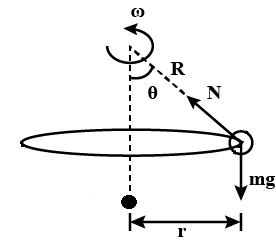
Hint: First, you have to understand the system represented in the question. A bead is rotating with a radius and angular frequency. If the angular frequency \[\omega \] is less than the square root of gravity divided by radius, which means the bead is at rest position. If the angular frequency is equal to the square root of two-time gravity divided by radius means how many angles the bead will make to the origin, it is the question. Here the picture represents the system and question.
Complete answer:
The normal force \[N\] for the horizontal component is equal to the angular force acting on the bead,
\[N\sin \theta = mr{\omega ^2}\]-------1
We can write $r$ as,
\[r = R\sin \theta \]
Substitute this into equation 1, we get,
\[N\sin \theta = mR\sin \theta {\omega ^2}\]--------2
The normal force \[N\] for the vertical component is equal to the downward force acting on the bead,
\[N\cos \theta = mg\]-------3
Divide the equation 3 by eq 2, we get,
\[\cos \theta = \dfrac{{mg}}{{mR{\omega ^2}}}\]
\[\cos \theta = \dfrac{g}{{R{\omega ^2}}}\]
We need \[\omega \] only, so we get,
\[\omega = \sqrt {\dfrac{g}{{R\cos \theta }}} \]--------4
At the rest position \[\theta = 0\] means,
\[\omega = \sqrt {\dfrac{g}{R}} \]
Substitute \[\omega = \sqrt {\dfrac{{2g}}{R}} \], we get,
\[\cos \theta = \dfrac{1}{2}\]
\[\theta = 60{}^0\]
Note:
The angle \[\theta \] will always be in the range of \[{0^0} \leqslant \theta < {90^0}\]. The angle cannot be greater than \[{90^0}\]. Because the maximum rotation of the bead will make the maximum angle less than \[{90^0}\]. The gravity is greater than the angular frequency means, the bead is at rest position because the angular velocity didn't have much efficiency to move the bead due to the interaction of gravity.
Complete answer:
The normal force \[N\] for the horizontal component is equal to the angular force acting on the bead,
\[N\sin \theta = mr{\omega ^2}\]-------1
We can write $r$ as,
\[r = R\sin \theta \]
Substitute this into equation 1, we get,
\[N\sin \theta = mR\sin \theta {\omega ^2}\]--------2
The normal force \[N\] for the vertical component is equal to the downward force acting on the bead,
\[N\cos \theta = mg\]-------3
Divide the equation 3 by eq 2, we get,
\[\cos \theta = \dfrac{{mg}}{{mR{\omega ^2}}}\]
\[\cos \theta = \dfrac{g}{{R{\omega ^2}}}\]
We need \[\omega \] only, so we get,
\[\omega = \sqrt {\dfrac{g}{{R\cos \theta }}} \]--------4
At the rest position \[\theta = 0\] means,
\[\omega = \sqrt {\dfrac{g}{R}} \]
Substitute \[\omega = \sqrt {\dfrac{{2g}}{R}} \], we get,
\[\cos \theta = \dfrac{1}{2}\]
\[\theta = 60{}^0\]
Note:
The angle \[\theta \] will always be in the range of \[{0^0} \leqslant \theta < {90^0}\]. The angle cannot be greater than \[{90^0}\]. Because the maximum rotation of the bead will make the maximum angle less than \[{90^0}\]. The gravity is greater than the angular frequency means, the bead is at rest position because the angular velocity didn't have much efficiency to move the bead due to the interaction of gravity.
Recently Updated Pages
Master Class 11 Computer Science: Engaging Questions & Answers for Success

Master Class 11 Business Studies: Engaging Questions & Answers for Success
Master Class 11 Economics: Engaging Questions & Answers for Success
Master Class 11 English: Engaging Questions & Answers for Success
Master Class 11 Maths: Engaging Questions & Answers for Success
Master Class 11 Biology: Engaging Questions & Answers for Success
Trending doubts
One Metric ton is equal to kg A 10000 B 1000 C 100 class 11 physics CBSE
There are 720 permutations of the digits 1 2 3 4 5 class 11 maths CBSE
Discuss the various forms of bacteria class 11 biology CBSE
Draw a diagram of a plant cell and label at least eight class 11 biology CBSE
State the laws of reflection of light
Explain zero factorial class 11 maths CBSE