




A thin bar of length $L$ has a mass per unit length $\lambda $, that increases linearly with distance from one end. If its total mass be $M$ and its mass per unit length at the lighter end be ${{\lambda }_{0}}$, then what will be the distance of the centre of mass from the lighter end?
$\begin{align}
& A.\dfrac{L}{2}-\dfrac{{{\lambda }_{0}}{{L}^{2}}}{4M} \\
& B.\dfrac{L}{3}+\dfrac{{{\lambda }_{0}}{{L}^{2}}}{4M} \\
& C.\dfrac{L}{3}+\dfrac{{{\lambda }_{0}}{{L}^{2}}}{8M} \\
& D.\dfrac{2L}{3}-\dfrac{{{\lambda }_{0}}{{L}^{2}}}{6M} \\
\end{align}$
Answer
 Verified
642.6k+ views
Hint: First of all write the equation for the mass per unit length of the bar. Rearrange this equation in terms of acceleration. Centre of mass of a body is the imaginary point we are assuming where the whole mass of the body has been concentrated. Then find the centre of mass equation. Substitute the needed parameters in it and simplify. This will help you in answering this question.
Complete answer:
Let the bar be placed along the x axis with its lighter end kept at the origin.
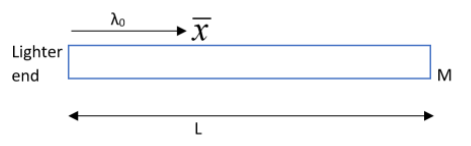
We can write the mass per unit length as,
\[\lambda \left( x \right)dx=\left[ {{\lambda }_{0}}x+\dfrac{a{{x}^{2}}}{2} \right]_{0}^{L}\]
Let us apply the limits in it,
\[\lambda \left( x \right)dx={{\lambda }_{0}}L+\dfrac{a{{L}^{2}}}{2}\]
Rearranging this equation will be written as,
\[a=\dfrac{2\left( M-{{\lambda }_{0}}L \right)}{{{L}^{2}}}\]
Let us assume that \[\bar{x}\] be the centre of mass.
Therefore the centre of mass of the body will be given as,
\[\bar{x}=\dfrac{\int x\lambda \left( x \right)dx}{M}\]
Substituting the values in it will give,
\[\bar{x}=\dfrac{\left[ {{\lambda }_{0}}\dfrac{{{x}^{2}}}{2}+a\dfrac{{{x}^{3}}}{3} \right]_{0}^{L}}{M}\]
Let us apply the limits in this equation which can be shown as,
\[\bar{x}=\dfrac{{{\lambda }_{0}}\dfrac{{{L}^{2}}}{2}+a\dfrac{{{L}^{3}}}{3}}{M}\]
Now let us substitute \[a\] in this equation,
\[\bar{x}=\dfrac{{{\lambda }_{0}}\dfrac{{{L}^{2}}}{2}+\dfrac{2\left( M-{{\lambda }_{0}}L \right)L}{3}}{M}\]
From this after simplifying the equation, we can write that,
\[\bar{x}=\dfrac{2L}{3}-\dfrac{{{\lambda }_{0}}{{L}^{2}}}{6M}\]
This will be the distance of the centre of mass from the lighter end.
The answer has been mentioned as option D.
Note:
The centre of mass is defined as a location described relative to a body or system of objects. It will be the average location of all the parts of the system, weighted with respect to their masses. For rigid bodies with uniform density, the centre of mass is found to be at the centroid.
Complete answer:
Let the bar be placed along the x axis with its lighter end kept at the origin.
We can write the mass per unit length as,
\[\lambda \left( x \right)dx=\left[ {{\lambda }_{0}}x+\dfrac{a{{x}^{2}}}{2} \right]_{0}^{L}\]
Let us apply the limits in it,
\[\lambda \left( x \right)dx={{\lambda }_{0}}L+\dfrac{a{{L}^{2}}}{2}\]
Rearranging this equation will be written as,
\[a=\dfrac{2\left( M-{{\lambda }_{0}}L \right)}{{{L}^{2}}}\]
Let us assume that \[\bar{x}\] be the centre of mass.
Therefore the centre of mass of the body will be given as,
\[\bar{x}=\dfrac{\int x\lambda \left( x \right)dx}{M}\]
Substituting the values in it will give,
\[\bar{x}=\dfrac{\left[ {{\lambda }_{0}}\dfrac{{{x}^{2}}}{2}+a\dfrac{{{x}^{3}}}{3} \right]_{0}^{L}}{M}\]
Let us apply the limits in this equation which can be shown as,
\[\bar{x}=\dfrac{{{\lambda }_{0}}\dfrac{{{L}^{2}}}{2}+a\dfrac{{{L}^{3}}}{3}}{M}\]
Now let us substitute \[a\] in this equation,
\[\bar{x}=\dfrac{{{\lambda }_{0}}\dfrac{{{L}^{2}}}{2}+\dfrac{2\left( M-{{\lambda }_{0}}L \right)L}{3}}{M}\]
From this after simplifying the equation, we can write that,
\[\bar{x}=\dfrac{2L}{3}-\dfrac{{{\lambda }_{0}}{{L}^{2}}}{6M}\]
This will be the distance of the centre of mass from the lighter end.
The answer has been mentioned as option D.
Note:
The centre of mass is defined as a location described relative to a body or system of objects. It will be the average location of all the parts of the system, weighted with respect to their masses. For rigid bodies with uniform density, the centre of mass is found to be at the centroid.
Recently Updated Pages
If x a + bt + ct2 where x is in meters and t is in class 11 physics CBSE

A car covers the first half distance between two places class 11 physics CBSE
The resultant of two vectors overrightarrow P and overrightarrow class 11 physics CBSE
Find the value of cos 135 class 11 maths CBSE
A mass M is held in place by an applied force F and class 11 physics CBSE
A solution of glucose in water is labelled as 10 dfracwv class 11 chemistry CBSE
Trending doubts
One Metric ton is equal to kg A 10000 B 1000 C 100 class 11 physics CBSE
Find the value of the expression given below sin 30circ class 11 maths CBSE
What do you mean by retardation What is its SI uni class 11 physics CBSE
Draw a diagram of nephron and explain its structur class 11 biology CBSE
10 examples of friction in our daily life
Difference between physical and chemical change class 11 chemistry CBSE