




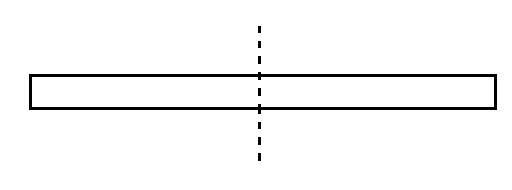
A thin bar magnet is cut into two equal parts as shown in figure the rotation of moment of inertia, magnetic moment of each part will become: (as compare to original magnet)
(A) $ \dfrac{1}{2} $
(B) $ \dfrac{1}{4} $
(C) $ \dfrac{1}{8} $
(D) $ 1 $
Answer
 Verified
582.3k+ views
Hint :Here, the magnet given is acting like a rod so we have to use the concept of moment of inertia of rod along the axis of rotation from the middle of the bar magnet. Here, the extra property is the magnetic moment of the bar magnet. And we have to find the ratio between original and after cutting off the bar magnet from the middle as shown in the figure given.
Complete Step By Step Answer:
When the magnet is not cut from the between into two equal parts as shown in figure above.
Let $ L $ be the length of the magnet and $ M $ be the magnetic moment of the magnet.
Let pole strength be $ S $ and $ m $ be the mass of the magnet.
According to given data,
Initial moment of inertia $ = m{L^2} $
Thus, initial magnetic moment $ = S \times 2L $
Their ratios $ = \dfrac{{mL}}{{2S}} $ …….. $ (1) $
After cutting the magnet pole strength remains the same.
Thus, final moment of inertia $ = \dfrac{m}{2}{\left( {\dfrac{L}{2}} \right)^2} = \dfrac{{m{L^2}}}{8} $
Magnetic moment $ = S \times 2\left( {\dfrac{L}{2}} \right) = S \times L $
Now, their ratios are given by $ = \dfrac{{mL}}{{8S}} $ ……. $ (2) $
For the ratios of magnetic moment we have
Ratios of $ (1) $ and $ (2) $ $ = \dfrac{{\dfrac{{mL}}{{8S}}}}{{\dfrac{{mL}}{{2S}}}} = \dfrac{1}{4} $
Thus magnetic moment of each part will become $ 1:4 $
The correct answer is the option B.
Note :
We know how to calculate the moment of inertia of a rod that is why it is easier to calculate the moment of inertia of a bar magnet as it represents rod-like structure. Also magnetic moment is the moment calculated as a product of strength of pole and twice the length. Be careful while calculating.
Complete Step By Step Answer:
When the magnet is not cut from the between into two equal parts as shown in figure above.
Let $ L $ be the length of the magnet and $ M $ be the magnetic moment of the magnet.
Let pole strength be $ S $ and $ m $ be the mass of the magnet.
According to given data,
Initial moment of inertia $ = m{L^2} $
Thus, initial magnetic moment $ = S \times 2L $
Their ratios $ = \dfrac{{mL}}{{2S}} $ …….. $ (1) $
After cutting the magnet pole strength remains the same.
Thus, final moment of inertia $ = \dfrac{m}{2}{\left( {\dfrac{L}{2}} \right)^2} = \dfrac{{m{L^2}}}{8} $
Magnetic moment $ = S \times 2\left( {\dfrac{L}{2}} \right) = S \times L $
Now, their ratios are given by $ = \dfrac{{mL}}{{8S}} $ ……. $ (2) $
For the ratios of magnetic moment we have
Ratios of $ (1) $ and $ (2) $ $ = \dfrac{{\dfrac{{mL}}{{8S}}}}{{\dfrac{{mL}}{{2S}}}} = \dfrac{1}{4} $
Thus magnetic moment of each part will become $ 1:4 $
The correct answer is the option B.
Note :
We know how to calculate the moment of inertia of a rod that is why it is easier to calculate the moment of inertia of a bar magnet as it represents rod-like structure. Also magnetic moment is the moment calculated as a product of strength of pole and twice the length. Be careful while calculating.
Recently Updated Pages
Basicity of sulphurous acid and sulphuric acid are

Master Class 11 English: Engaging Questions & Answers for Success
Master Class 11 Physics: Engaging Questions & Answers for Success
Master Class 11 Computer Science: Engaging Questions & Answers for Success
Master Class 11 Chemistry: Engaging Questions & Answers for Success
Master Class 11 Social Science: Engaging Questions & Answers for Success
Trending doubts
Difference Between Prokaryotic Cells and Eukaryotic Cells
Two of the body parts which do not appear in MRI are class 11 biology CBSE
One Metric ton is equal to kg A 10000 B 1000 C 100 class 11 physics CBSE
10 examples of friction in our daily life
Draw a diagram of nephron and explain its structur class 11 biology CBSE
What will happen if the mucus is not secreted by the class 11 biology CBSE