




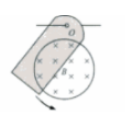
A thick strip of copper is mounted as a compound pendulum about O. It is made to swing through a uniform magnetic field B normal to the plane of the strip then (neglecting air resistance) it is found that
(A) strip swings almost freely.
(B) motion of the strip is heavily damped.
(C) strip does not oscillate at all but comes to rest in the vertical position.
(D) strip swings almost freely but it’s temperature decreases.
Answer
 Verified
586.8k+ views
Hint:To solve this problem we need to know about Faraday’s law of magnetic induction and also Lenzs’ law. Also we should have had a clear view on the origin of Eddy current and magnetic damping.
Complete step by step answer:
According to Faraday’s law, when a conducting loop passes through a magnetic field or a conducting loop in changing magnetic field \[\left( {non{\text{ }}uniform} \right),\]there will be generate an emf \[\left( {induced{\text{ }}current} \right)\]in the loop. And Lenz's law states that this induced current opposes the initial changing magnetic field or the motion of the loop.
If we deal with some solid conductor instead of a single loop in a varying magnetic field or the conductor sweeps in a uniform magnetic field then an electrical current induced in the conductor according to Faraday’s law of induction. This current is called Eddy current. Eddy current flow in a closed loops within conductors, in planes perpendicular to the field
Now come to our main problem, When the thick strip of copper made to swing through a uniform magnetic field, normal to the plane of the strip then there will be a change in flux in the stripand according to Faraday’s law small small electrical current loops will be formed across the strip that opposes the change in flux further in the strip(Lenz’s law). Therefore it experiences a force in a direction opposite to its motion. Due to this the motion of the pendulum is heavily damped.
So the correct answer is B.
Note:Also we should know about Faraday’s paradox.
Faraday’s paradox- The Faraday’s paradox is any experiment in which Michael Faraday’s lay of electromagnetic induction appears to predict an incorrect result. The paradox fall into two classes:
(I)Faraday’s law appears to predict that there will be zero EMF but there is a non-zero\[EMF\].
(II)Faraday’s law appears to predict that there will be a non-zero EMF but there is zero \[EMF\].
Complete step by step answer:
According to Faraday’s law, when a conducting loop passes through a magnetic field or a conducting loop in changing magnetic field \[\left( {non{\text{ }}uniform} \right),\]there will be generate an emf \[\left( {induced{\text{ }}current} \right)\]in the loop. And Lenz's law states that this induced current opposes the initial changing magnetic field or the motion of the loop.
If we deal with some solid conductor instead of a single loop in a varying magnetic field or the conductor sweeps in a uniform magnetic field then an electrical current induced in the conductor according to Faraday’s law of induction. This current is called Eddy current. Eddy current flow in a closed loops within conductors, in planes perpendicular to the field
Now come to our main problem, When the thick strip of copper made to swing through a uniform magnetic field, normal to the plane of the strip then there will be a change in flux in the stripand according to Faraday’s law small small electrical current loops will be formed across the strip that opposes the change in flux further in the strip(Lenz’s law). Therefore it experiences a force in a direction opposite to its motion. Due to this the motion of the pendulum is heavily damped.
So the correct answer is B.
Note:Also we should know about Faraday’s paradox.
Faraday’s paradox- The Faraday’s paradox is any experiment in which Michael Faraday’s lay of electromagnetic induction appears to predict an incorrect result. The paradox fall into two classes:
(I)Faraday’s law appears to predict that there will be zero EMF but there is a non-zero\[EMF\].
(II)Faraday’s law appears to predict that there will be a non-zero EMF but there is zero \[EMF\].
Recently Updated Pages
Master Class 12 Economics: Engaging Questions & Answers for Success

Master Class 12 Physics: Engaging Questions & Answers for Success
Master Class 12 English: Engaging Questions & Answers for Success
Master Class 12 Social Science: Engaging Questions & Answers for Success
Master Class 12 Maths: Engaging Questions & Answers for Success
Master Class 12 Business Studies: Engaging Questions & Answers for Success
Trending doubts
Which are the Top 10 Largest Countries of the World?
What are the major means of transport Explain each class 12 social science CBSE
Draw a labelled sketch of the human eye class 12 physics CBSE
Differentiate between insitu conservation and exsitu class 12 biology CBSE
Draw a neat and well labeled diagram of TS of ovary class 12 biology CBSE
Differentiate between homogeneous and heterogeneous class 12 chemistry CBSE