




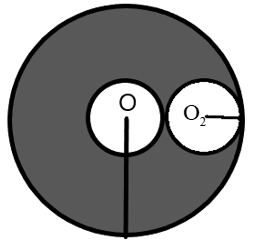
A thick shell with inner radius R and outer radius 3R has uniform charge density $\rho$ \[C{{m}^{-3}}\]. It has a spherical cavity of radius R as shown in the figure. What is the electric field at the centre \[{{\text{O}}_{\text{2}}}\] of the cavity?
Answer
 Verified
607.2k+ views
Hint: We have to consider the given spherical shell to find the electric field at the given point. We can find the electric field at the center of the cavity using the relation between the electric field and the point under consideration logically keeping the potential conditions in mind.
Complete step by step answer:
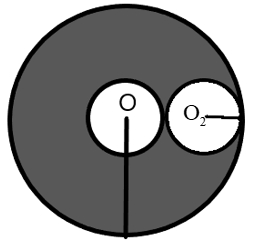
We are given that a thick shell of outer radius 3R and inner radius R consists of a uniform electric field density. The uniform charge density is spread across the volume of the thick shell. We need to analyse this situation and find the electric field at the point \[{{\text{O}}_{\text{2}}}\]which is the centre of a cavity of the than the cavity if the shell.
When we closely look at the shell, we know that the cavity regions are within the shell that encloses the uniform charge density, but the cavity doesn’t hold an electric field when inside a conducting sphere.
According to the Gauss’ law of electrostatics, the region bounded by a conductor is devoid of any electric field. It is because the surface of the region will be in an equipotential state. i.e.,
\[\oint{E.dA}=\dfrac{q}{{{\varepsilon }_{0}}}\]
Where, q is the charge enclosed by the area under consideration. We understand from the figure of the shell that there exists no electric charge in the cavity, therefore, the electric field enclosed by the area will be zero.
The electric field at the centre \[{{\text{O}}_{\text{2}}}\] is zero.
Note: The Gauss law of electricity is the closed integral over the area enclosed by the surface in which an electric charge is supposed to be present. A cavity inside a conductor acts as a Faraday’s cage, which doesn’t allow an electric field to pass through.
Complete step by step answer:
We are given that a thick shell of outer radius 3R and inner radius R consists of a uniform electric field density. The uniform charge density is spread across the volume of the thick shell. We need to analyse this situation and find the electric field at the point \[{{\text{O}}_{\text{2}}}\]which is the centre of a cavity of the than the cavity if the shell.
When we closely look at the shell, we know that the cavity regions are within the shell that encloses the uniform charge density, but the cavity doesn’t hold an electric field when inside a conducting sphere.
According to the Gauss’ law of electrostatics, the region bounded by a conductor is devoid of any electric field. It is because the surface of the region will be in an equipotential state. i.e.,
\[\oint{E.dA}=\dfrac{q}{{{\varepsilon }_{0}}}\]
Where, q is the charge enclosed by the area under consideration. We understand from the figure of the shell that there exists no electric charge in the cavity, therefore, the electric field enclosed by the area will be zero.
The electric field at the centre \[{{\text{O}}_{\text{2}}}\] is zero.
Note: The Gauss law of electricity is the closed integral over the area enclosed by the surface in which an electric charge is supposed to be present. A cavity inside a conductor acts as a Faraday’s cage, which doesn’t allow an electric field to pass through.
Recently Updated Pages
Master Class 12 Business Studies: Engaging Questions & Answers for Success

Master Class 12 Chemistry: Engaging Questions & Answers for Success
Master Class 12 Biology: Engaging Questions & Answers for Success
Class 12 Question and Answer - Your Ultimate Solutions Guide
Master Class 9 General Knowledge: Engaging Questions & Answers for Success
Master Class 9 Maths: Engaging Questions & Answers for Success
Trending doubts
Which are the Top 10 Largest Countries of the World?
Draw a labelled sketch of the human eye class 12 physics CBSE
Name the crygenes that control cotton bollworm and class 12 biology CBSE
Differentiate between homogeneous and heterogeneous class 12 chemistry CBSE
In a transcription unit the promoter is said to be class 12 biology CBSE
Sulphuric acid is known as the king of acids State class 12 chemistry CBSE