




a) The pointer in the galvanometer deflects, when a bar magnet pushed or away from the coil connected to a galvanometer. Identify the phenomenon causing this deflection and write the factors on which the amount and direction of the deflection depends. State the laws describing this phenomenon.
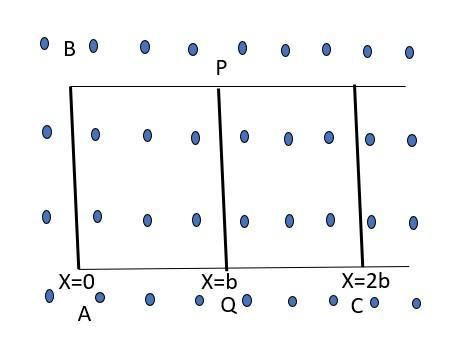
(b) Sketch the change in flux, emf and force when a conducting rod PQ of resistance R and length l moves freely to and fro between A and C with speed v on a rectangular conductor placed in uniform magnetic field as shown in the figure.
Answer
 Verified
600.9k+ views
Hint: Whenever there is change of magnetic flux, emf induced in the coil. It is according to Faraday’s law of motion. Emf induced or current induced is in the opposite direction of motion. Many factors affecting the emf like number of terms, magnetic field strength and speed of magnet towards or away from the coil.
Complete step-by-step answer:
a) When the magnet is pushed towards or away from the coil, the Galvanometer needle will deflect from its central position in one area only. When the magnet holds and is kept stationary regarding the coil, the Galvanometer needle returns to zero as there is no magnetic field movement. This is as per Faraday's law of electromagnetic induction, which states: " Whenever relative motion exists among a conductor and a magnetic field then a voltage is in the circuit that its magnitude is proportionate to the rate of flux change."
Factors on which amount and deflection direction depend are as follows-.
$1$) Progressing the turn numbers of wires. By increasing the number of conductors penetrating through the magnetic field, the value of induced emf generated will be the sum of all the coil's loops.
$2$) Increasing the relative speed between the magnet and the coil, the wire will cut the flux lines faster so induced emf would be generated.
$3$) Growing the strength of the magnetic field. If the same coil of wire is moved through a stronger magnetic field, more emf is produced because more lines of force are cut.
b) When a rod of length l is moving in a magnetic field then change of flux takes place.
Flux, $\phi = BA =Blb$
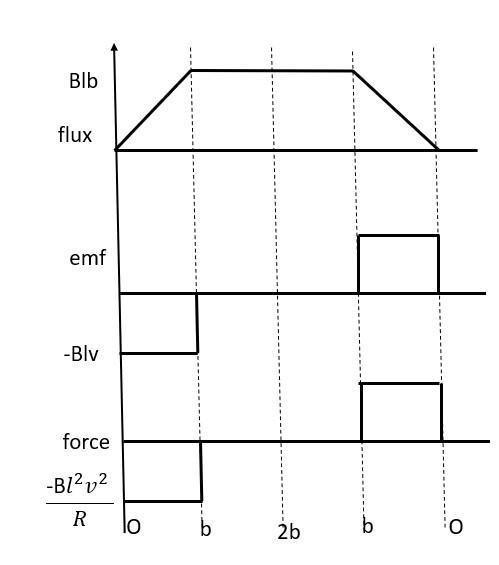
When the rod enters the magnetic flux then it changes from $0$ to b, after that rod is in the magnetic field from b to 2b, there is no change of flux. So, flux remains constant. When the rod exits the magnetic field, then flux decreases.
Emf, $e = - \dfrac{flux}{time} =- \dfrac{Blb}{t} = -Blv$
Current is the ratio of emf to the resistance.
$I = \dfrac{Blv}{R}$
Force due to conducting rod, $F = BIl$
$F = BIl = -\dfrac{Bl^{2}v^{2}}{R}$
Additional Information: The electric field and magnetic field are dependent on each other. A change in electric field can induce a magnetic field and also, a change in magnetic field can induce electric field. Induced emf is defined as rate of change of flux. It is applicable to any shape in any magnetic field.
Note: Magnitude of emf is positive but there is a negative sign in the expression of induced emf which shows the opposite direction of the emf. The emf induced is in such a direction to oppose the change in flux. Whenever flux increases, induced emf is negative and whenever flux decreases, induced emf is positive.
Complete step-by-step answer:
a) When the magnet is pushed towards or away from the coil, the Galvanometer needle will deflect from its central position in one area only. When the magnet holds and is kept stationary regarding the coil, the Galvanometer needle returns to zero as there is no magnetic field movement. This is as per Faraday's law of electromagnetic induction, which states: " Whenever relative motion exists among a conductor and a magnetic field then a voltage is in the circuit that its magnitude is proportionate to the rate of flux change."
Factors on which amount and deflection direction depend are as follows-.
$1$) Progressing the turn numbers of wires. By increasing the number of conductors penetrating through the magnetic field, the value of induced emf generated will be the sum of all the coil's loops.
$2$) Increasing the relative speed between the magnet and the coil, the wire will cut the flux lines faster so induced emf would be generated.
$3$) Growing the strength of the magnetic field. If the same coil of wire is moved through a stronger magnetic field, more emf is produced because more lines of force are cut.
b) When a rod of length l is moving in a magnetic field then change of flux takes place.
Flux, $\phi = BA =Blb$
When the rod enters the magnetic flux then it changes from $0$ to b, after that rod is in the magnetic field from b to 2b, there is no change of flux. So, flux remains constant. When the rod exits the magnetic field, then flux decreases.
Emf, $e = - \dfrac{flux}{time} =- \dfrac{Blb}{t} = -Blv$
Current is the ratio of emf to the resistance.
$I = \dfrac{Blv}{R}$
Force due to conducting rod, $F = BIl$
$F = BIl = -\dfrac{Bl^{2}v^{2}}{R}$
Additional Information: The electric field and magnetic field are dependent on each other. A change in electric field can induce a magnetic field and also, a change in magnetic field can induce electric field. Induced emf is defined as rate of change of flux. It is applicable to any shape in any magnetic field.
Note: Magnitude of emf is positive but there is a negative sign in the expression of induced emf which shows the opposite direction of the emf. The emf induced is in such a direction to oppose the change in flux. Whenever flux increases, induced emf is negative and whenever flux decreases, induced emf is positive.
Recently Updated Pages
Which of the following graphs shows the variation of class 12 physics CBSE

Draw a labelled diagram of the human male reproductive class 12 biology CBSE
Describe the experiment to compare the emf of two cells class 12 physics CBSE
What is standard hydrogen electrode
What is conventional current and electric current class 12 physics CBSE
2Bromopentane is treated with an alcoholic KOH solution class 12 chemistry CBSE
Trending doubts
Draw a labelled sketch of the human eye class 12 physics CBSE
Which are the Top 10 Largest Countries of the World?
Differentiate between homogeneous and heterogeneous class 12 chemistry CBSE
Draw ray diagrams each showing i myopic eye and ii class 12 physics CBSE
Which is the correct genotypic ratio of mendel dihybrid class 12 biology CBSE
What is the Full Form of PVC, PET, HDPE, LDPE, PP and PS ?