




A tetrahedron has Vertices at \[O\left( {0,{\text{ }}0,0} \right)\] , \[A\left( {1,{\text{ }}2,1} \right)\], \[B\left( {2,{\text{ }}1,3} \right)\;\] and \[C\left( { - 1,{\text{ }}1,2} \right)\].Then the angle between the faces $OAB$ and $ABC$ will be ?
A. \[{\cos ^{ - 1}}\left( {\dfrac{{19}}{{35}}} \right)\]
B. \[{\cos ^{ - 1}}\left( {\dfrac{{71}}{{31}}} \right)\]
C. \[{30^ \circ }\]
D. \[{90^ \circ }\]
Answer
 Verified
534.6k+ views
Hint:In this question, we have to find the angle between the faces of the tetrahedron. We will use the fact that the angle between the faces of the tetrahedron is the same as the angle between the perpendicular vectors to the faces. First, we will find the perpendicular vector \[{n_1}\] and \[{n_2}\] to the faces of the tetrahedron OAB and ABC respectively. We then find the angle between these two perpendicular vectors to get the required angle between faces of the tetrahedron.
Complete step by step answer:
This question is based on the tetrahedron. A tetrahedron is \[3 - D\] solid with a triangular face. It has \[4\] triangular faces. Consider the given question, draw a 3D tetrahedron with vertices,
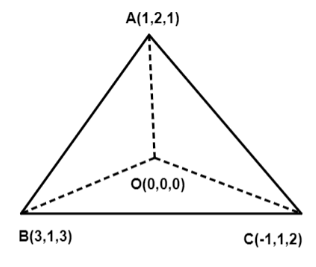
The vertices of tetrahedron are \[O\left( {0,{\text{ }}0,0} \right)\] , \[A\left( {1,{\text{ }}2,1} \right)\], \[B\left( {2,{\text{ }}1,3} \right)\;\]and \[C\left( { - 1,{\text{ }}1,2} \right)\].
Then the distance in vector form can be written as ,
\[\overrightarrow {OA} = (1i + 2j + 1k)\],\[\overrightarrow {OB} = (2i + 1j + 3k)\],\[\overrightarrow {AB} = (1i - 1j + 2k)\] and \[\overrightarrow {AC} = ( - 2i - 1j + 1k)\]
Let \[{n_1}\] be the perpendicular vector to the face OAB. Then we know that \[{n_1}\] can be written as a cross product of sides \[\overrightarrow {OA} \times \overrightarrow {OB} \] of the face OAB.
i.e. \[{n_1} = \overrightarrow {OA} \times \overrightarrow {OB} = \left| {\begin{array}{*{20}{c}}
i&j&k \\
1&2&1 \\
2&1&3
\end{array}} \right|\]
on solving the determinant , we have
\[ \Rightarrow {n_1} = (6 - 1)i - (3 - 2)j + (1 - 4)k\]
On solving we get
\[ \Rightarrow {n_1} = 5i - 1j - 3k\]
Similarly, let \[{n_2}\] be the perpendicular vector to the face ABC. Then we know that \[{n_2}\] can be written as a cross product of sides \[\overrightarrow {AB} \times \overrightarrow {AC} \] of the face ABC.
i.e. \[{n_2} = \overrightarrow {AB} \times \overrightarrow {AC} = \left| {\begin{array}{*{20}{c}}
i&j&k \\
1&{ - 1}&2 \\
{ - 2}&{ - 1}&1
\end{array}} \right|\]
on solving the determinant , we have
\[ \Rightarrow {n_2} = ( - 1 + 2)i - (1 + 4)j + ( - 1 - 2)k\]
On solving we get
\[ \Rightarrow {n_2} = 1i - 5j - 3k\]
Now , the angles between the faces OAB and ABC are the same as the angle between their corresponding perpendicular vectors(i.e. \[{n_1}\] and \[{n_2}\] respectively ).
Hence the angle between two vectors is given by ,
\[\cos \theta = \dfrac{{{n_1} \cdot {n_2}}}{{\begin{array}{*{20}{c}}
{\left| {{n_1}} \right|}&{\left| {{n_2}} \right|}
\end{array}}}\] where \[\theta \] is the angle between the normal \[{n_1}\] and \[{n_2}\].
\[ \Rightarrow \cos \theta = \dfrac{{(5i - 1j - 3k) \cdot (1i - 5j - 3k)}}{{\sqrt {{5^2} + {{( - 1)}^2} + {{( - 3)}^2}} \sqrt {{1^2} + {{( - 5)}^2} + {{( - 3)}^2}} }}\]
On solving the dot product we have
\[ \Rightarrow \cos \theta = \dfrac{{5 \times 1 + ( - 1) \times ( - 5) + ( - 3) \times ( - 3)}}{{\sqrt {25 + 1 + 9} \sqrt {1 + 25 + 9} }}\]
On simplifying, we have
\[ \Rightarrow \cos \theta = \dfrac{{5 + 5 + 9}}{{\sqrt {35} \sqrt {35} }}\]
\[ \Rightarrow \cos \theta = \dfrac{{19}}{{35}}\]
Taking inverse of cosine we get,
Hence \[\;\theta = {\cos ^{ - 1}}\dfrac{{19}}{{35}}\]
Hence option A is correct.
Note:To find the cross product of two vectors, we write them into matrix form and then find its determinant. For example, let \[\overrightarrow A = {a_1}i + {b_1}j + {c_1}k\] and \[\overrightarrow B = {a_2}i + {b_2}j + {c_2}k\] then , the cross product is given as
\[\overrightarrow A \times \overrightarrow B = \left| {\begin{array}{*{20}{c}}
i&j&k \\
{{a_1}}&{{b_1}}&{{c_1}} \\
{{a_2}}&{{b_2}}&{{c_2}}
\end{array}} \right| = ({b_1}{c_2} - {b_2}{c_1})i - ({a_1}{c_2} - {a_2}{c_1}) + ({a_1}{b_2} - {a_2}{b_1})k\] .
-To find the dot product of two vectors, we simply multiply them. For example, let \[\overrightarrow A = {a_1}i + {b_1}j + {c_1}k\] and \[\overrightarrow B = {a_2}i + {b_2}j + {c_2}k\] then , the dot product is given as
\[\overrightarrow A \cdot \overrightarrow B = {a_1}{a_2} + {b_1}{b_2} + {c_1}{c_2}\]
-Distance between two points with coordinates \[A({a_1},{b_1},{c_1})\] and \[B({a_2},{b_2},{c_2})\] in vector form is given as \[\overrightarrow {AB} = ({a_2} - {a_1})i + ({b_2} - {b_1})j + ({c_2} - {c_1})k\].
Complete step by step answer:
This question is based on the tetrahedron. A tetrahedron is \[3 - D\] solid with a triangular face. It has \[4\] triangular faces. Consider the given question, draw a 3D tetrahedron with vertices,
The vertices of tetrahedron are \[O\left( {0,{\text{ }}0,0} \right)\] , \[A\left( {1,{\text{ }}2,1} \right)\], \[B\left( {2,{\text{ }}1,3} \right)\;\]and \[C\left( { - 1,{\text{ }}1,2} \right)\].
Then the distance in vector form can be written as ,
\[\overrightarrow {OA} = (1i + 2j + 1k)\],\[\overrightarrow {OB} = (2i + 1j + 3k)\],\[\overrightarrow {AB} = (1i - 1j + 2k)\] and \[\overrightarrow {AC} = ( - 2i - 1j + 1k)\]
Let \[{n_1}\] be the perpendicular vector to the face OAB. Then we know that \[{n_1}\] can be written as a cross product of sides \[\overrightarrow {OA} \times \overrightarrow {OB} \] of the face OAB.
i.e. \[{n_1} = \overrightarrow {OA} \times \overrightarrow {OB} = \left| {\begin{array}{*{20}{c}}
i&j&k \\
1&2&1 \\
2&1&3
\end{array}} \right|\]
on solving the determinant , we have
\[ \Rightarrow {n_1} = (6 - 1)i - (3 - 2)j + (1 - 4)k\]
On solving we get
\[ \Rightarrow {n_1} = 5i - 1j - 3k\]
Similarly, let \[{n_2}\] be the perpendicular vector to the face ABC. Then we know that \[{n_2}\] can be written as a cross product of sides \[\overrightarrow {AB} \times \overrightarrow {AC} \] of the face ABC.
i.e. \[{n_2} = \overrightarrow {AB} \times \overrightarrow {AC} = \left| {\begin{array}{*{20}{c}}
i&j&k \\
1&{ - 1}&2 \\
{ - 2}&{ - 1}&1
\end{array}} \right|\]
on solving the determinant , we have
\[ \Rightarrow {n_2} = ( - 1 + 2)i - (1 + 4)j + ( - 1 - 2)k\]
On solving we get
\[ \Rightarrow {n_2} = 1i - 5j - 3k\]
Now , the angles between the faces OAB and ABC are the same as the angle between their corresponding perpendicular vectors(i.e. \[{n_1}\] and \[{n_2}\] respectively ).
Hence the angle between two vectors is given by ,
\[\cos \theta = \dfrac{{{n_1} \cdot {n_2}}}{{\begin{array}{*{20}{c}}
{\left| {{n_1}} \right|}&{\left| {{n_2}} \right|}
\end{array}}}\] where \[\theta \] is the angle between the normal \[{n_1}\] and \[{n_2}\].
\[ \Rightarrow \cos \theta = \dfrac{{(5i - 1j - 3k) \cdot (1i - 5j - 3k)}}{{\sqrt {{5^2} + {{( - 1)}^2} + {{( - 3)}^2}} \sqrt {{1^2} + {{( - 5)}^2} + {{( - 3)}^2}} }}\]
On solving the dot product we have
\[ \Rightarrow \cos \theta = \dfrac{{5 \times 1 + ( - 1) \times ( - 5) + ( - 3) \times ( - 3)}}{{\sqrt {25 + 1 + 9} \sqrt {1 + 25 + 9} }}\]
On simplifying, we have
\[ \Rightarrow \cos \theta = \dfrac{{5 + 5 + 9}}{{\sqrt {35} \sqrt {35} }}\]
\[ \Rightarrow \cos \theta = \dfrac{{19}}{{35}}\]
Taking inverse of cosine we get,
Hence \[\;\theta = {\cos ^{ - 1}}\dfrac{{19}}{{35}}\]
Hence option A is correct.
Note:To find the cross product of two vectors, we write them into matrix form and then find its determinant. For example, let \[\overrightarrow A = {a_1}i + {b_1}j + {c_1}k\] and \[\overrightarrow B = {a_2}i + {b_2}j + {c_2}k\] then , the cross product is given as
\[\overrightarrow A \times \overrightarrow B = \left| {\begin{array}{*{20}{c}}
i&j&k \\
{{a_1}}&{{b_1}}&{{c_1}} \\
{{a_2}}&{{b_2}}&{{c_2}}
\end{array}} \right| = ({b_1}{c_2} - {b_2}{c_1})i - ({a_1}{c_2} - {a_2}{c_1}) + ({a_1}{b_2} - {a_2}{b_1})k\] .
-To find the dot product of two vectors, we simply multiply them. For example, let \[\overrightarrow A = {a_1}i + {b_1}j + {c_1}k\] and \[\overrightarrow B = {a_2}i + {b_2}j + {c_2}k\] then , the dot product is given as
\[\overrightarrow A \cdot \overrightarrow B = {a_1}{a_2} + {b_1}{b_2} + {c_1}{c_2}\]
-Distance between two points with coordinates \[A({a_1},{b_1},{c_1})\] and \[B({a_2},{b_2},{c_2})\] in vector form is given as \[\overrightarrow {AB} = ({a_2} - {a_1})i + ({b_2} - {b_1})j + ({c_2} - {c_1})k\].
Recently Updated Pages
Master Class 11 Economics: Engaging Questions & Answers for Success

Master Class 11 English: Engaging Questions & Answers for Success
Master Class 11 Maths: Engaging Questions & Answers for Success
Class 11 Question and Answer - Your Ultimate Solutions Guide
Master Class 11 Social Science: Engaging Questions & Answers for Success
Master Class 11 Business Studies: Engaging Questions & Answers for Success
Trending doubts
There are 720 permutations of the digits 1 2 3 4 5 class 11 maths CBSE
In what year Guru Nanak Dev ji was born A15 April 1469 class 11 social science CBSE
When guru nanak ji was born in 1469 AD according to class 11 social studies CBSE
Draw a diagram of nephron and explain its structur class 11 biology CBSE
Super glue is a polymer of ATerephthalic acid chloride class 11 chemistry CBSE
Cornea transplant in humans is almost never rejected class 11 biology NEET_UG