




A tennis ball dropped from the height of $2m$ rebounds only $1.5m$ after hitting the ground. What fraction of energy is lost in the impact?
A.$\dfrac{1}{4}$
B.$\dfrac{1}{8}$
C.$\dfrac{1}{2}$
D.$\dfrac{1}{{16}}$
Answer
 Verified
497.1k+ views
Hint: As a result of its position, an object can store its energy. Potential energy is the stored energy. It is an energy that can be held by an object as its position is relative to the other objects that stress within itself and it is dependent on the height of an object.
Formula used:
$ E = mgh$
Where, $E$ is the energy, $m$ is the mass, $g$ gravitational constant, and $h$ is for height.
Complete answer:
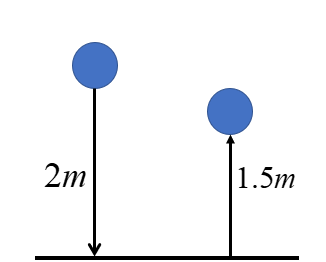
In the diagram, a tennis ball is dropped from the $2m$ height, and the same ball rebounds after hitting the ground at the height of $1.5m$.
Need to calculate the fraction of the energy that is lost. For that, we need the formula of the potential energy. The potential energy is the form of energy of an object that is relative to its position. To potential energy formula is,
$ \Rightarrow E = mgh$
Where,
$E$ is the energy, $m$ is the mass, $g$ gravitational constant, and $h$ is for height.
From the given formula it is understood that the given potential energy is dependent on the height. The values of heights are given.
There are two values of heights. One is when the ball hits the ground and another one is the ball rebounds. So, we need to calculate the energy for both values of energies separately.
The energy value when the ball hits on the ground at the height of $2m$
$ \Rightarrow E = mgh$
$ \Rightarrow E = mg2$
The energy value of when the ball rebounds at the height of $1.5m$
$ \Rightarrow E = mgh'$
$ \Rightarrow E = mg1.5$
To calculate the change in the energy:
$ \Rightarrow \Delta E = mgh - mgh'$
To find the energy loss in the impact, divide the value of loss in energy and energy. That is,
$ \Rightarrow \dfrac{{\Delta E}}{E} = \dfrac{{mgh - mgh'}}{{mgh}}$
Take the common terms out.
$ \Rightarrow \dfrac{{\Delta E}}{E} = \dfrac{{mg\left( {h - h'} \right)}}{{mgh}}$
Cancel out the common terms.
$ \Rightarrow \dfrac{{\Delta E}}{E} = \dfrac{{\left( {h - h'} \right)}}{h}$
Substitute the value of heights.
\[ \Rightarrow \dfrac{{\Delta E}}{E} = \dfrac{{\left( {2 - 1.5} \right)}}{2}\]
Simplify the equation.
\[ \Rightarrow \dfrac{{\Delta E}}{E} = \dfrac{1}{4}\]
Therefore, the fraction of the energy that is a loss in the impact is $\dfrac{1}{4}$.
Hence, the option $\left( A \right)$ is the correct answer.
Note:
The potential energy is classified into two forms of the energies. They are and Elastic potential energy and gravitational potential energy. Gravitational potential energy is a form of energy in which the object rises to a certain height against gravity. Elastic energy is energy that can be stretched or compressed.
Formula used:
$ E = mgh$
Where, $E$ is the energy, $m$ is the mass, $g$ gravitational constant, and $h$ is for height.
Complete answer:
In the diagram, a tennis ball is dropped from the $2m$ height, and the same ball rebounds after hitting the ground at the height of $1.5m$.
Need to calculate the fraction of the energy that is lost. For that, we need the formula of the potential energy. The potential energy is the form of energy of an object that is relative to its position. To potential energy formula is,
$ \Rightarrow E = mgh$
Where,
$E$ is the energy, $m$ is the mass, $g$ gravitational constant, and $h$ is for height.
From the given formula it is understood that the given potential energy is dependent on the height. The values of heights are given.
There are two values of heights. One is when the ball hits the ground and another one is the ball rebounds. So, we need to calculate the energy for both values of energies separately.
The energy value when the ball hits on the ground at the height of $2m$
$ \Rightarrow E = mgh$
$ \Rightarrow E = mg2$
The energy value of when the ball rebounds at the height of $1.5m$
$ \Rightarrow E = mgh'$
$ \Rightarrow E = mg1.5$
To calculate the change in the energy:
$ \Rightarrow \Delta E = mgh - mgh'$
To find the energy loss in the impact, divide the value of loss in energy and energy. That is,
$ \Rightarrow \dfrac{{\Delta E}}{E} = \dfrac{{mgh - mgh'}}{{mgh}}$
Take the common terms out.
$ \Rightarrow \dfrac{{\Delta E}}{E} = \dfrac{{mg\left( {h - h'} \right)}}{{mgh}}$
Cancel out the common terms.
$ \Rightarrow \dfrac{{\Delta E}}{E} = \dfrac{{\left( {h - h'} \right)}}{h}$
Substitute the value of heights.
\[ \Rightarrow \dfrac{{\Delta E}}{E} = \dfrac{{\left( {2 - 1.5} \right)}}{2}\]
Simplify the equation.
\[ \Rightarrow \dfrac{{\Delta E}}{E} = \dfrac{1}{4}\]
Therefore, the fraction of the energy that is a loss in the impact is $\dfrac{1}{4}$.
Hence, the option $\left( A \right)$ is the correct answer.
Note:
The potential energy is classified into two forms of the energies. They are and Elastic potential energy and gravitational potential energy. Gravitational potential energy is a form of energy in which the object rises to a certain height against gravity. Elastic energy is energy that can be stretched or compressed.
Recently Updated Pages
Master Class 11 Computer Science: Engaging Questions & Answers for Success

Master Class 11 Business Studies: Engaging Questions & Answers for Success
Master Class 11 Economics: Engaging Questions & Answers for Success
Master Class 11 English: Engaging Questions & Answers for Success
Master Class 11 Maths: Engaging Questions & Answers for Success
Master Class 11 Biology: Engaging Questions & Answers for Success
Trending doubts
One Metric ton is equal to kg A 10000 B 1000 C 100 class 11 physics CBSE
There are 720 permutations of the digits 1 2 3 4 5 class 11 maths CBSE
Discuss the various forms of bacteria class 11 biology CBSE
Draw a diagram of a plant cell and label at least eight class 11 biology CBSE
State the laws of reflection of light
Explain zero factorial class 11 maths CBSE