



A teacher attempting to arrange the students for a mass drill in the form of a solid square found that 24 students were left. When he increased the size of the square by one student, he found that he was short of 25 students. Find the number of students. Find the number of students.
Answer
 Verified
574.5k+ views
Hint: Assume the total number of students as ‘N’ and the number of students standing initially as ‘x’. Take the area of this square and add 24 to it to form equation (1). Now, increase the number of students standing in each row and column by 1 to make it (x + 1). Take the area of the new square and subtract 25 from it to form equation (2). Equate the two equations to find the value of x and N.
Complete step-by-step solution
Let us assume the total number of students required for mass drill as ‘N’.
Now, in the first case, it is given that students are arranged to form a solid square. So, let us assume the number of students standing in each row and column is ‘x’. The arrangement can be shown as: -
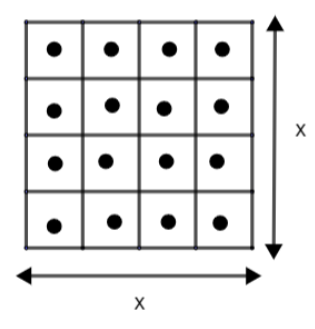
So, the total number of students in the above arrangement will be the area of the square with side ‘x’.
\[\Rightarrow \] Area = \[{{x}^{2}}\]
It is given that in this arrangement 24 students were left.
Therefore, the total number of students will be,
\[\Rightarrow N={{x}^{2}}+24\] ------- (1)
Now, in the second case, it is given that the teacher increased the size of the square by one student. So, the number of students in each row and column will become (x + 1).
\[\Rightarrow \] Area = \[{{\left( x+1 \right)}^{2}}\]
It is given that this time he was short of 25 students.
Therefore, the total number of students will be,
\[\Rightarrow N={{\left( x+1 \right)}^{2}}-25\] ------ (2)
Equating equations (1) and (2), we get,
\[\Rightarrow {{x}^{2}}+24={{\left( x+1 \right)}^{2}}-25\]
Applying the identity, \[{{\left( a+b \right)}^{2}}={{a}^{2}}+{{b}^{2}}-2ab\], we get,
\[\Rightarrow {{x}^{2}}+24={{x}^{2}}+1+2x-25\]
Cancelling the like terms, we get,
\[\begin{align}
& \Rightarrow 2x=48 \\
& \Rightarrow x=24 \\
\end{align}\]
Substituting, x = 24 in equation (1), we get,
\[\begin{align}
& \Rightarrow N={{\left( 24 \right)}^{2}}+24 \\
& \Rightarrow N=576+24 \\
& \Rightarrow N=600 \\
\end{align}\]
Hence, the total number of students is 600.
Note: One may note that we have added 24 to the area of the square in equation (1) because to form the square they needed x students in each row and column and 24 students were in extra. In equation (2) he needed 25 more students to complete the square with (x + 1) students in each row and column and that is why 25 is subtracted from the area. So, we have to read the question carefully so that we do not get confused.
Complete step-by-step solution
Let us assume the total number of students required for mass drill as ‘N’.
Now, in the first case, it is given that students are arranged to form a solid square. So, let us assume the number of students standing in each row and column is ‘x’. The arrangement can be shown as: -
So, the total number of students in the above arrangement will be the area of the square with side ‘x’.
\[\Rightarrow \] Area = \[{{x}^{2}}\]
It is given that in this arrangement 24 students were left.
Therefore, the total number of students will be,
\[\Rightarrow N={{x}^{2}}+24\] ------- (1)
Now, in the second case, it is given that the teacher increased the size of the square by one student. So, the number of students in each row and column will become (x + 1).
\[\Rightarrow \] Area = \[{{\left( x+1 \right)}^{2}}\]
It is given that this time he was short of 25 students.
Therefore, the total number of students will be,
\[\Rightarrow N={{\left( x+1 \right)}^{2}}-25\] ------ (2)
Equating equations (1) and (2), we get,
\[\Rightarrow {{x}^{2}}+24={{\left( x+1 \right)}^{2}}-25\]
Applying the identity, \[{{\left( a+b \right)}^{2}}={{a}^{2}}+{{b}^{2}}-2ab\], we get,
\[\Rightarrow {{x}^{2}}+24={{x}^{2}}+1+2x-25\]
Cancelling the like terms, we get,
\[\begin{align}
& \Rightarrow 2x=48 \\
& \Rightarrow x=24 \\
\end{align}\]
Substituting, x = 24 in equation (1), we get,
\[\begin{align}
& \Rightarrow N={{\left( 24 \right)}^{2}}+24 \\
& \Rightarrow N=576+24 \\
& \Rightarrow N=600 \\
\end{align}\]
Hence, the total number of students is 600.
Note: One may note that we have added 24 to the area of the square in equation (1) because to form the square they needed x students in each row and column and 24 students were in extra. In equation (2) he needed 25 more students to complete the square with (x + 1) students in each row and column and that is why 25 is subtracted from the area. So, we have to read the question carefully so that we do not get confused.
Recently Updated Pages
Master Class 11 Computer Science: Engaging Questions & Answers for Success

Master Class 11 Business Studies: Engaging Questions & Answers for Success
Master Class 11 Economics: Engaging Questions & Answers for Success
Master Class 11 English: Engaging Questions & Answers for Success
Master Class 11 Maths: Engaging Questions & Answers for Success
Master Class 11 Biology: Engaging Questions & Answers for Success
Trending doubts
One Metric ton is equal to kg A 10000 B 1000 C 100 class 11 physics CBSE
There are 720 permutations of the digits 1 2 3 4 5 class 11 maths CBSE
Discuss the various forms of bacteria class 11 biology CBSE
Draw a diagram of a plant cell and label at least eight class 11 biology CBSE
State the laws of reflection of light
Explain zero factorial class 11 maths CBSE