




A tank, which is open at the top, contains a liquid up to a height $H$ . A small hole is made in the side of a tank at a distance $y$ below the liquid surface. The liquid emerging from the hole lands at a distance $x$ from the tank.
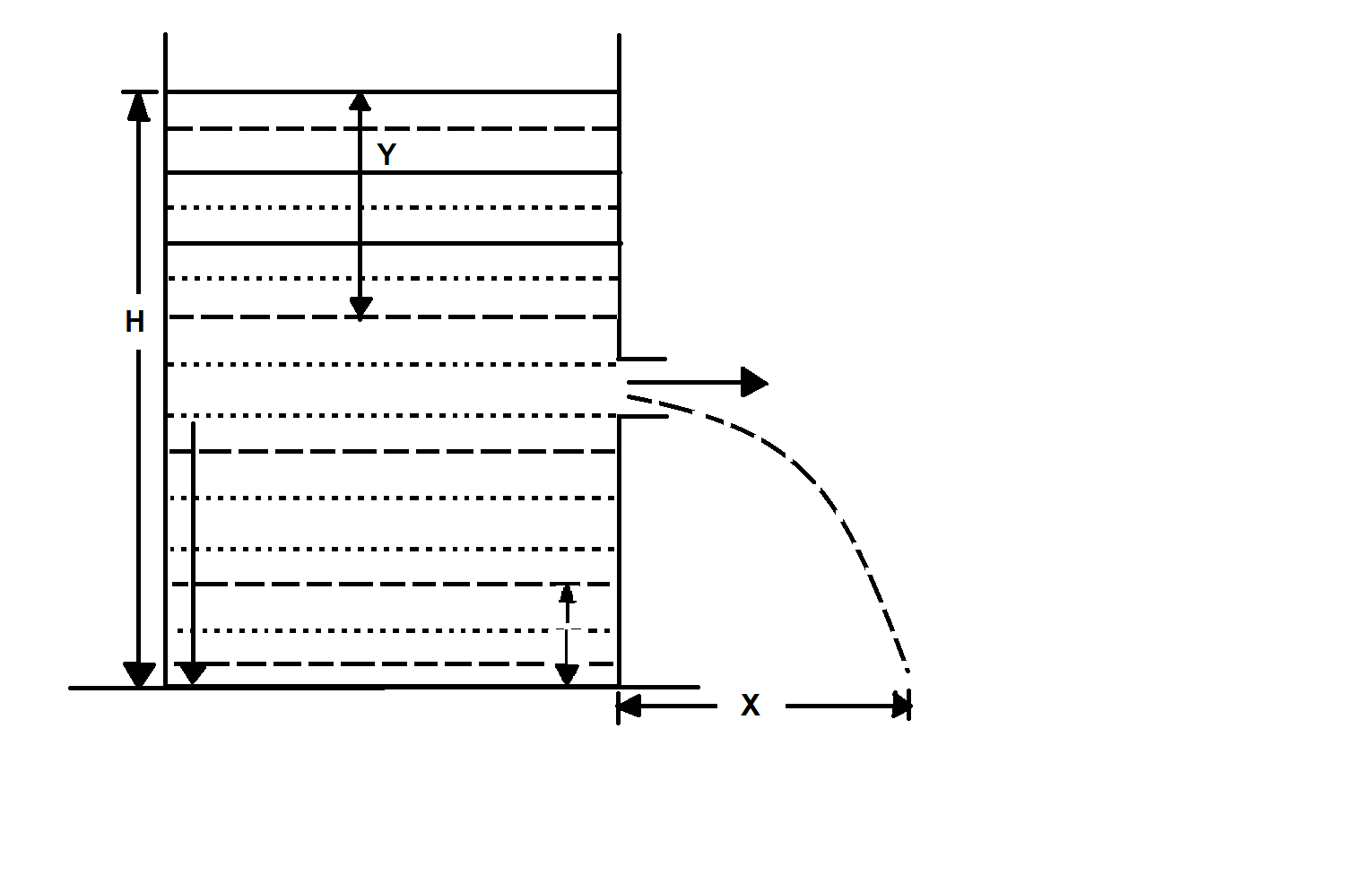
$\left( a \right)$ If $y$ is increased from zero to$H$ . $x$ will first increase and then decrease.
$\left( b \right)$ $x$ is maximum for $y = \dfrac{H}{2}$ .
$\left( c \right)$ The maximum value of $x$ is$H$ .
$\left( d \right)$ The maximum value of $x$ will depend on the density of the liquid.
Answer
 Verified
616.2k+ views
Hint: We are given with the level markings on the tank and are asked to find the change in basically the value $x$ as $y$ changes. Thus, we will take into account the efflux velocity of the liquid flowing out. Then, we will differentiate it with respect to the targeted variable.
Formulae Used:
$v = \sqrt {2gy} $
Where, $v$ is the efflux velocity, $g$ is the acceleration due to gravity and $y$ is the reduced height of the liquid.
Complete Step by Step Solution:
Here,
The liquid coming out of the opening is a parabola.
Clearly,
The emerging liquid moves upwards as the projectile reaches the ground after time $t$ .
Thus,
We have
$ \Rightarrow H - y = \dfrac{1}{2}g{t^2}$
Thus,
Targeting the time and rearranging the equation, we get
$ \Rightarrow t = \sqrt {\dfrac{{2(H - y)}}{g}} $
Thus,
We can say,
$x = vt$
Substituting the values, we get
$ \Rightarrow x = \sqrt {2gy} \times \sqrt {\dfrac{{2(H - y)}}{g}} $
Further, we can say
$ \Rightarrow x = 2\sqrt {(H - y)y} $
Now,
Differentiating both sides with respect to $y$ , we get
\[ \Rightarrow \dfrac{{dx}}{{dy}} = \dfrac{{(H - 2y)}}{{\sqrt {(H - y)y} }}\]
Now,
Clearly,
$ \Rightarrow \dfrac{{dx}}{{dy}} > 0$ If $y < \dfrac{H}{2}$
And,
$ \Rightarrow \dfrac{{dx}}{{dy}} < 0$ If $y > \dfrac{H}{2}$
Thus, option $\left( a \right)$ is correct.
Also,
For maxima or minima,
$ \Rightarrow \dfrac{{dx}}{{dy}} = 0$
Thus, we can say
$ \Rightarrow H - 2y = 0$
That means,
$ \Rightarrow y = \dfrac{H}{2}$
Hence, the option $\left( b \right)$ is also correct.
Now,
The maximum value of $x$ is at $y = \dfrac{H}{2}$.
Thus,
$ \Rightarrow {x_{\max }} = 2\sqrt {(H - \dfrac{H}{2}) \times \dfrac{H}{2}} $
Thus, we get
$ \Rightarrow {x_{\max }} = H$
Hence, the option $\left( c \right)$ is also correct.
Now,
Option $\left( d \right)$ is clearly incorrect as the efflux itself is independent of the density of the liquid. Thus, it is not possible to have $x$ depending on the density of the liquid.
Note: As we have seen here, a question can have more than one correct answer. So, it is better to go through a generalized methodology to solve a problem otherwise we might end up overlooking the multiple correct possibility. We can also make a habit of cross checking all the given options before we finalize.
Formulae Used:
$v = \sqrt {2gy} $
Where, $v$ is the efflux velocity, $g$ is the acceleration due to gravity and $y$ is the reduced height of the liquid.
Complete Step by Step Solution:
Here,
The liquid coming out of the opening is a parabola.
Clearly,
The emerging liquid moves upwards as the projectile reaches the ground after time $t$ .
Thus,
We have
$ \Rightarrow H - y = \dfrac{1}{2}g{t^2}$
Thus,
Targeting the time and rearranging the equation, we get
$ \Rightarrow t = \sqrt {\dfrac{{2(H - y)}}{g}} $
Thus,
We can say,
$x = vt$
Substituting the values, we get
$ \Rightarrow x = \sqrt {2gy} \times \sqrt {\dfrac{{2(H - y)}}{g}} $
Further, we can say
$ \Rightarrow x = 2\sqrt {(H - y)y} $
Now,
Differentiating both sides with respect to $y$ , we get
\[ \Rightarrow \dfrac{{dx}}{{dy}} = \dfrac{{(H - 2y)}}{{\sqrt {(H - y)y} }}\]
Now,
Clearly,
$ \Rightarrow \dfrac{{dx}}{{dy}} > 0$ If $y < \dfrac{H}{2}$
And,
$ \Rightarrow \dfrac{{dx}}{{dy}} < 0$ If $y > \dfrac{H}{2}$
Thus, option $\left( a \right)$ is correct.
Also,
For maxima or minima,
$ \Rightarrow \dfrac{{dx}}{{dy}} = 0$
Thus, we can say
$ \Rightarrow H - 2y = 0$
That means,
$ \Rightarrow y = \dfrac{H}{2}$
Hence, the option $\left( b \right)$ is also correct.
Now,
The maximum value of $x$ is at $y = \dfrac{H}{2}$.
Thus,
$ \Rightarrow {x_{\max }} = 2\sqrt {(H - \dfrac{H}{2}) \times \dfrac{H}{2}} $
Thus, we get
$ \Rightarrow {x_{\max }} = H$
Hence, the option $\left( c \right)$ is also correct.
Now,
Option $\left( d \right)$ is clearly incorrect as the efflux itself is independent of the density of the liquid. Thus, it is not possible to have $x$ depending on the density of the liquid.
Note: As we have seen here, a question can have more than one correct answer. So, it is better to go through a generalized methodology to solve a problem otherwise we might end up overlooking the multiple correct possibility. We can also make a habit of cross checking all the given options before we finalize.
Recently Updated Pages
If x a + bt + ct2 where x is in meters and t is in class 11 physics CBSE

A car covers the first half distance between two places class 11 physics CBSE
The resultant of two vectors overrightarrow P and overrightarrow class 11 physics CBSE
Find the value of cos 135 class 11 maths CBSE
A mass M is held in place by an applied force F and class 11 physics CBSE
A solution of glucose in water is labelled as 10 dfracwv class 11 chemistry CBSE
Trending doubts
Find the value of the expression given below sin 30circ class 11 maths CBSE
One Metric ton is equal to kg A 10000 B 1000 C 100 class 11 physics CBSE
Draw a diagram of nephron and explain its structur class 11 biology CBSE
10 examples of friction in our daily life
Proton was discovered by A Thomson B Rutherford C Chadwick class 11 chemistry CBSE
Bond order ofO2 O2+ O2 and O22 is in order A O2 langle class 11 chemistry CBSE