




A tall measuring jar contains ethyl alcohol of density \[0.\text{8 g/c}{{\text{m}}^{3}}\]. An iron ball is dropped into it and the level rises by \[20\text{ c}{{\text{m}}^{3}}\]. The buoyant force acting on the ball is: (Take acceleration due to gravity to be \[10\text{ m/}{{\text{s}}^{2}}\])
A. \[0.2\text{ }N\]
B. \[25\text{ }N\]
C. \[0.16\text{ }N\]
D. \[1.6\text{ }N\]
Answer
 Verified
620.7k+ views
Hint: When an object is dropped in a fluid, it experiences an upward force. This force is known as buoyant force. If values of fluid density, fluid volume and acceleration due to gravity are known, we can find out the force experienced by the object. This force acting on the object submerged in a fluid also depends on the volume of that object. And this volume is equal to the volume of fluid displaced by that object.
Formula used:
\[{{F}_{Buoyant}}=V\rho g\]
Complete answer:
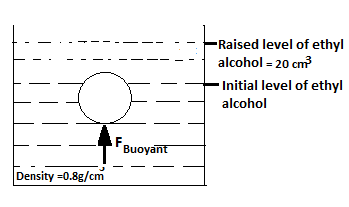
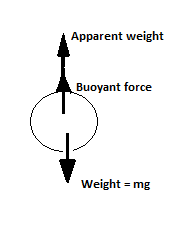
We have,
\[{{F}_{Buoyant}}=V\rho g\] ------ 1
Where,
\[{{\text{F}}_{\text{Buoyant}}}\text{=buoyant force}\]
\[\text{V = volume of fluid}\]
\[\text{ }\!\!\rho\!\!\text{ = density of fluid}\]
\[\text{g = acceleration due to gravity}\]
Given,
Density of ethyl alcohol = \[0.8g/c{{m}^{3}}\]
Convert it into \[Kg/{{m}^{3}}\]
Then,
\[Density=0.8g\times \dfrac{{{10}^{-3}}}{{{10}^{-6}}}=800Kg/{{m}^{3}}\]------2
It is given that, when iron ball is dropped in ethyl alcohol, ethyl alcohol raised by \[20~cm^3\]
Then,
\[Volume\text{ }of\text{ }alcohol\text{ }displaced\text{ }by\text{ }the\text{ }iron\text{ }ball=20\text{ c}{{\text{m}}^{3}}=20\times {{10}^{-6}}{{m}^{3}}\]-------- 3
Substituting 2 and 3 in equation 1, we get,
Buoyant force acting on the iron ball,
\[{{F}_{Buoyant}}=20\times {{10}^{-6}}\times 800\times 10\] \[=0.16N\]
So, the correct answer is “Option C”.
Additional Information:
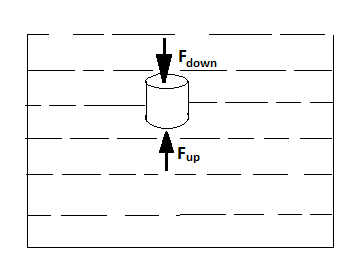
The upward force exerted on objects submerged in fluids is known as buoyant force. The pressure under the fluid increases as we go down. Hence force from the pressure exerted on the top of that object is lesser than the pressure exerted upward on the bottom. If force pushing down the object is \[{{F}_{down}}\] and force pushing up the object is \[{{F}_{up}}\], then buoyant force can be given by,
\[{{F}_{Buoyant}}={{F}_{up}}-{{F}_{down}}\]
And this buoyant force can be given by the equation.
\[{{F}_{Buoyant}}=V\rho g\]
Note:
If the submerged object has more volume, there would be a greater difference in depth between the top and the bottom. This greater depth difference would produce a greater buoyant force, no matter what shape the submerged object has; there is a net upward force. This force depends only on the volume of the object.
Formula used:
\[{{F}_{Buoyant}}=V\rho g\]
Complete answer:
We have,
\[{{F}_{Buoyant}}=V\rho g\] ------ 1
Where,
\[{{\text{F}}_{\text{Buoyant}}}\text{=buoyant force}\]
\[\text{V = volume of fluid}\]
\[\text{ }\!\!\rho\!\!\text{ = density of fluid}\]
\[\text{g = acceleration due to gravity}\]
Given,
Density of ethyl alcohol = \[0.8g/c{{m}^{3}}\]
Convert it into \[Kg/{{m}^{3}}\]
Then,
\[Density=0.8g\times \dfrac{{{10}^{-3}}}{{{10}^{-6}}}=800Kg/{{m}^{3}}\]------2
It is given that, when iron ball is dropped in ethyl alcohol, ethyl alcohol raised by \[20~cm^3\]
Then,
\[Volume\text{ }of\text{ }alcohol\text{ }displaced\text{ }by\text{ }the\text{ }iron\text{ }ball=20\text{ c}{{\text{m}}^{3}}=20\times {{10}^{-6}}{{m}^{3}}\]-------- 3
Substituting 2 and 3 in equation 1, we get,
Buoyant force acting on the iron ball,
\[{{F}_{Buoyant}}=20\times {{10}^{-6}}\times 800\times 10\] \[=0.16N\]
So, the correct answer is “Option C”.
Additional Information:
The upward force exerted on objects submerged in fluids is known as buoyant force. The pressure under the fluid increases as we go down. Hence force from the pressure exerted on the top of that object is lesser than the pressure exerted upward on the bottom. If force pushing down the object is \[{{F}_{down}}\] and force pushing up the object is \[{{F}_{up}}\], then buoyant force can be given by,
\[{{F}_{Buoyant}}={{F}_{up}}-{{F}_{down}}\]
And this buoyant force can be given by the equation.
\[{{F}_{Buoyant}}=V\rho g\]
Note:
If the submerged object has more volume, there would be a greater difference in depth between the top and the bottom. This greater depth difference would produce a greater buoyant force, no matter what shape the submerged object has; there is a net upward force. This force depends only on the volume of the object.
Recently Updated Pages
Master Class 11 English: Engaging Questions & Answers for Success

Master Class 11 Social Science: Engaging Questions & Answers for Success
Master Class 11 Maths: Engaging Questions & Answers for Success
Master Class 11 Biology: Engaging Questions & Answers for Success
Master Class 11 Physics: Engaging Questions & Answers for Success
Master Class 11 Chemistry: Engaging Questions & Answers for Success
Trending doubts
One Metric ton is equal to kg A 10000 B 1000 C 100 class 11 physics CBSE
Find the value of the expression given below sin 30circ class 11 maths CBSE
Length of female urethra is A 15cm B 10cm C 4cm D class 11 biology CBSE
The floral formula of Malvaceae is class 11 biology CBSE
Agaragar is obtained from A Chlorella B Spirogyra C class 11 biology CBSE
A hollow sphere and a solid sphere having the same class 11 physics CBSE