




A tall man of height 6 feet wants to see his full image. Then the minimum required length of the mirror will be.
a) 12 feet
b) 3 feet
c) 6 feet
d) Any length
Answer
 Verified
549.5k+ views
Hint: To find the minimum length of the mirror, using a ray diagram, trace the minimum length of the mirror such that the person standing in front of the mirror can see his top as well as the bottom. Consider the point of vision of the observer near his head. This is because his line of sight and head are at a minimum distance.
Complete answer:
To begin with, let us first draw the ray diagram so that we get a proper view of the situation.
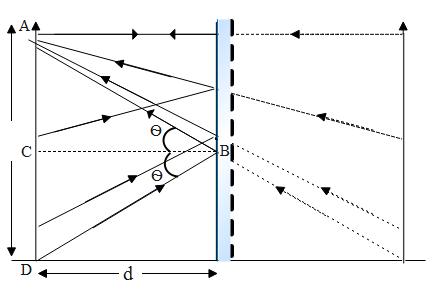
In the above diagram, the length of the mirror is equal to the height of the man standing in front of it at a distance d. By using the law of reflection i.e. angle of incidence is equal to the angle of reflection, we trace different parts of the body of the observer. The angle $\theta $ is the angle of incidence from the legs of the man going to his line of sight. Since the observer can see his legs, he can see any part of the body that is in between.
If we consider the triangle formed with the angle $2\theta $ base as h and height as d, triangle ABC is congruent to triangle DBC by SAS congruence criteria. Therefore (side) AC = (side)CD.
From the ray diagram we can clearly see that the observer requires only half of the mirror to view his entire image of his body. Hence the minimum length of the mirror required to see the entire image of a man of height of 6 feet is 3 feet.
So, the correct answer is “Option C”.
Note:
The mirror should be placed at the top i.e. at the line of sight of the man, of half its length to see the entire image. In the above conclusion we found out that the mirror can be placed at any distance i.e. the entire image formed is independent of d. We feel that when we move away from the mirror the height increases, but it is just the field of view that increases.
Complete answer:
To begin with, let us first draw the ray diagram so that we get a proper view of the situation.
In the above diagram, the length of the mirror is equal to the height of the man standing in front of it at a distance d. By using the law of reflection i.e. angle of incidence is equal to the angle of reflection, we trace different parts of the body of the observer. The angle $\theta $ is the angle of incidence from the legs of the man going to his line of sight. Since the observer can see his legs, he can see any part of the body that is in between.
If we consider the triangle formed with the angle $2\theta $ base as h and height as d, triangle ABC is congruent to triangle DBC by SAS congruence criteria. Therefore (side) AC = (side)CD.
From the ray diagram we can clearly see that the observer requires only half of the mirror to view his entire image of his body. Hence the minimum length of the mirror required to see the entire image of a man of height of 6 feet is 3 feet.
So, the correct answer is “Option C”.
Note:
The mirror should be placed at the top i.e. at the line of sight of the man, of half its length to see the entire image. In the above conclusion we found out that the mirror can be placed at any distance i.e. the entire image formed is independent of d. We feel that when we move away from the mirror the height increases, but it is just the field of view that increases.
Recently Updated Pages
Master Class 12 Business Studies: Engaging Questions & Answers for Success

Master Class 12 Biology: Engaging Questions & Answers for Success
Master Class 12 Chemistry: Engaging Questions & Answers for Success
Class 12 Question and Answer - Your Ultimate Solutions Guide
Master Class 11 Social Science: Engaging Questions & Answers for Success
Master Class 11 English: Engaging Questions & Answers for Success
Trending doubts
Explain the Treaty of Vienna of 1815 class 10 social science CBSE
Which Indian city is known as the "City of Victory"?
Which instrument is used to measure the Blood Pressure?
Who Won 36 Oscar Awards? Record Holder Revealed
What is the median of the first 10 natural numbers class 10 maths CBSE
Why is it 530 pm in india when it is 1200 afternoon class 10 social science CBSE