




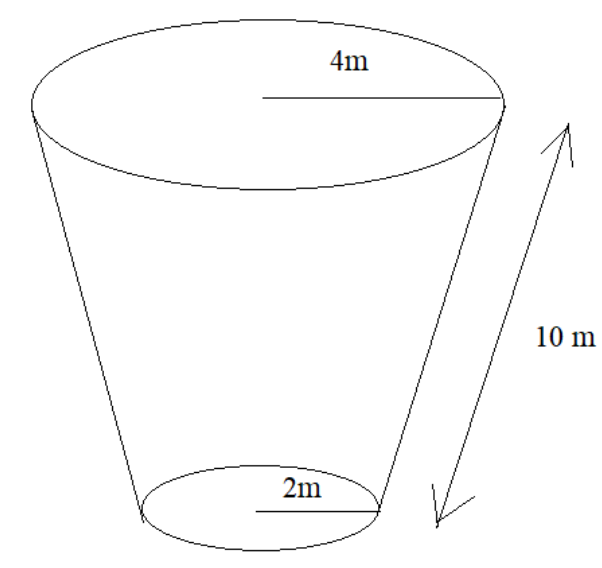
A table lamp is in the form of a frustum of a cone whose area of the top and the bottom circle bases are $212\,{{\rm{m}}^2}$ and $103\,{{\rm{m}}^2}$. Find the total surface area, if the slant height is $10\,{\rm{m}}$ and top and bottom radii are $2\,{\rm{m}}$ and $4\,{\rm{m}}$.(Use $\pi = 3$)
A) $595\,{{\rm{m}}^{\rm{2}}}$
B) $550\,{{\rm{m}}^{\rm{2}}}$
C) $510\,{{\rm{m}}^{\rm{2}}}$
D) $505\,{{\rm{m}}^{\rm{2}}}$
Answer
 Verified
654k+ views
Hint: In the given problem, first we need to find the total surface area of the frustum. The smaller value of area is the area of the top circle and the bigger value of area is the area of the bottom circle. We need to use the formula $\pi \left( {r + R} \right) \times l + \pi {r^2} + \pi {R^2}$, here $r,R$ represent the radius of the circle, and $l$ is the length. After substituting the respective values in the formula, we can calculate the total surface area.
Complete step by step answer:
In this given problem, let us take a smaller radius as ‘$r$’; bigger radius as ‘$R$’; slant height as ‘$l$’.
Given,
Area of the smaller base $\left( {\pi {r^2}} \right) = 103\,{{\rm{m}}^{\rm{2}}}$
Area of the bigger base $\left( {\pi {R^2}} \right) = 212\,{{\rm{m}}^{\rm{2}}}$
Slant height, $l = 10\,{\rm{m}}$
Smaller radius, $r = 2\,{\rm{m}}$
Bigger radius, $R = 4\,{\rm{m}}$
The total surface area (TSA) of the frustum is:
$\begin{array}{c} = \pi \left( {r + R} \right) \times l + \pi {r^2} + \pi {R^2}\\ = 3\left( {2 + 4} \right) \times 10 + 103 + 212\\ = 3 \times 6 \times 10 + 315\\ = 180 + 315\\ = 495\,{{\rm{m}}^{\rm{2}}}\end{array}$
Hence, the total surface area of the frustum is $495\,{{\rm{m}}^{\rm{2}}}$.
Note: A frustum (plural: frusta or frustums) is in geometry the portion of a solid (normally a cone or pyramid) that lies between one or two parallel planes that cut it. A right frustum is a parallel truncation of the right cone or pyramid. Here we have to find the total surface area of the frustum for the given data. Since the radius and the length are given, so by substituting the value in the formula, we get our required surface area.
Complete step by step answer:
In this given problem, let us take a smaller radius as ‘$r$’; bigger radius as ‘$R$’; slant height as ‘$l$’.
Given,
Area of the smaller base $\left( {\pi {r^2}} \right) = 103\,{{\rm{m}}^{\rm{2}}}$
Area of the bigger base $\left( {\pi {R^2}} \right) = 212\,{{\rm{m}}^{\rm{2}}}$
Slant height, $l = 10\,{\rm{m}}$
Smaller radius, $r = 2\,{\rm{m}}$
Bigger radius, $R = 4\,{\rm{m}}$
The total surface area (TSA) of the frustum is:
$\begin{array}{c} = \pi \left( {r + R} \right) \times l + \pi {r^2} + \pi {R^2}\\ = 3\left( {2 + 4} \right) \times 10 + 103 + 212\\ = 3 \times 6 \times 10 + 315\\ = 180 + 315\\ = 495\,{{\rm{m}}^{\rm{2}}}\end{array}$
Hence, the total surface area of the frustum is $495\,{{\rm{m}}^{\rm{2}}}$.
Note: A frustum (plural: frusta or frustums) is in geometry the portion of a solid (normally a cone or pyramid) that lies between one or two parallel planes that cut it. A right frustum is a parallel truncation of the right cone or pyramid. Here we have to find the total surface area of the frustum for the given data. Since the radius and the length are given, so by substituting the value in the formula, we get our required surface area.
Recently Updated Pages
Class 10 Question and Answer - Your Ultimate Solutions Guide

Master Class 10 Computer Science: Engaging Questions & Answers for Success
Master Class 10 General Knowledge: Engaging Questions & Answers for Success
Master Class 12 Economics: Engaging Questions & Answers for Success
Master Class 12 Social Science: Engaging Questions & Answers for Success
Master Class 12 English: Engaging Questions & Answers for Success
Trending doubts
The slogan Jai Hind was given by A Lal Bahadur Shastri class 10 social science CBSE
Five things I will do to build a great India class 10 english CBSE
Identify the feminine form of noun nephew a shenephew class 10 english CBSE
CSIR full form?
State BPT theorem and prove it class 10 maths CBSE
Draw a diagram of the human eye as seen in a vertical class 10 biology CBSE