




A swimmer crosses a flowing stream of width ‘w’ to and fro in time \[{t_1}\]. The time taken to cover the same distance up and down the stream is \[{t_2}\]. If the \[{t_3}\] is the time a swimmer would take to swim a distance of 2w in still water, then:
A. \[{t_1}^2{\text{ = }}{t_2}{\text{ }}{t_3}\]
B. \[{t_2}^2{\text{ = }}{t_1}{\text{ }}{t_3}\]
C. \[{t_3}^2{\text{ = }}{t_2}{\text{ }}{t_3}\]
D. \[{t_3}{\text{ = }}{t_1}{\text{ + }}{t_2}\]
Answer
 Verified
514.8k+ views
Hint: The time taken by a swimmer to travel a distance w is calculated by finding the distance travelled by the swimmer and the resultant speed in various cases. We will find the resultant velocity of the swimmer in each case and thus find the ratio of distance travelled and velocity. Then we can compare the time taken in each case respectively.
Formula Used:
Resultant Velocity \[{\text{ = }}\sqrt[{}]{{{v_1}^2{\text{ + }}{v_2}^2{\text{ + 2}}{v_1}{v_2}\cos \theta }}\]
Where, \[{v_1}\] and \[{v_2}\] are the velocities and \[\theta \] is the between the \[{v_1}\] and \[{v_2}\].
Complete step by step answer:
Let us assume that \[u\] be the velocity of a swimmer in still water and \[{v_{}}\] be the velocity of a river.
Case \[(1)\]: When a swimmer takes time \[{t_1}\] to cross the river in to and fro direction.
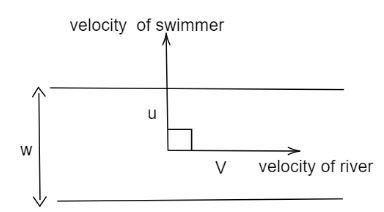
We can observe that both \[{v_{}}\] and \[u\] are in perpendicular directions. Then the resultant velocity can be calculated as:
Resultant Velocity \[{\text{ = }}\sqrt[{}]{{{v_1}^2{\text{ + }}{v_2}^2{\text{ + 2}}{v_1}{v_2}\cos \theta }}\]
Resultant Velocity \[{\text{ = }}\sqrt[{}]{{{v^2}{\text{ + }}{{\text{u}}^2}{\text{ + 2}}vu\cos {{90}^ \circ }}}\]
Since we know that \[\cos {90^ \circ }{\text{ = 0}}\] therefore it can be written as,
Resultant Velocity\[{\text{ = }}\sqrt[{}]{{{v^2}{\text{ - }}{{\text{u}}^2}{\text{ }}}}\],
Time taken when swimmer travel in to and fro motion:
\[{t_1}{\text{ = 2}}\left( {\dfrac{w}{{\sqrt {{v^2}{\text{ - }}{{\text{u}}^2}} }}} \right)\]_______________\[(a)\]
Case \[(2)\]: When a swimmer travels upstream and down-stream. The resultant velocity will be the vector addition of velocity while going up and going down the direction of the stream of water.
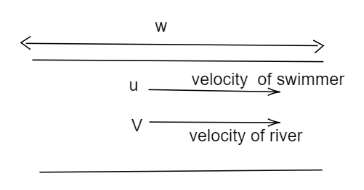
When swimmer travels with the flow of water then resultant velocity can be calculated as:
Resultant Velocity \[{\text{ = u + v}}\]
Time taken to travel distance w is : \[\dfrac{w}{{u{\text{ + v}}}}\]
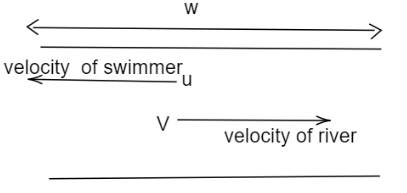
When swimmer travel in opposite of flow of water then resultant speed can be calculated as:
Resultant Velocity \[{\text{ = }}\left( {{\text{ - u}}} \right){\text{ + v}}\]
Time taken to travel distance w will be : \[\dfrac{w}{{ - u{\text{ + v}}}}\]
Total time taken to cover the same distance up and down the stream \[{t_2}\] will be:
\[{t_2}{\text{ = }}\dfrac{w}{{u{\text{ + v}}}}{\text{ + }}\dfrac{w}{{ - u{\text{ + v}}}}\]
On taking L.C.M and solving the numerator and denominator we get the result as:
\[{t_2}{\text{ = }}\dfrac{{2wu}}{{{{\text{v}}^2}{\text{ - }}{{\text{u}}^2}}}{\text{ }}\]____________\[(b)\]
Case \[(3)\]: When swimmer travels a distance 2w in still water:
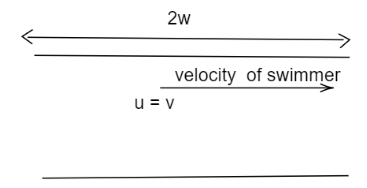
Here the velocity of the swimmer is equal to the velocity of still water ( \[u = v\]). The time taken for travelling distance 2w with speed u is:
\[{t_3}{\text{ = }}\dfrac{{2w}}{u}\] _________\[(c)\]
Now multiply equation \[(b)\] and \[(c)\] and take square of equation \[(a)\] we get the result as:
\[ \Rightarrow {\text{ }}{t_2}{\text{ }}{t_3}{\text{ = }}\dfrac{{2wu}}{{{{\text{v}}^2}{\text{ - }}{{\text{u}}^2}}}{\text{ }} \times {\text{ }}\dfrac{{2w}}{u}\]
\[ \Rightarrow {\text{ }}{t_2}{\text{ }}{t_3}{\text{ = }}\dfrac{{4{w^2}}}{{{{\text{v}}^2}{\text{ - }}{{\text{u}}^2}}}\]
\[ \Rightarrow {\text{ }}{t_1}^2{\text{ = }}{\left( {{\text{2}}\left( {\dfrac{w}{{\sqrt {{v^2}{\text{ - }}{{\text{u}}^2}} }}} \right)} \right)^2}\]
\[ \Rightarrow {\text{ }}{t_1}^2{\text{ = }}\dfrac{{4{w^2}}}{{{{\text{v}}^2}{\text{ - }}{{\text{u}}^2}}}\]
\[\therefore {\text{ }}{t_1}^2{\text{ = }}{t_2}{\text{ }}{t_3}\]
Therefore, the correct option is A.
Note: In case first the swimmer goes into and fro motion therefore we multiply the time by two. Also when a swimmer goes in to and fro motion the resultant velocity will be the difference of square of both velocity. Still water refers to water flowing with zero velocity.Make note directions while going upstream and downstream.
Formula Used:
Resultant Velocity \[{\text{ = }}\sqrt[{}]{{{v_1}^2{\text{ + }}{v_2}^2{\text{ + 2}}{v_1}{v_2}\cos \theta }}\]
Where, \[{v_1}\] and \[{v_2}\] are the velocities and \[\theta \] is the between the \[{v_1}\] and \[{v_2}\].
Complete step by step answer:
Let us assume that \[u\] be the velocity of a swimmer in still water and \[{v_{}}\] be the velocity of a river.
Case \[(1)\]: When a swimmer takes time \[{t_1}\] to cross the river in to and fro direction.
We can observe that both \[{v_{}}\] and \[u\] are in perpendicular directions. Then the resultant velocity can be calculated as:
Resultant Velocity \[{\text{ = }}\sqrt[{}]{{{v_1}^2{\text{ + }}{v_2}^2{\text{ + 2}}{v_1}{v_2}\cos \theta }}\]
Resultant Velocity \[{\text{ = }}\sqrt[{}]{{{v^2}{\text{ + }}{{\text{u}}^2}{\text{ + 2}}vu\cos {{90}^ \circ }}}\]
Since we know that \[\cos {90^ \circ }{\text{ = 0}}\] therefore it can be written as,
Resultant Velocity\[{\text{ = }}\sqrt[{}]{{{v^2}{\text{ - }}{{\text{u}}^2}{\text{ }}}}\],
Time taken when swimmer travel in to and fro motion:
\[{t_1}{\text{ = 2}}\left( {\dfrac{w}{{\sqrt {{v^2}{\text{ - }}{{\text{u}}^2}} }}} \right)\]_______________\[(a)\]
Case \[(2)\]: When a swimmer travels upstream and down-stream. The resultant velocity will be the vector addition of velocity while going up and going down the direction of the stream of water.
When swimmer travels with the flow of water then resultant velocity can be calculated as:
Resultant Velocity \[{\text{ = u + v}}\]
Time taken to travel distance w is : \[\dfrac{w}{{u{\text{ + v}}}}\]
When swimmer travel in opposite of flow of water then resultant speed can be calculated as:
Resultant Velocity \[{\text{ = }}\left( {{\text{ - u}}} \right){\text{ + v}}\]
Time taken to travel distance w will be : \[\dfrac{w}{{ - u{\text{ + v}}}}\]
Total time taken to cover the same distance up and down the stream \[{t_2}\] will be:
\[{t_2}{\text{ = }}\dfrac{w}{{u{\text{ + v}}}}{\text{ + }}\dfrac{w}{{ - u{\text{ + v}}}}\]
On taking L.C.M and solving the numerator and denominator we get the result as:
\[{t_2}{\text{ = }}\dfrac{{2wu}}{{{{\text{v}}^2}{\text{ - }}{{\text{u}}^2}}}{\text{ }}\]____________\[(b)\]
Case \[(3)\]: When swimmer travels a distance 2w in still water:
Here the velocity of the swimmer is equal to the velocity of still water ( \[u = v\]). The time taken for travelling distance 2w with speed u is:
\[{t_3}{\text{ = }}\dfrac{{2w}}{u}\] _________\[(c)\]
Now multiply equation \[(b)\] and \[(c)\] and take square of equation \[(a)\] we get the result as:
\[ \Rightarrow {\text{ }}{t_2}{\text{ }}{t_3}{\text{ = }}\dfrac{{2wu}}{{{{\text{v}}^2}{\text{ - }}{{\text{u}}^2}}}{\text{ }} \times {\text{ }}\dfrac{{2w}}{u}\]
\[ \Rightarrow {\text{ }}{t_2}{\text{ }}{t_3}{\text{ = }}\dfrac{{4{w^2}}}{{{{\text{v}}^2}{\text{ - }}{{\text{u}}^2}}}\]
\[ \Rightarrow {\text{ }}{t_1}^2{\text{ = }}{\left( {{\text{2}}\left( {\dfrac{w}{{\sqrt {{v^2}{\text{ - }}{{\text{u}}^2}} }}} \right)} \right)^2}\]
\[ \Rightarrow {\text{ }}{t_1}^2{\text{ = }}\dfrac{{4{w^2}}}{{{{\text{v}}^2}{\text{ - }}{{\text{u}}^2}}}\]
\[\therefore {\text{ }}{t_1}^2{\text{ = }}{t_2}{\text{ }}{t_3}\]
Therefore, the correct option is A.
Note: In case first the swimmer goes into and fro motion therefore we multiply the time by two. Also when a swimmer goes in to and fro motion the resultant velocity will be the difference of square of both velocity. Still water refers to water flowing with zero velocity.Make note directions while going upstream and downstream.
Recently Updated Pages
Master Class 11 Social Science: Engaging Questions & Answers for Success

Master Class 11 Physics: Engaging Questions & Answers for Success
Master Class 11 Maths: Engaging Questions & Answers for Success
Master Class 11 Economics: Engaging Questions & Answers for Success
Master Class 11 Computer Science: Engaging Questions & Answers for Success
Master Class 11 Chemistry: Engaging Questions & Answers for Success
Trending doubts
One Metric ton is equal to kg A 10000 B 1000 C 100 class 11 physics CBSE
There are 720 permutations of the digits 1 2 3 4 5 class 11 maths CBSE
1 Quintal is equal to a 110 kg b 10 kg c 100kg d 1000 class 11 physics CBSE
State and prove Bernoullis theorem class 11 physics CBSE
Difference Between Prokaryotic Cells and Eukaryotic Cells
Which among the following are examples of coming together class 11 social science CBSE