




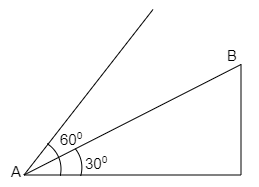
A surface of the hill is nearly plane with ${30^ \circ }$ slope as shown in figure. From a point $A$ at a base, a shell is fired using a gun with an initial velocity $30\,m/s$ . In the direction making the ${60^ \circ }$angle with the horizontal, the distance $AB$ at which the shell strikes the hill is $K \times 10\,m$ . Then find the value of $K$ .
Answer
 Verified
590.1k+ views
Hint: From the given diagram and the formula, first calculate the angle of the shell with the surface of the hill. Substitute this in the maximum range of the firing formula and the simplification of this provides the value of the distance between the points.
Useful formula:
(1) The angle between the line of bullet and the surface of hill is given by
$\theta = \beta - \alpha $
Where $\theta $ is the angle in which the bullet motion makes with the surface of the hill, $\beta $ is the angle in which the motion of the bullet makes with the horizontal and $\alpha $ is the slope of the hill.
(2) The distance between two points is given by
$d = \dfrac{{2{u^2}\sin \theta \cos \left( {\theta + \alpha } \right)}}{{g{{\cos }^2}\alpha }}$
Where $d$ is the distance between two points, $u$ is the initial velocity of the bullet and $g$ is the acceleration due to gravity.
Complete Step by Step Solution:
It is given that the
Slope of the hill, $\alpha = {30^ \circ }$
The initial velocity of the bullet, $u = 30\,m{s^{ - 1}}$
The angle in which the motion of the bullet makes with the horizontal, $\beta = {60^0}$
Using the formula (1),
$\theta = \beta - \alpha $
$\theta = {60^ \circ } - {30^ \circ } = {30^ \circ }$
Using the formula (2),
$d = \dfrac{{2{u^2}\sin \theta \cos \left( {\theta + \alpha } \right)}}{{g{{\cos }^2}\alpha }}$
Substituting the known values,
$d = \dfrac{{2 \times {{30}^2} \times \sin {{30}^ \circ }\cos \left( {{{30}^ \circ } + {{30}^ \circ }} \right)}}{{9.8 \times {{\cos }^2}{{30}^ \circ }}}$
$K \times 10 = \dfrac{{1800 \times 4}}{{4 \times 9.8 \times 3}}$
By performing the basic arithmetic operation, we get
$K = 6.12\,m$
Hence the value of $K$ is $6.12\,m$ .
Note: Usually the firing the shell is done for the purpose of destroying the huge mass of lands, or killing the enemy in the war. It is also the kind of example of the projectile which follows the curved parabolic path. It is fired by the gun and it moves at some angles with horizontal, when the force gets over it falls on a place.
Useful formula:
(1) The angle between the line of bullet and the surface of hill is given by
$\theta = \beta - \alpha $
Where $\theta $ is the angle in which the bullet motion makes with the surface of the hill, $\beta $ is the angle in which the motion of the bullet makes with the horizontal and $\alpha $ is the slope of the hill.
(2) The distance between two points is given by
$d = \dfrac{{2{u^2}\sin \theta \cos \left( {\theta + \alpha } \right)}}{{g{{\cos }^2}\alpha }}$
Where $d$ is the distance between two points, $u$ is the initial velocity of the bullet and $g$ is the acceleration due to gravity.
Complete Step by Step Solution:
It is given that the
Slope of the hill, $\alpha = {30^ \circ }$
The initial velocity of the bullet, $u = 30\,m{s^{ - 1}}$
The angle in which the motion of the bullet makes with the horizontal, $\beta = {60^0}$
Using the formula (1),
$\theta = \beta - \alpha $
$\theta = {60^ \circ } - {30^ \circ } = {30^ \circ }$
Using the formula (2),
$d = \dfrac{{2{u^2}\sin \theta \cos \left( {\theta + \alpha } \right)}}{{g{{\cos }^2}\alpha }}$
Substituting the known values,
$d = \dfrac{{2 \times {{30}^2} \times \sin {{30}^ \circ }\cos \left( {{{30}^ \circ } + {{30}^ \circ }} \right)}}{{9.8 \times {{\cos }^2}{{30}^ \circ }}}$
$K \times 10 = \dfrac{{1800 \times 4}}{{4 \times 9.8 \times 3}}$
By performing the basic arithmetic operation, we get
$K = 6.12\,m$
Hence the value of $K$ is $6.12\,m$ .
Note: Usually the firing the shell is done for the purpose of destroying the huge mass of lands, or killing the enemy in the war. It is also the kind of example of the projectile which follows the curved parabolic path. It is fired by the gun and it moves at some angles with horizontal, when the force gets over it falls on a place.
Recently Updated Pages
Master Class 5 English: Engaging Questions & Answers for Success

Master Class 5 Maths: Engaging Questions & Answers for Success
Master Class 5 Social Science: Engaging Questions & Answers for Success
Master Class 5 Science: Engaging Questions & Answers for Success
Class 5 Question and Answer - Your Ultimate Solutions Guide
Master Class 9 General Knowledge: Engaging Questions & Answers for Success
Trending doubts
One Metric ton is equal to kg A 10000 B 1000 C 100 class 11 physics CBSE
What is cell theory Who formulated it class 11 biology CBSE
Phyllotaxy is the arrangement of ALeaflets BLeaves class 11 biology CBSE
Difference Between Prokaryotic Cells and Eukaryotic Cells
The symbiotic association of fungi and algae is called class 11 biology CBSE
Cell theory was formulated by A Schleiden and Schwann class 11 biology CBSE