




A student wants to project the image of a candle flame on the walls of school laboratory by using a lens:
(A). Which type of lens should he use and why?
(B). At what distance in terms of focal length ‘f’ of the lens should he place the candle flames so as to get (i) a magnified, and (ii) a diminished image respectively on the wall?
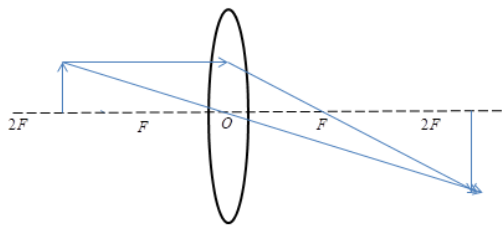
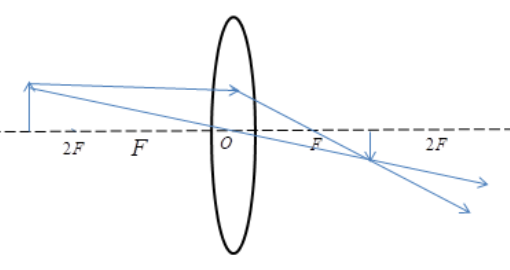
(C). Draw a ray diagram to show the formation of the image in each case.
Answer
 Verified
660.6k+ views
Hint - Before we go through the given questions section we will discuss some definitions which will help in solving the given problem .Since it's related to types of lens, focal length and magnified or diminished so we will go through all of them one by one.
Complete step-by-step solution -
Convex lenses- A convex lens is a converging lens. When a parallel ray of light is passing through a convex lens, the refracted rays converge at the focal point.
Concave lens- Concave lens is a lens that possesses at least one surface that curves inwards. It is a diverging lens, meaning that it spreads out light rays that have been refracted through it.
Focal length – It is defined as the distance between the center of a lens and its focus.
From the above discussion it is clear that the student should use a convex lens because with the help of a convex lens he will be able to form a real image on the walls.
(i) To form the magnified image the candle flames should be placed between F and 2F
(ii) Also in order to form the diminished image, the flame should be placed at a distance greater than 2F.
Note- A lens, unlike a prism that refracts light without focusing, can concentrate light to form an image. Sometimes called lenses, for instance, microwave lenses, neutron lenses, acoustic lenses, or explosive lenses, are instruments that concentrate or scatter similar waves and radiation, rather than visible light. A mirror produces an image through reflection while a lens forms an image through refraction by converging or diverging the light.
Complete step-by-step solution -
Convex lenses- A convex lens is a converging lens. When a parallel ray of light is passing through a convex lens, the refracted rays converge at the focal point.
Concave lens- Concave lens is a lens that possesses at least one surface that curves inwards. It is a diverging lens, meaning that it spreads out light rays that have been refracted through it.
Focal length – It is defined as the distance between the center of a lens and its focus.
From the above discussion it is clear that the student should use a convex lens because with the help of a convex lens he will be able to form a real image on the walls.
(i) To form the magnified image the candle flames should be placed between F and 2F
(ii) Also in order to form the diminished image, the flame should be placed at a distance greater than 2F.
Note- A lens, unlike a prism that refracts light without focusing, can concentrate light to form an image. Sometimes called lenses, for instance, microwave lenses, neutron lenses, acoustic lenses, or explosive lenses, are instruments that concentrate or scatter similar waves and radiation, rather than visible light. A mirror produces an image through reflection while a lens forms an image through refraction by converging or diverging the light.
Recently Updated Pages
Class 10 Question and Answer - Your Ultimate Solutions Guide

Master Class 12 Economics: Engaging Questions & Answers for Success
Master Class 12 Social Science: Engaging Questions & Answers for Success
Master Class 12 English: Engaging Questions & Answers for Success
Master Class 12 Maths: Engaging Questions & Answers for Success
Master Class 12 Physics: Engaging Questions & Answers for Success
Trending doubts
Explain the Treaty of Vienna of 1815 class 10 social science CBSE
The slogan Jai Hind was given by A Lal Bahadur Shastri class 10 social science CBSE
10 examples of evaporation in daily life with explanations
What is the full form of POSCO class 10 social science CBSE
Identify the feminine form of noun nephew a shenephew class 10 english CBSE
CSIR full form?