




A student uses a simple pendulum of exactly $1\;m$ length to determine $g$, the acceleration due to gravity. He uses a stopwatch with the least count of $1\;\sec $ for this and records $40\;s$ for $20$ oscillations. For this observation, which of the following statements is (are) true?
A. Error $\Delta T$ in measuring $T$, the time period, is $0.05\;\sec $
B. Error $\Delta T$ in measuring $T$, the time period, is $1\;\sec $
C. Percentage error in the determination of $g$ is $5\% $
D. Percentage error in the determination of $g$ is $2.5\% $
Answer
 Verified
585.9k+ views
Hint:
From the question, using given data and the formula for the time period of a simple pendulum can be derived. Also using the relation of the acceleration due to gravity in the simple pendulum, the error in the determination of $g$ can be obtained. Also, the error in time can be calculated.
Formula used:
The time period of simple pendulum, $t = 2\pi \times \sqrt {\dfrac{L}{g}} $
Where, $L$ is the length of the pendulum and $g$ is the acceleration due to gravity.
The acceleration due to gravity in simple pendulum, $g = \dfrac{{4{\pi ^2}L}}{{{t^2}}}$
Complete step by step answer:
Given data:
The length of the pendulum, $L = 1\;m$
The least count of time, $\Delta t = 1\;s$
The total time, $t = 40\;s$
No. of oscillations, $N = 20$
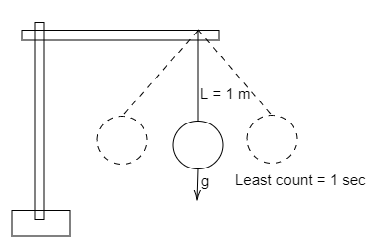
The time taken for $20$ oscillations is $40\;s$.
Then, for one oscillation it will take $T = \dfrac{{40}}{{20}} = 2\;s$
In a simple pendulum, the relation between the observed time and the original time is given by,
$\dfrac{{\Delta T}}{T} = \dfrac{{\Delta t}}{t}$
By substituting the given values, we get
$\Rightarrow \dfrac{{\Delta T}}{{2\;s}} = \dfrac{{1\;s}}{{40\;s}}$
By rearranging the terms in the above equation, then the above equation is written as,
$\Rightarrow \Delta T = \dfrac{2}{{40}}\;s$
On dividing the above equation, then the above equation is written as,
$\Rightarrow \Delta T = 0.05\;s$
Here, $\Delta T$ is the error in measuring time.
Also, the error in finding the acceleration due to gravity is given by,
$\Rightarrow \dfrac{{\Delta g}}{g} = \dfrac{{\Delta L}}{L} + \dfrac{{2\Delta t}}{t}$
In this question, there is not any change in the length. Thus, $\Delta L = 0$
Hence,
$\Rightarrow \dfrac{{\Delta g}}{g} = \dfrac{{2\Delta t}}{t}$
Where, $\Delta g$ is the error in acceleration due to gravity.
Substituting the given values, we get
$\Rightarrow \dfrac{{\Delta g}}{g} = \dfrac{2}{{40}} $
Then, the percentage error of $g$, $\dfrac{{\Delta g}}{g} \times 100 = \dfrac{2}{{40}} \times 100 = 5\% $
Hence, the option (A) and (C) are correct.
Note:
The simple pendulum has the time period which slightly varies from the observed time in the stopwatch. The error on the time and acceleration due to gravity is completely based on the least count of a stopwatch and also the number of oscillations of the pendulum.
From the question, using given data and the formula for the time period of a simple pendulum can be derived. Also using the relation of the acceleration due to gravity in the simple pendulum, the error in the determination of $g$ can be obtained. Also, the error in time can be calculated.
Formula used:
The time period of simple pendulum, $t = 2\pi \times \sqrt {\dfrac{L}{g}} $
Where, $L$ is the length of the pendulum and $g$ is the acceleration due to gravity.
The acceleration due to gravity in simple pendulum, $g = \dfrac{{4{\pi ^2}L}}{{{t^2}}}$
Complete step by step answer:
Given data:
The length of the pendulum, $L = 1\;m$
The least count of time, $\Delta t = 1\;s$
The total time, $t = 40\;s$
No. of oscillations, $N = 20$
The time taken for $20$ oscillations is $40\;s$.
Then, for one oscillation it will take $T = \dfrac{{40}}{{20}} = 2\;s$
In a simple pendulum, the relation between the observed time and the original time is given by,
$\dfrac{{\Delta T}}{T} = \dfrac{{\Delta t}}{t}$
By substituting the given values, we get
$\Rightarrow \dfrac{{\Delta T}}{{2\;s}} = \dfrac{{1\;s}}{{40\;s}}$
By rearranging the terms in the above equation, then the above equation is written as,
$\Rightarrow \Delta T = \dfrac{2}{{40}}\;s$
On dividing the above equation, then the above equation is written as,
$\Rightarrow \Delta T = 0.05\;s$
Here, $\Delta T$ is the error in measuring time.
Also, the error in finding the acceleration due to gravity is given by,
$\Rightarrow \dfrac{{\Delta g}}{g} = \dfrac{{\Delta L}}{L} + \dfrac{{2\Delta t}}{t}$
In this question, there is not any change in the length. Thus, $\Delta L = 0$
Hence,
$\Rightarrow \dfrac{{\Delta g}}{g} = \dfrac{{2\Delta t}}{t}$
Where, $\Delta g$ is the error in acceleration due to gravity.
Substituting the given values, we get
$\Rightarrow \dfrac{{\Delta g}}{g} = \dfrac{2}{{40}} $
Then, the percentage error of $g$, $\dfrac{{\Delta g}}{g} \times 100 = \dfrac{2}{{40}} \times 100 = 5\% $
Hence, the option (A) and (C) are correct.
Note:
The simple pendulum has the time period which slightly varies from the observed time in the stopwatch. The error on the time and acceleration due to gravity is completely based on the least count of a stopwatch and also the number of oscillations of the pendulum.
Recently Updated Pages
Master Class 11 Computer Science: Engaging Questions & Answers for Success

Master Class 11 Business Studies: Engaging Questions & Answers for Success
Master Class 11 Economics: Engaging Questions & Answers for Success
Master Class 11 English: Engaging Questions & Answers for Success
Master Class 11 Maths: Engaging Questions & Answers for Success
Master Class 11 Biology: Engaging Questions & Answers for Success
Trending doubts
One Metric ton is equal to kg A 10000 B 1000 C 100 class 11 physics CBSE
There are 720 permutations of the digits 1 2 3 4 5 class 11 maths CBSE
Discuss the various forms of bacteria class 11 biology CBSE
Draw a diagram of a plant cell and label at least eight class 11 biology CBSE
State the laws of reflection of light
Explain zero factorial class 11 maths CBSE