




A student traces the path of light through a triangular glass prism for different values of angle of incidence. On analyzing the ray diagrams, which one of the following conclusions is he likely to draw?
A. The emergent ray is parallel to the incident ray
B. The emergent ray bends at an angle to the direction of the incident ray
C. The emergent ray and the refracted ray are at right angles to each other
D. The emergent ray is perpendicular to the incident ray
Answer
 Verified
620.4k+ views
Hint:The incident ray is a light ray that strikes the surface. The angle of incidence between this ray and the perpendicular or natural surface is the angle of incidence. It is refracted against the usual as an incident ray of light passes a prism. This refracted ray then strikes the other side of the prism and deviates away from the usual and leaves the glass prism to enter the air, i.e. from one medium to the other. This ray that leaves the prism is called an emerging ray.
Complete answer:
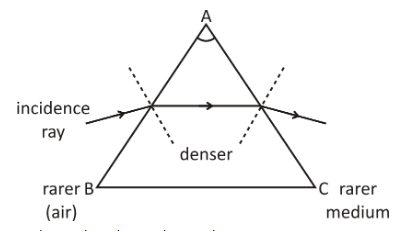
A ray of light which is incident on the surface of a glass prism goes from rarer to denser medium. So, the ray will bend towards the normal after refraction. Again the ray of light is going from denser to rarer medium. So, the ray of light will bend away from the normal while coming out the glass prism.
An angle of deviation will be formed between the incidence ray and emergent ray. The different direction represents the incident ray and the emerging ray after going through the prism. The emerging ray still bends at an angle with the incident ray, called the angle of deviation, when refracting a ray of light through the prism. The emerging ray bends at an angle to the direction of the incident ray should then be the correct statement.
Hence, option B is correct.
Note:The emergent ray and the incident ray are parallel on a glass slab. So, we should not be confused between the glass slab and prism. In a prism the angle of incidence and angle of refraction are different.Prism is a triangular glass, which has two triangular bases and three rectangular lateral surfaces.The unique shape of the prism makes the emergent ray bend at an angle to the direction of the incident ray and this angle is known as the angle of deviation.
Complete answer:
A ray of light which is incident on the surface of a glass prism goes from rarer to denser medium. So, the ray will bend towards the normal after refraction. Again the ray of light is going from denser to rarer medium. So, the ray of light will bend away from the normal while coming out the glass prism.
An angle of deviation will be formed between the incidence ray and emergent ray. The different direction represents the incident ray and the emerging ray after going through the prism. The emerging ray still bends at an angle with the incident ray, called the angle of deviation, when refracting a ray of light through the prism. The emerging ray bends at an angle to the direction of the incident ray should then be the correct statement.
Hence, option B is correct.
Note:The emergent ray and the incident ray are parallel on a glass slab. So, we should not be confused between the glass slab and prism. In a prism the angle of incidence and angle of refraction are different.Prism is a triangular glass, which has two triangular bases and three rectangular lateral surfaces.The unique shape of the prism makes the emergent ray bend at an angle to the direction of the incident ray and this angle is known as the angle of deviation.
Recently Updated Pages
Basicity of sulphurous acid and sulphuric acid are

Master Class 12 Economics: Engaging Questions & Answers for Success
Master Class 12 Biology: Engaging Questions & Answers for Success
Master Class 11 English: Engaging Questions & Answers for Success
Master Class 11 Physics: Engaging Questions & Answers for Success
Master Class 11 Computer Science: Engaging Questions & Answers for Success
Trending doubts
Draw a labelled sketch of the human eye class 12 physics CBSE
The chemical formula of tear gas is A CO Cl 2 B C 10 class 12 chemistry CBSE
Draw ray diagrams each showing i myopic eye and ii class 12 physics CBSE
Which are the Top 10 Largest Countries of the World?
Differentiate between homogeneous and heterogeneous class 12 chemistry CBSE
Which is the correct genotypic ratio of mendel dihybrid class 12 biology CBSE