




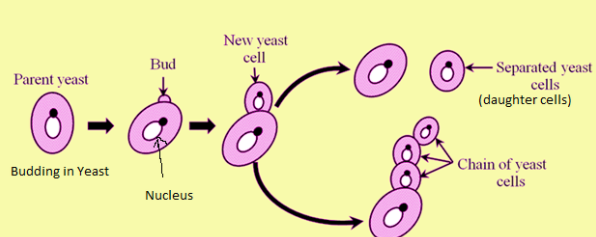
A student is viewing under a microscope a permanent slide showing various stages of asexual reproduction by budding in yeast. Draw diagrams of what he observes (in proper sequence).
Answer
 Verified
618.3k+ views
Hint:The method of budding may be a sort of asexual reproduction where a new living being is made from an outgrowth or bud developing on parent organism due to cell division happening at one particular area. A small bulb-like outgrowth anticipating from the parent yeast cell is called a bud.
Complete answer:
The first common mode of vegetative improvement in yeast is the abiogenetic generation by budding, where a small bud (besides known as a bleb or girl cell) is formed on the parent cell. The centre of the parent cell parts into a young lady centre and moves into the young lady cell. Yeast budding is an imperative preparation to get its cell polarization and symmetry breaking. Studies utilizing both test and illustrating approaches have been broadly conducted on yeast budding. In the midst of budding, a modern girl cell creates from a mother cell through polarized cell improvement. Yeast is single-celled infectious life forms that are Eukaryotes. The most commonly copy asexually by mitosis, but the strategy is to some degree unmistakable from other shapes of Mitosis, in that it incorporates budding.
Additional information:
Saccharomyces cerevisiae is a species of yeast. The species has been instrumental in winemaking, heating, and brewing since old times. It is accepted to have been originally isolated from the skin of grapes.
Note:Yeast could be a unicellular life form whereas Hydra may be a multicellular life form within the yeast, the bud begins from a little bulge on the parent body, whereas in Hydra the bud emerges due to the rehashed mitotic division.
Complete answer:
The first common mode of vegetative improvement in yeast is the abiogenetic generation by budding, where a small bud (besides known as a bleb or girl cell) is formed on the parent cell. The centre of the parent cell parts into a young lady centre and moves into the young lady cell. Yeast budding is an imperative preparation to get its cell polarization and symmetry breaking. Studies utilizing both test and illustrating approaches have been broadly conducted on yeast budding. In the midst of budding, a modern girl cell creates from a mother cell through polarized cell improvement. Yeast is single-celled infectious life forms that are Eukaryotes. The most commonly copy asexually by mitosis, but the strategy is to some degree unmistakable from other shapes of Mitosis, in that it incorporates budding.
Additional information:
Saccharomyces cerevisiae is a species of yeast. The species has been instrumental in winemaking, heating, and brewing since old times. It is accepted to have been originally isolated from the skin of grapes.
Note:Yeast could be a unicellular life form whereas Hydra may be a multicellular life form within the yeast, the bud begins from a little bulge on the parent body, whereas in Hydra the bud emerges due to the rehashed mitotic division.
Recently Updated Pages
Basicity of sulphurous acid and sulphuric acid are

Master Class 11 English: Engaging Questions & Answers for Success
Master Class 11 Physics: Engaging Questions & Answers for Success
Master Class 11 Computer Science: Engaging Questions & Answers for Success
Master Class 11 Chemistry: Engaging Questions & Answers for Success
Master Class 11 Social Science: Engaging Questions & Answers for Success
Trending doubts
Difference Between Prokaryotic Cells and Eukaryotic Cells
One Metric ton is equal to kg A 10000 B 1000 C 100 class 11 physics CBSE
Draw a diagram of nephron and explain its structur class 11 biology CBSE
What will happen if the mucus is not secreted by the class 11 biology CBSE
Draw a diagram of a plant cell and label at least eight class 11 biology CBSE
Proton was discovered by A Thomson B Rutherford C Chadwick class 11 chemistry CBSE