




A string tied on a roof can bear a maximum weight of 50 kg wt. The minimum acceleration that can be acquired by a man of 98 kg to descend will be:
(take g=9.8$m{{s}^{-2}}$).
$\text{A}\text{. }9.8m{{s}^{-2}}$
$\text{B}\text{. 4}.9m{{s}^{-2}}$
$\text{C}\text{. 4}\text{.8}m{{s}^{-2}}$
$\text{D}\text{. 5}m{{s}^{-2}}$
Answer
 Verified
592.2k+ views
Hint: When the man accelerates downwards, the tension in the string will try to pull the man upwards and the gravity will pull him downwards. Therefore, draw a free body diagram of the man. Equate the net force to ma and put the value of tension equal to the maximum weight. Then find the value of the minimum acceleration.
Formula used:
${{F}_{net}}=ma$
Complete answer:
When the man is descending from the string, the free body diagram will be as shown below.
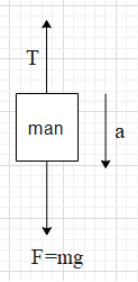
When the man slides down on the string, there will be friction between the man and the rope. The friction will be equal to the tension in the rope. The tension in the rope will try to pull the man upwards. However, the gravitational force will pull the man downwards.
The man can adjust the tension in the string by adjusting his acceleration. However, it is given that the rope can bear a maximum tension of 50 kg wt, which is equal to 50g N (g is acceleration due to gravity).
The magnitude of gravitational force acting on a body of mass m is given as F = mg.
Therefore, the net force on the man is ${{F}_{net}}=F-T=mg-T$.
And from Newton’s second law of motion we know that ${{F}_{net}}=ma$, where a is the acceleration of the body.
$\Rightarrow mg-T=ma$…. (i).
Here, m= 98kg, g = 9.8$m{{s}^{-2}}$. Substitute the value of tension T = 50g = $50\times 9.8N$.
$\Rightarrow 98\times 9.8-(50\times 9.8)=98a$
$\Rightarrow a=\dfrac{98\times 9.8-(50\times 9.8)}{98}=9.8-5=4.8m{{s}^{-2}}$
This means the minimum acceleration that the man must acquire is $4.8m{{s}^{-2}}$.
Hence, the correct option is C.
Note:
Let us understand why a minimum value of acceleration of the man is required.
Consider equation (i), i.e. $mg-T=ma$.
Here, mg and m are constant values. Therefore, as the tension T increases the value of mg-T will decrease. Thus the value of a will increase.
As a result, when the tension reaches its maximum value, the acceleration of the man will be minimum. Therefore, if the man accelerates less than the minimum value the rope will break.
Formula used:
${{F}_{net}}=ma$
Complete answer:
When the man is descending from the string, the free body diagram will be as shown below.
When the man slides down on the string, there will be friction between the man and the rope. The friction will be equal to the tension in the rope. The tension in the rope will try to pull the man upwards. However, the gravitational force will pull the man downwards.
The man can adjust the tension in the string by adjusting his acceleration. However, it is given that the rope can bear a maximum tension of 50 kg wt, which is equal to 50g N (g is acceleration due to gravity).
The magnitude of gravitational force acting on a body of mass m is given as F = mg.
Therefore, the net force on the man is ${{F}_{net}}=F-T=mg-T$.
And from Newton’s second law of motion we know that ${{F}_{net}}=ma$, where a is the acceleration of the body.
$\Rightarrow mg-T=ma$…. (i).
Here, m= 98kg, g = 9.8$m{{s}^{-2}}$. Substitute the value of tension T = 50g = $50\times 9.8N$.
$\Rightarrow 98\times 9.8-(50\times 9.8)=98a$
$\Rightarrow a=\dfrac{98\times 9.8-(50\times 9.8)}{98}=9.8-5=4.8m{{s}^{-2}}$
This means the minimum acceleration that the man must acquire is $4.8m{{s}^{-2}}$.
Hence, the correct option is C.
Note:
Let us understand why a minimum value of acceleration of the man is required.
Consider equation (i), i.e. $mg-T=ma$.
Here, mg and m are constant values. Therefore, as the tension T increases the value of mg-T will decrease. Thus the value of a will increase.
As a result, when the tension reaches its maximum value, the acceleration of the man will be minimum. Therefore, if the man accelerates less than the minimum value the rope will break.
Recently Updated Pages
Basicity of sulphurous acid and sulphuric acid are

Master Class 11 Business Studies: Engaging Questions & Answers for Success
Master Class 11 Computer Science: Engaging Questions & Answers for Success
Master Class 11 Economics: Engaging Questions & Answers for Success
Master Class 11 Social Science: Engaging Questions & Answers for Success
Master Class 11 English: Engaging Questions & Answers for Success
Trending doubts
One Metric ton is equal to kg A 10000 B 1000 C 100 class 11 physics CBSE
The largest wind power cluster is located in the state class 11 social science CBSE
Explain zero factorial class 11 maths CBSE
State and prove Bernoullis theorem class 11 physics CBSE
What steps did the French revolutionaries take to create class 11 social science CBSE
Which among the following are examples of coming together class 11 social science CBSE