




A string passing over a smooth light pulley connects two blocks of masses ${{\text{m}}_{\text{1}}}\text{ and }{{\text{m}}_{\text{2}}}$ where (${{\text{m}}_{\text{1}}}\text{}{{\text{m}}_{\text{2}}}$ ). The masses are moving vertically. If the acceleration of the system is g/8 then:
This question has multiple correct options
$\begin{align}
& a)\dfrac{{{m}_{1}}}{{{m}_{2}}}=\dfrac{9}{7} \\
& b)\dfrac{{{m}_{1}}}{{{m}_{2}}}=\dfrac{4}{3} \\
& c)\text{tension in the string=}\dfrac{3}{4}{{m}_{1}}g \\
& d)\text{tension in the string=}\dfrac{9}{8}{{m}_{2}}g \\
\end{align}$
Answer
 Verified
630.9k+ views
Hint:
It is given in the question that ${{\text{m}}_{\text{1}}}\text{}{{\text{m}}_{\text{2}}}$ hence ${{\text{m}}_{\text{1}}}$ will move vertically downwards and ${{\text{m}}_{\text{2}}}$ will move vertically upwards. Both the masses are connected to a common string and hence both of them will move with a common acceleration. Hence will draw the free body diagram of the above system and find the ratio of the masses and the tension in the string to verify with the given options.
Complete answer:
To begin with let us first draw the free body diagram and obtain the net force on each of the masses.
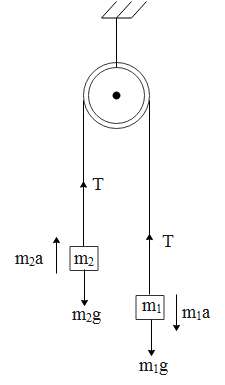
If we see the above free body diagram the mass ${{m}_{1}}$ moves downwards, while the mass ${{m}_{2}}$ moves upwards. Both of the masses move with common acceleration i.e. a. The net force on mass ${{m}_{1}}$ is,
${{m}_{1}}a={{m}_{1}}g-T...(1)$ where g is the acceleration due to gravity and T is the tension in the rope. Similarly, the net force on ${{m}_{2}}$ is given by, ${{m}_{2}}a=T-{{m}_{2}}g...(2)$ where g is the acceleration due to gravity and T is the tension in the rope.
Adding both the equations 1 and 2 we get,
$\begin{align}
& \Rightarrow {{m}_{1}}a+{{m}_{2}}a={{m}_{1}}g-T+T-{{m}_{2}}g \\
& \Rightarrow a({{m}_{1}}+{{m}_{2}})=({{m}_{1}}-{{m}_{2}})g,\text{since a=g/8} \\
& \Rightarrow \dfrac{g}{8}({{m}_{1}}+{{m}_{2}})=({{m}_{1}}-{{m}_{2}})g \\
& \Rightarrow \dfrac{{{m}_{1}}}{8}+\dfrac{{{m}_{2}}}{8}={{m}_{1}}-{{m}_{2}} \\
& \Rightarrow {{m}_{1}}\left( \dfrac{1}{8}-1 \right)=-{{m}_{2}}\left( 1+\dfrac{1}{8} \right) \\
& \Rightarrow {{m}_{1}}\left( -\dfrac{7}{8} \right)=-{{m}_{2}}\left( \dfrac{9}{8} \right) \\
& \implies \dfrac{{{m}_{1}}}{{{m}_{2}}}=\dfrac{9}{7} \\
\end{align}$
Dividing equation 1 by 2 we get,
$\begin{align}
& \Rightarrow \dfrac{{{m}_{1}}a}{{{m}_{2}}a}=\dfrac{{{m}_{1}}g-T}{T-{{m}_{2}}g} \\
& \Rightarrow \dfrac{{{m}_{1}}}{{{m}_{2}}}=\dfrac{{{m}_{1}}g-T}{T-{{m}_{2}}g} \\
& \Rightarrow {{m}_{1}}T-{{m}_{1}}{{m}_{2}}g={{m}_{2}}Mg-T{{m}_{2}} \\
& \Rightarrow {{m}_{1}}T+T{{m}_{2}}={{m}_{2}}{{m}_{1}}g+{{m}_{1}}{{m}_{2}}g \\
& \Rightarrow T({{m}_{1}}+{{m}_{2}})=2{{m}_{2}}{{m}_{1}}g \\
& \Rightarrow T=\dfrac{2{{m}_{2}}{{m}_{1}}g}{{{m}_{1}}+{{m}_{2}}}\text{N dividing the equation by }{{m}_{1}}\text{we get,} \\
& \Rightarrow T=\dfrac{\dfrac{2{{m}_{2}}{{m}_{1}}g}{{{m}_{1}}}}{\dfrac{{{m}_{1}}+{{m}_{2}}}{{{m}_{1}}}}\text{ } \\
& \implies T=\dfrac{2{{m}_{2}}g}{1+\dfrac{{{m}_{2}}}{{{m}_{1}}}}\text{ since}\dfrac{{{m}_{1}}}{{{m}_{2}}}=\dfrac{9}{7}, \\
& \implies T=\dfrac{2{{m}_{2}}g}{1+\dfrac{7}{9}}=\dfrac{2{{m}_{2}}g}{\dfrac{16}{9}}=\dfrac{9}{8}{{m}_{2}}g \\
\end{align}$
So, the correct answer is “Option A and D”.
Note:
It is to be noted that the above thread is assumed to be mass less. Hence we can conclude that the tension at every point on the thread is constant. But in reality the thread also has mass, as a result the tension along the thread will be more at higher points from the point where the mass is attached to the thread.
It is given in the question that ${{\text{m}}_{\text{1}}}\text{}{{\text{m}}_{\text{2}}}$ hence ${{\text{m}}_{\text{1}}}$ will move vertically downwards and ${{\text{m}}_{\text{2}}}$ will move vertically upwards. Both the masses are connected to a common string and hence both of them will move with a common acceleration. Hence will draw the free body diagram of the above system and find the ratio of the masses and the tension in the string to verify with the given options.
Complete answer:
To begin with let us first draw the free body diagram and obtain the net force on each of the masses.
If we see the above free body diagram the mass ${{m}_{1}}$ moves downwards, while the mass ${{m}_{2}}$ moves upwards. Both of the masses move with common acceleration i.e. a. The net force on mass ${{m}_{1}}$ is,
${{m}_{1}}a={{m}_{1}}g-T...(1)$ where g is the acceleration due to gravity and T is the tension in the rope. Similarly, the net force on ${{m}_{2}}$ is given by, ${{m}_{2}}a=T-{{m}_{2}}g...(2)$ where g is the acceleration due to gravity and T is the tension in the rope.
Adding both the equations 1 and 2 we get,
$\begin{align}
& \Rightarrow {{m}_{1}}a+{{m}_{2}}a={{m}_{1}}g-T+T-{{m}_{2}}g \\
& \Rightarrow a({{m}_{1}}+{{m}_{2}})=({{m}_{1}}-{{m}_{2}})g,\text{since a=g/8} \\
& \Rightarrow \dfrac{g}{8}({{m}_{1}}+{{m}_{2}})=({{m}_{1}}-{{m}_{2}})g \\
& \Rightarrow \dfrac{{{m}_{1}}}{8}+\dfrac{{{m}_{2}}}{8}={{m}_{1}}-{{m}_{2}} \\
& \Rightarrow {{m}_{1}}\left( \dfrac{1}{8}-1 \right)=-{{m}_{2}}\left( 1+\dfrac{1}{8} \right) \\
& \Rightarrow {{m}_{1}}\left( -\dfrac{7}{8} \right)=-{{m}_{2}}\left( \dfrac{9}{8} \right) \\
& \implies \dfrac{{{m}_{1}}}{{{m}_{2}}}=\dfrac{9}{7} \\
\end{align}$
Dividing equation 1 by 2 we get,
$\begin{align}
& \Rightarrow \dfrac{{{m}_{1}}a}{{{m}_{2}}a}=\dfrac{{{m}_{1}}g-T}{T-{{m}_{2}}g} \\
& \Rightarrow \dfrac{{{m}_{1}}}{{{m}_{2}}}=\dfrac{{{m}_{1}}g-T}{T-{{m}_{2}}g} \\
& \Rightarrow {{m}_{1}}T-{{m}_{1}}{{m}_{2}}g={{m}_{2}}Mg-T{{m}_{2}} \\
& \Rightarrow {{m}_{1}}T+T{{m}_{2}}={{m}_{2}}{{m}_{1}}g+{{m}_{1}}{{m}_{2}}g \\
& \Rightarrow T({{m}_{1}}+{{m}_{2}})=2{{m}_{2}}{{m}_{1}}g \\
& \Rightarrow T=\dfrac{2{{m}_{2}}{{m}_{1}}g}{{{m}_{1}}+{{m}_{2}}}\text{N dividing the equation by }{{m}_{1}}\text{we get,} \\
& \Rightarrow T=\dfrac{\dfrac{2{{m}_{2}}{{m}_{1}}g}{{{m}_{1}}}}{\dfrac{{{m}_{1}}+{{m}_{2}}}{{{m}_{1}}}}\text{ } \\
& \implies T=\dfrac{2{{m}_{2}}g}{1+\dfrac{{{m}_{2}}}{{{m}_{1}}}}\text{ since}\dfrac{{{m}_{1}}}{{{m}_{2}}}=\dfrac{9}{7}, \\
& \implies T=\dfrac{2{{m}_{2}}g}{1+\dfrac{7}{9}}=\dfrac{2{{m}_{2}}g}{\dfrac{16}{9}}=\dfrac{9}{8}{{m}_{2}}g \\
\end{align}$
So, the correct answer is “Option A and D”.
Note:
It is to be noted that the above thread is assumed to be mass less. Hence we can conclude that the tension at every point on the thread is constant. But in reality the thread also has mass, as a result the tension along the thread will be more at higher points from the point where the mass is attached to the thread.
Recently Updated Pages
Master Class 11 English: Engaging Questions & Answers for Success

Master Class 11 Social Science: Engaging Questions & Answers for Success
Master Class 11 Maths: Engaging Questions & Answers for Success
Master Class 11 Biology: Engaging Questions & Answers for Success
Master Class 11 Physics: Engaging Questions & Answers for Success
Master Class 11 Chemistry: Engaging Questions & Answers for Success
Trending doubts
One Metric ton is equal to kg A 10000 B 1000 C 100 class 11 physics CBSE
Difference Between Prokaryotic Cells and Eukaryotic Cells
Find the value of the expression given below sin 30circ class 11 maths CBSE
Difference between physical and chemical change class 11 chemistry CBSE
Two of the body parts which do not appear in MRI are class 11 biology CBSE
Draw a diagram of a plant cell and label at least eight class 11 biology CBSE