




A string is wrapped over the edge of a uniform disc and its free end is fixed to the ceiling. The disc moves down unwinding the string with an acceleration equal to (assuming string to be vertical):
A. \[\dfrac{2}{3}g\]
B. \[\dfrac{2}{5}g\]
C. \[\dfrac{2}{7}g\]
D. \[\dfrac{g}{2}\]
Answer
 Verified
578.4k+ views
Hint: Use the expression for Newton’s second law of motion and the torque due to a force. Also use the expression for the moment of inertia of the disc about its centre and the relation between the linear and angular acceleration. Apply Newton’s second law of motion to the disc and determine the value of the tension in the string.
Formulae used:
The expression for Newton’s second law of motion is
\[{F_{net}} = ma\] …… (1)
Here, \[{F_{net}}\] is the net force on the object, \[m\] is the mass of the object and \[a\] is the acceleration of the object.
The torque \[\tau \] acting due to a force \[F\] is
\[\tau = Fr\] …… (2)
Here, \[r\] is the perpendicular distance between the point of action of the force and the centre point of the torque.
The torque acting on an object is given by
\[\tau = I\alpha \] …… (3)
Here, is the moment of inertia of the object and is the angular acceleration of the object.
The linear acceleration \[a\] in terms of angular acceleration \[\alpha \] is
\[a = R\alpha \] …… (4)
Here, \[R\] is the radius.
Complete step by step answer:
It is given that the string is wrapped over the edge of a uniform disc and its free end is fixed to the ceiling.
Let \[m\] and \[R\] be the mass and radius of the disc. Let \[a\] is the acceleration of the disc.
The free body diagram of the disc with the string is as follows:
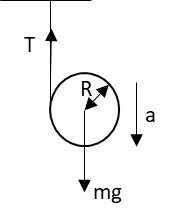
Apply Newton's second law of motion to the disc in the vertical direction.
\[T - mg = - ma\] …… (5)
Determine the torque on the disc due to the tension in the string.
Substitute \[T\] for \[F\] and \[R\] for \[r\] in equation (2).
\[\tau = TR\]
Substitute \[I\alpha \] for \[\tau \] in the above equation.
\[I\alpha = TR\]
The moment of inertia of the disc about at an axis passing through its centre is \[\dfrac{{m{R^2}}}{2}\].
Substitute \[\dfrac{{m{R^2}}}{2}\] for \[I\] and \[\dfrac{a}{R}\] for \[\alpha \] in the above equation.
\[\dfrac{{m{R^2}}}{2}\dfrac{a}{R} = TR\]
\[ \Rightarrow T = \dfrac{{ma}}{2}\]
Substitute \[\dfrac{{ma}}{2}\] for \[T\] in equation (5).
\[\dfrac{{ma}}{2} - mg = - ma\]
\[ \Rightarrow \dfrac{a}{2} + a = g\]
\[ \Rightarrow \dfrac{{3a}}{2} = g\]
\[ \Rightarrow a = \dfrac{{2g}}{3}\]
Therefore, the acceleration of the string is \[\dfrac{{2g}}{3}\].
So, the correct answer is “Option A”.
Note:
The students may get confused as to why the acceleration of the disc is taken with minus sign while applying Newton’s second law of motion to the disc. Since the string is unwinding and moving in the downward direction with the disc moving down the acceleration is taken with the negative sign.
Formulae used:
The expression for Newton’s second law of motion is
\[{F_{net}} = ma\] …… (1)
Here, \[{F_{net}}\] is the net force on the object, \[m\] is the mass of the object and \[a\] is the acceleration of the object.
The torque \[\tau \] acting due to a force \[F\] is
\[\tau = Fr\] …… (2)
Here, \[r\] is the perpendicular distance between the point of action of the force and the centre point of the torque.
The torque acting on an object is given by
\[\tau = I\alpha \] …… (3)
Here, is the moment of inertia of the object and is the angular acceleration of the object.
The linear acceleration \[a\] in terms of angular acceleration \[\alpha \] is
\[a = R\alpha \] …… (4)
Here, \[R\] is the radius.
Complete step by step answer:
It is given that the string is wrapped over the edge of a uniform disc and its free end is fixed to the ceiling.
Let \[m\] and \[R\] be the mass and radius of the disc. Let \[a\] is the acceleration of the disc.
The free body diagram of the disc with the string is as follows:
Apply Newton's second law of motion to the disc in the vertical direction.
\[T - mg = - ma\] …… (5)
Determine the torque on the disc due to the tension in the string.
Substitute \[T\] for \[F\] and \[R\] for \[r\] in equation (2).
\[\tau = TR\]
Substitute \[I\alpha \] for \[\tau \] in the above equation.
\[I\alpha = TR\]
The moment of inertia of the disc about at an axis passing through its centre is \[\dfrac{{m{R^2}}}{2}\].
Substitute \[\dfrac{{m{R^2}}}{2}\] for \[I\] and \[\dfrac{a}{R}\] for \[\alpha \] in the above equation.
\[\dfrac{{m{R^2}}}{2}\dfrac{a}{R} = TR\]
\[ \Rightarrow T = \dfrac{{ma}}{2}\]
Substitute \[\dfrac{{ma}}{2}\] for \[T\] in equation (5).
\[\dfrac{{ma}}{2} - mg = - ma\]
\[ \Rightarrow \dfrac{a}{2} + a = g\]
\[ \Rightarrow \dfrac{{3a}}{2} = g\]
\[ \Rightarrow a = \dfrac{{2g}}{3}\]
Therefore, the acceleration of the string is \[\dfrac{{2g}}{3}\].
So, the correct answer is “Option A”.
Note:
The students may get confused as to why the acceleration of the disc is taken with minus sign while applying Newton’s second law of motion to the disc. Since the string is unwinding and moving in the downward direction with the disc moving down the acceleration is taken with the negative sign.
Recently Updated Pages
Master Class 11 Computer Science: Engaging Questions & Answers for Success

Master Class 11 Business Studies: Engaging Questions & Answers for Success
Master Class 11 Economics: Engaging Questions & Answers for Success
Master Class 11 English: Engaging Questions & Answers for Success
Master Class 11 Maths: Engaging Questions & Answers for Success
Master Class 11 Biology: Engaging Questions & Answers for Success
Trending doubts
One Metric ton is equal to kg A 10000 B 1000 C 100 class 11 physics CBSE
There are 720 permutations of the digits 1 2 3 4 5 class 11 maths CBSE
Discuss the various forms of bacteria class 11 biology CBSE
Draw a diagram of a plant cell and label at least eight class 11 biology CBSE
State the laws of reflection of light
Explain zero factorial class 11 maths CBSE